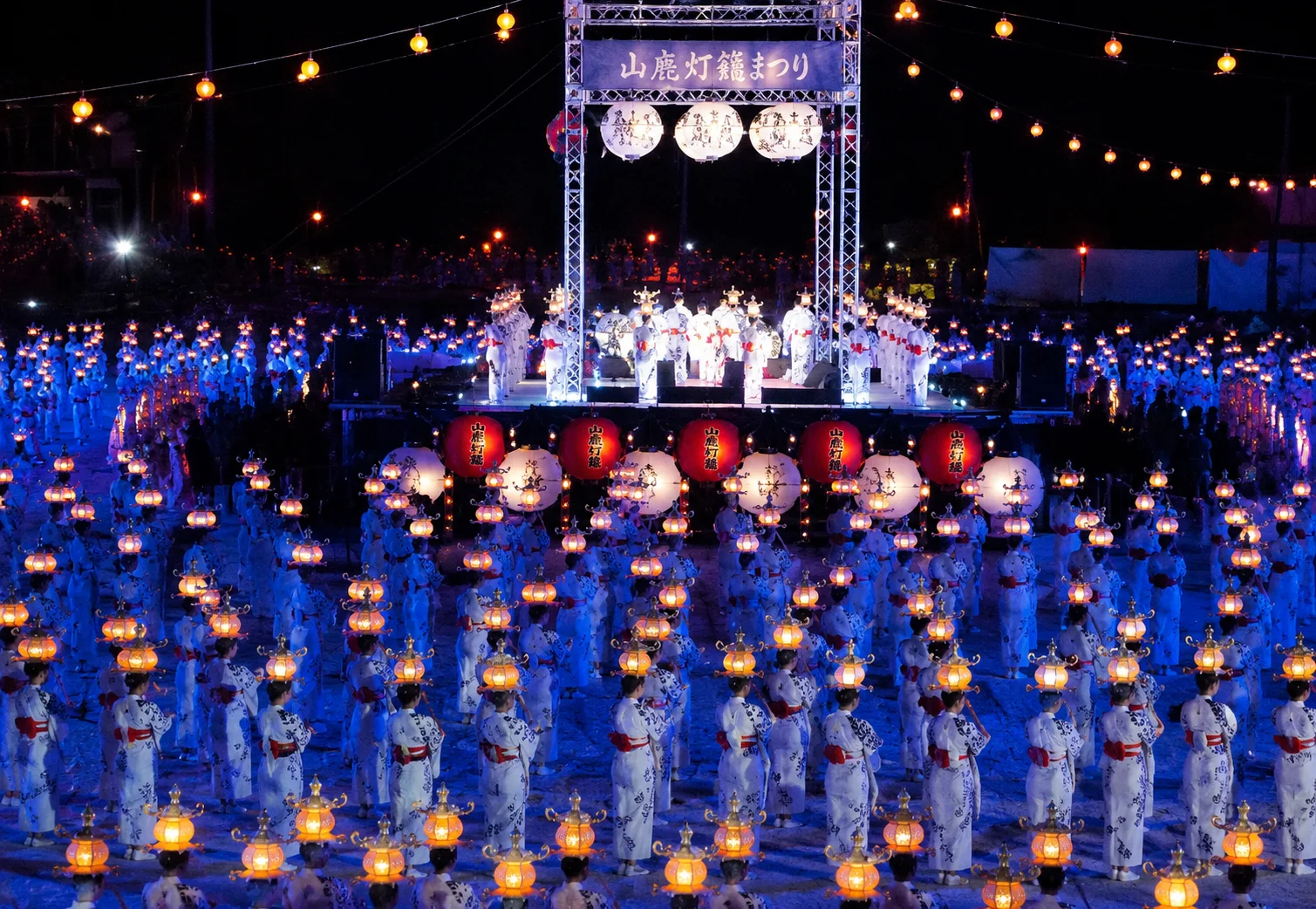
I really hesitated about introducing Kumamoto's festivals, but at a time like this, I want to convey the charm of this festival which is one of Kumamoto's best assets.
Introducing Yamaga Toro Matsuri of Kumamoto. Though events are canceled this year due to the earthquake, we look back at the past festival to pray for reconstruction and its return.
First, we post the announcement from the official page: "This year's Yamaga Toro Matsuri, following the Reiwa 8 Kumamoto Earthquake, has been decided by the emergency executive committee to prioritize the safety of visitors and staff. Only the Shinto rituals of Omiya Shrine and related Shinto events will be conducted, while other events (cooling fireworks display, Thousand Lantern Dance, festival plaza, etc.) are canceled. Refund for the Thousand Lantern Dance viewing ticket: Details will be announced later on the official website (Yamaga Tanbo Navi, Instagram)."
Therefore, tourist events are completely canceled. If you were planning to go there to support Kumamoto and volunteer, please be careful.
Now, in a normal year, in mid-August, Yamaga City, Kumamoto Prefecture is wrapped in soft lights and the emotional melody of "Yoheho-bushi." The "Yamaga Toro Matsuri" held here is a summer festival representing Kumamoto, where women gracefully dance carrying "Yamaga Lanterns," the traditional craft of Yamaga, on their heads.
Especially, the "Thousand Lantern Dance" held at the Yamaga Elementary School ground draws spectators into a fantastic fantasy world, with the lights twinkling on the heads of a thousand women drawing multiple rings of light. In this article, we introduce the historical origin of this beautiful festival, the amazing craftsmanship of Yamaga Lanterns made only of Japanese paper and glue without using any wood or nails, the route and highlights of the Thousand Lantern Dance, and the characteristic differences from light festivals in other regions.
History and Origin: Emperor Keiko's Getting Lost in the Fog and Yamaga's Lights#
The origin of the Yamaga Toro Matsuri dates back to an ancient legend of nearly two thousand years ago. When the 12th Emperor Keiko traveled to Kyushu and was about to enter Yamaga from Chikugo (currently the southern part of Fukuoka Prefecture), a deep thick fog rose and the Emperor's party lost their way. At that time, the villagers of Yamaga carried torches to lead the Emperor's party and welcomed them safely. Since then, to express gratitude for welcoming the Emperor, the villagers began to offer torches every year to Omiya Shrine, which enshrines the Emperor.
This torch offering event changed under the elegant influence of Muromachi culture when it entered the Muromachi period (around the mid-15th century). The style gradually shifted from the conventional raw torches to offering handmade paper lanterns. This became the prototype of the current "Yamaga Lantern," which has been inherited as a local identity for many years. In the Edo period, it received generous protection from the Hosokawa family, the lords of the Kumamoto Domain, establishing its position as a prestigious traditional event. The ancient torchlights have been sublimated into the beauty of refined paper crafts through the changes of times, shaping the current elegant figure of the lantern festival.
Craftsmanship of Yamaga Lanterns: Art of Only Japanese Paper and Glue without Wood or Nails#
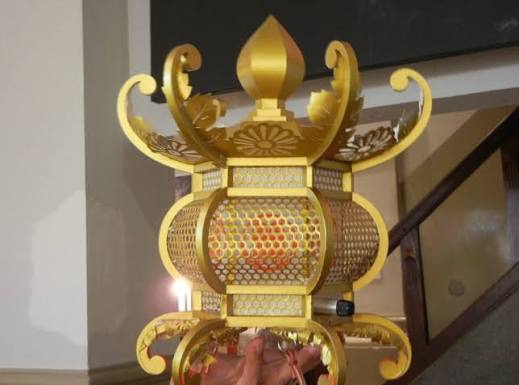
The protagonist of the festival, the "Yamaga Lantern," is a highly sophisticated paper craft designated as a national traditional craft. Its greatest feature lies in the fact that it is assembled using only Kumamoto-produced Japanese paper and a small amount of glue, without using any wood or wire. The inside of the lantern is hollow and extremely lightweight, designed so that women can carry it on their heads and dance for a long time.
These lanterns are produced by skilled craftsmen called "Toro-shi" (lantern masters). The lantern masters make "Miyamairi Lanterns" that faithfully reproduce shrine pavilions and castles. These require extremely delicate work on a millimeter scale, requiring intuition backed by many years of experience, from adjusting the thickness of the paper to mixing the glue and cutting out fine details. Especially, the shoji screens and fine carving-like decorations built inside the "Miyamairi Lanterns" are all expressed only with paper, and their elaborateness surprises viewers. These lanterns are displayed at various places in the city during the festival and offered (Agari-toro) to Omiya Shrine on the final night. The Yamaga Lanterns, where the persistence and passion of craftsmen bear fruit, can be said to be the pinnacle of Japanese traditional crafts that go beyond simple festival tools.
Highlight: "Thousand Lantern Dance" where a Thousand Women Gracefully Dance and the Melody of Yoheho-bushi#
The climax of the Yamaga Toro Matsuri, and the biggest event attracting many tourists from all over the country, is the "Thousand Lantern Dance" held at night. Centered around the special stage of the Yamaga Elementary School ground specially set up, a thousand women carrying lanterns with lights turned on on their heads dance gracefully to the slow melody of the traditional folk song "Yoheho-bushi."
"Yoheho" is said to be a word meaning "If you get drunk, come and get drunk," and its sound itself is very glamorous and emotional. When the night falls and the lights in the venue are turned off all at once, only a thousand lights float in the dark. As the dancers match their breaths and dance, the rings of light slowly rotate in the ground, making people feel as if the Milky Way has descended to the ground. The contrast between the white of the yukata, the dancers' costume, and the warm orange light of the lanterns maximizes the fleeting and beautiful aesthetic sense unique to the Japanese summer. This Thousand Lantern Dance offers paid viewing seats by reservation in advance (which seems to be canceled and refunded this year), allowing you to experience its overwhelming scale and quiet beauty up close.
Light Festivals: Comparison between Yamaga Toro Matsuri and Other Festivals#
There are many famous festivals in various parts of Japan that use "lights" or "fire" to color summer nights, but their characters and spirits differ greatly from region to region. We organized the characteristics of the Yamaga Toro Matsuri, Aomori Nebuta Matsuri, and Akita Kanto Matsuri in the comparison table.
| Festival Name (Main Venues) | Light Features and Materials | Dance and Movement Style | Main Highlights and Atmosphere |
|---|---|---|---|
| Yamaga Toro Matsuri (Yamaga City, Kumamoto) |
Small lanterns on the head. Made of only Japanese paper and glue, lightweight and elaborate. | Graceful and static dance by women. Slow "Yoheho-bushi." | "Thousand Lantern Dance". Rings of light and silence drawn by a thousand lights floating in the dark. |
| Aomori Nebuta Matsuri (Aomori City, Aomori) |
Huge doll lanterns (Nebuta). Wire, wooden frames, Japanese paper with colorful painting. | Dancers called "Haneto" jump around, extremely dynamic and powerful dance. | Power of huge nebutas parading with the shout of "Rassera". |
| Akita Kanto Matsuri (Akita City, Akita) |
Many lanterns hung on bamboo poles. Huge poles resembling ears of rice. | Men called sashite balance the poles on their foreheads, hips, and shoulders. | Shout of "Dokkoisho" and thrilling skills of sashite. |
While the Nebuta Matsuri in Tohoku and the Kanto Matsuri are characterized by the powerful and dynamic energy of men's "motion," the Yamaga Toro Matsuri in Kumamoto is based on the "static" aesthetics emphasizing the harmony of women's graceful movements and soft lights. This contrast of silence and elegance makes the Yamaga Toro Matsuri a unique existence found nowhere else.
For Tourists: Complete Guide and Countermeasures for On-site Viewing#
Normally, the Yamaga Toro Matsuri is held in the intense summer of Kyushu, so severe heat and crowds are expected. Refer to the survival guide to enjoy the viewing comfortably and safely, and prepare for next year lol.
【Yamaga Toro Matsuri Comfortable Viewing Survival Guide】
1. Thorough heatstroke countermeasures:
Next year will surely be even hotter due to global warming. In a normal year, it is not rare for the daily maximum temperature to exceed 35 degrees. Since it is humid and muggy even after evening, please supply enough water and salt. We highly recommend bringing portable fans, cooling sheets, and neck coolers.
2. Securing viewing areas and tickets:
To watch the highlight "Thousand Lantern Dance" at the special venue of the Yamaga Elementary School ground, tickets for paid viewing seats are required in principle. Since popular seats sell out immediately after release, check information on major ticket sites and official tourist associations, and buy them early, although the release date for next year's tickets is not yet known. There are standing areas, but they are very crowded and require taking spots from early hours.
3. Parking and Access:
There is no railway in Yamaga City. Access is by temporary buses from Kumamoto Station or Fukuoka, or by private cars. During the festival, temporary parking lots are set up around the area, but they become full in the afternoon, so we recommend using public transport (temporary shuttle buses) when you go there next year.
4. Viewing Miyamairi Lanterns in the city:
Around Omiya Shrine and Sakura-yu, Miyamairi Lanterns are beautifully displayed along the old streets of Yamaga. Walking around to appreciate these craftsmanship during the daytime, not just the Thousand Lantern Dance, is also an important way to enjoy this festival.
Conclusion: Inherited Light Heritage and Community Pride#
A thousand lights shaking in the night wind and the song "Yoheho" that sounds somewhat sad but warm. The reason why the Yamaga Toro Matsuri captures people's hearts is because the "pride in tradition" that the people of Yamaga have nurtured over generations lives there, going beyond a mere tourist event. The commitment of craftsmen who do not use wood or nails, and the thoughts of women who keep the beauty of dancing with lanterns on their heads. These unite and paint a miraculous scene in the summer night of Yamaga. Although it was canceled this year, please experience the drama of tradition and beauty continuing from the ancient light that cleared the fog and illuminated the path in Yamaga next year. There lies the delicate and graceful "Wa" (Japanese) heart that Japan should be proud of. Kumamoto overcame two scale-7 earthquakes 10 years ago. I cannot help but expect that this time, too, they will achieve an even stronger recovery than before, and show us an even more wonderful festival next year. Hang in there, Kumamon!
【Sources】#
1. Yamaga Onsen Tourist Association Official Website "Yamaga Toro Matsuri Special Guide"2. Yamaga City Official Website "History and Event Outline of Yamaga Toro Matsuri"
3. Yamaga Lantern Promotion Association "Traditional Crafts: Craftsmanship and History of Yamaga Lanterns"