This Year is the Triennial Hon-matsuri! Water Splash Excitement Returns! Highlights of 2026 Fukagawa Hachiman Matsuri
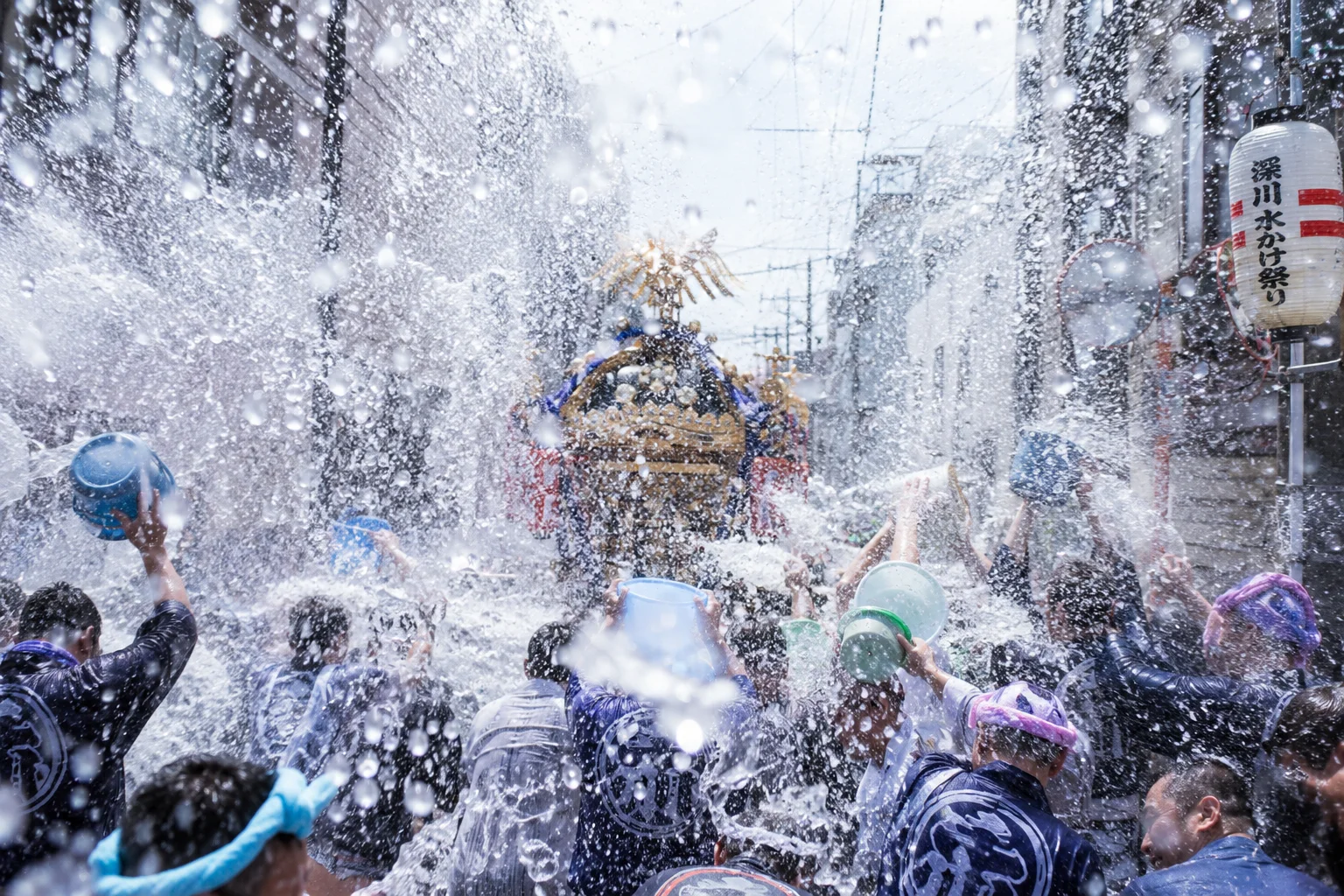
Fukagawa Hachiman Matsuri of Tomioka Hachiman-gu, an Edo Great Festival. On the 2026 Hon-matsuri, 50 portable shrines parade while people splash water to purify the carriers.
Overcoming the gruesome incident at Tomioka Hachiman-gu that occurred about 10 years ago, this year's triennial Hon-matsuri will be held in mid-August along with echoing festival music, powerful shouts of "Wasshoi, Wasshoi," and intensely splashing "purifying water." This "Fukagawa Hachiman Matsuri," held in Fukagawa, Koto Ward, Tokyo, is a historic event counted as one of the "Three Great Festivals of Edo," alongside the Kanda Matsuri of Kanda Myojin and the Sanno Matsuri of Hie Shrine. This year is particularly special as it marks the triennial "Hon-matsuri," where about 50 portable town shrines (Mikoshi) fill the streets of Fukagawa for a joint parade (Rengo-togyo), overwhelming spectators with its scale and power. Since it is the long-awaited "Hon-matsuri," there's no way we can skip covering it lol. We introduce the historical origins of the Fukagawa Hachiman Matsuri, the symbolic meaning of the water-splashing ritual (also known as the "Water Splashing Festival"), a comparison of the characteristics of the three Great Festivals of Edo, and a survival guide to safely enjoy the viewing where you are guaranteed to get soaked.
History and Origin: Dignity of the "Three Great Festivals of Edo" Loved by Tokugawa Shoguns and the Style of Townspeople#
Tomioka Hachiman-gu, the stage of the Fukagawa Hachiman Matsuri, was founded in Kan'ei 4 (1627). It began when Nagashige Hoin, a descendant of Sugawara no Michizane, reclaimed the land of Fukagawa, which was a sandbar, and enshrined Hachiman-sama. It was highly revered by the Shogun family, including Tokugawa Ieyasu who established the Edo Shogunate, and the area surrounding Hachiman-gu flourished greatly as a temple town.
Festivals as annual rites were actively held since the early Edo period, but it developed into the current popular and large-scale style after the Genroku era (1688-1704). At that time, the "townspeople of Fukagawa" (merchants, craftsmen, boatmen) led the festival, competing in the Edo style of "Iki" (chic) and "Inase" (gallant). The gorgeousness of the portable shrines parading in the Hon-matsuri was a symbol of Fukagawa's economic wealth and the townspeople's pride. Tokugawa Shoguns also deeply loved this festival through the guards of Edo Castle, and under Shogunate approval as the largest summer entertainment for the whole Edo area, a prestigious tradition was shaped.
What is Hachiman-gu?
Usa Jingu in Usa City, Oita Prefecture is the head shrine of all Hachiman-gu shrines, enshrining the following three deities:#
Emperor Ojin (Homutawake no Mikoto): The 15th Emperor
Empress Jingu: The mother of Emperor Ojin
Himegami: Deities including the three Munakata goddess deities
Tomioka Hachiman-gu also enshrines Emperor Ojin (Hachiman Daibosatsu) as the main enshrined deity.
Spirit of the Water-Splashing Ritual: Why Splash "Water" on Shrines and Carriers?#
The greatest feature of the Fukagawa Hachiman Matsuri, and the reason why it is also called the "Water Splashing Festival," is the "water" splashed simultaneously from spectators along the streets toward the portable shrines and carriers. Buckets, hoses, water guns are used, and in some areas, huge water tanks prepared on truck beds or even water hoses by fire brigades appear, splashing water magnificently.
This water-splashing act has two main meanings. One is as a "practical heatstroke countermeasure" to cool the bodies of carriers who continue to carry heavy shrines and walk several kilometers in the intense midsummer heat. The other is a symbolic meaning of "purification and Bexie (amulet)" to wash away impurities of the shrines and carriers and expel evil diseases and spirits. The carriers burn with more fighting spirit by receiving water, and their shouts become hotter. This sense of unity where spectators directly participate in the festival through the role of water-splashing is the unique charm of the Fukagawa Hachiman Matsuri.
Highlight of the 2026 Hon-matsuri: Joint Parade of Town Shrines and the Difficult Point of Eitai Bridge#
The highlight of the 2026 Hon-matsuri is the "Joint Parade of Town Shrines" held on Sunday. About 50 town shrines owned by each neighborhood association in the Fukagawa area gather together and parade through an 8-kilometer route without interruption. The line of shrines starting in front of Tomioka Hachiman-gu early in the morning passes through Monzen-nakacho, Kiyosumi-shirakawa, Morishita, crosses Eitai Bridge, and returns to Monzen-nakacho.
The ultimate climax is the "moment of crossing Eitai Bridge." Since this bridge has gentle uphill and downhill slopes, it is the biggest obstacle where the carriers' physical strength is tested most, and at the same time, the most beautiful highlight. Water-splashing is restricted on the bridge for safety, but in the areas right before and after crossing, tremendous water spraying awaits like a broken dam. The rumbling sound of drums and the traditional shout of "Wasshoi, Wasshoi" integrate, turning Eitai-dori literally into a water-soaked enthusiastic stadium. The strict insistence on the traditional shout of "Wasshoi" (meaning carrying harmony, or going together with harmony) instead of "Soiya" or "Seiya" makes us feel the depth of Fukagawa's history.
Comparison of the "Three Great Festivals of Edo" that Color Tokyo#
Tokyo has many festivals inherited from the Edo period, but among them, the prestigious "Three Great Festivals of Edo" have different charms and styles. We organized the differences among Kanda Matsuri, Sanno Matsuri, and Fukagawa Hachiman Matsuri in the table.
| Festival Name (Shrine / Main Areas) | Style and Atmosphere | Highlights and Main Parade | Performance Features like Water/Fire |
|---|---|---|---|
| Fukagawa Hachiman Matsuri (Tomioka Hachiman-gu / Fukagawa, Koto Ward) |
"Iki" (chic) and "Inase" (gallant) townspeople style. Extremely close distance between carriers and spectators. | Joint parade of about 50 town shrines held during the triennial Hon-matsuri (crossing Eitai Bridge) | "Water-splashing." Splash a large amount of purifying water from buckets, hoses, and truck water tanks. |
| Kanda Matsuri (Kanda Myojin / Chiyoda Ward, Chuo Ward) |
Characterized by the vigor and roughness of "Edokko" (Tokyoites). Parade in business districts. | "Shinkosai" parading through Kanda, Nihonbashi, Akihabara, and town shrines' Miyairi/Miyade (entering/leaving shrine) | "Vigor" and "Sound." Festival music and collision of shrines echoing in office districts. |
| Sanno Matsuri (Hie Shrine / Nagatacho, Chiyoda Ward) |
Solemnity and court-style dignity as the "Tenka Matsuri" (national festival). Parade around the Imperial Palace. | "Shinkosai" with people dressed in dynastic costumes parading through government office districts and Marunouchi | "Dignity" and "Silence." Traditional beauty by elegant dynastic costumes and quiet march. |
Thus, compared to the Sanno Matsuri which emphasizes court-style dignity, or the Kanda Matsuri going vigorously through the office districts of Nihonbashi, the Fukagawa Hachiman Matsuri is a highly popular and dynamic festival where carriers and down-town spectators physically and emotionally integrate into one through the dynamic performance of "water-splashing."
For Tourists: Complete Water-Splashing Protection and Route Strategy#
If you want to enjoy the Fukagawa Hachiman Matsuri seriously, it is wise to think that "it is impossible to view without getting wet." Especially near the front row of the joint parade route, the entire area becomes a water-splashing zone. Prepare thoroughly with the following survival guide and head to the site.
[Fukagawa Hachiman Matsuri Wet Protection Survival Guide]
1. Complete waterproofing of belongings:
Be sure to put valuables like smartphones, cameras, and wallets in waterproof zip bags or sealed waterproof bags. We highly recommend putting a rain cover over the whole bag or using a waterproof backpack from the start.
2. Preparation of clothing and change of clothes:
Polyester clothes that dry easily or swimsuit-like outfits that do not get heavy when wet are best. Cotton T-shirts and denim get heavy when wet and take away body temperature. Also, to enter public baths or cafes around Monzen-nakacho after viewing, prepare a set of "dry change of clothes" and towels in a plastic bag.
3. Protection of eyes and feet:
With water flying vigorously, your view may be blocked or contact lenses washed away. Swimming goggles or clear fake glasses/sunglasses are helpful. Since there are many puddles and it is slippery, wear sneakers that can get wet and avoid sandals.
4. Recommended viewing points:
Avoid the crowded front of Tomioka Hachiman-gu, and choose areas around Kiyosumi-shirakawa Station, along Kiyosumi-dori, or around Fukagawa Park, which are recommended areas where you can see magnificent water-splashing with relatively more space.
Conclusion: Connecting through Fukagawa's "Water," the Hot Bonds of the Community#
Under the curtain of intensely falling water, people carry shrines, shout, and splash water with smiles. The scene of the Fukagawa Hachiman Matsuri goes beyond mere summer entertainment, embodying the "bonds of the community" that people living in Fukagawa have protected for hundreds of years. Just as water washes away impurities, the festival's heat blows away daily stress and pours new vitality into the whole town. In August 2026, experience the heat of the Hon-matsuri returning after three years and the drama of water and fire that integrates the whole town. There lies the chic and warm soul of the downtown that has not changed since the Edo period.
【Sources】#
1. Tomioka Hachiman-gu Official Website "Guidance on Fukagawa Hachiman Matsuri (Annual Festival)"2. Koto Ward Tourism Association Official Website "Koto Odekake Guide: Fukagawa Hachiman Matsuri Special Feature"
3. Fukagawa Edo Museum "Fukagawa Hachiman Matsuri and Townspeople's Lives Seen in Historical Documents"