Nagasaki's Soul Send-Off Wrapped in Firecracker Roar! Origins and Highlights of Shorolagashi
Nagasaki's traditional event "Shorolagashi" held on Aug 15. Despite its quiet name, it is filled with firecracker noise! Families parade with handmade boats to mourn the deceased with active energy.
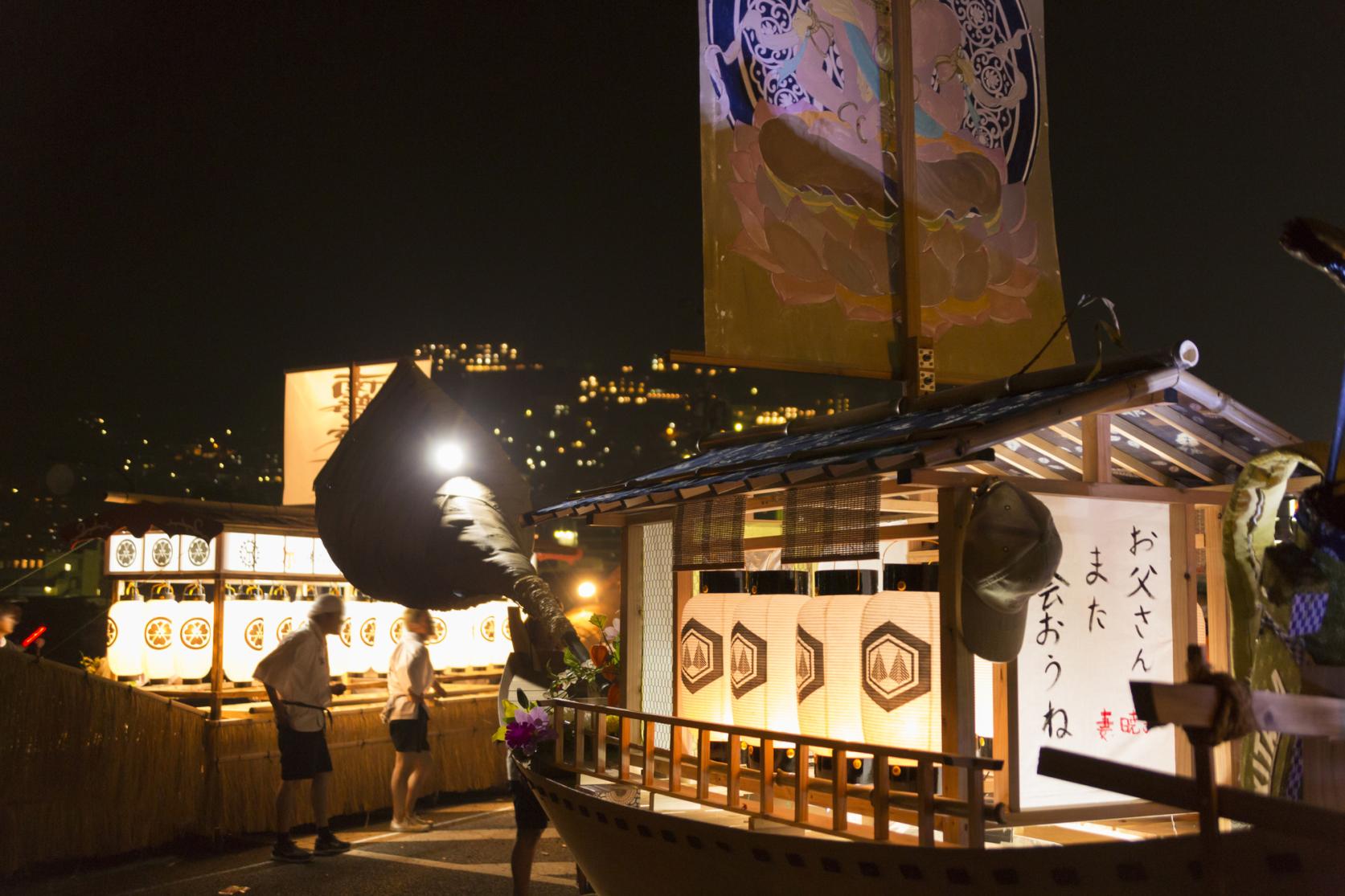
Every year on the night of August 15, the streets in various parts of Nagasaki Prefecture (such as Nagasaki City, Sasebo City, and Shimabara City) are wrapped in the ear-splitting roar of firecrackers and the heat of people pulling handmade spirit boats (Shorobune, which are huge!). This "Shorolagashi" is a traditional event where families who have welcomed the first Obon (Shinbon) mourn the souls of the deceased and send them off to the Pure Land. Unlike the quiet "Torolagashi" seen nationwide where small lanterns are floated on rivers and seas, Nagasaki's Shorolagashi is filled with "dynamic" energy and overwhelming scale. In this article, we explain the charms of this unique soul send-off event in detail from multi-dimensional perspectives, through its historical roots, Nagasaki's geopolitical background and fusion of Chinese culture, the structure and aesthetics of spirit boats, the demon-expelling philosophy of firecrackers, and comparisons with Obon events in other regions.
History and Origin: Fusion with Chinese Culture Nurtured by "Nagasaki", the Window of Foreign Trade#
Nagasaki's Shorolagashi was born from a historical background unique to Nagasaki, which was the only open trading port in Japan under the national isolation policy of the Edo period. In its origin, the culture of many Chinese people (overseas Chinese) who stayed in or naturalized in Nagasaki at that time is deeply involved.
What is said to have had a particularly strong influence is the "Saichuan-lagashi (Floating of Decorated Boats)" performed during the "Zhongyuan Festival," a traditional Chinese Obon event. This was a divine ritual to float model boats decorated gorgeously, carrying the souls of the deceased, onto the sea. This fused with Japan's ancient Obon events for ancestor worship and Buddhist thoughts of "spirit send-off," developing into Nagasaki's unique "Shorolagashi." In addition, Nagasaki has historically been a region where Christian faith (hidden Christians) was deep-rooted besides Buddhists. Christian symbols like crosses or images resembling the Virgin Mary were hidden in the designs of some spirit boats. In this way, diverse religious cultures fused and crossed complexly, establishing it as a custom of the common people.
Diversity and Craftsmanship of Spirit Boats: "Moving Artworks" Reflecting the Deceased's Personality#
The "Spirit Boat," the protagonist of Shorolagashi, is handcrafted using bamboo, wood, straw, etc., by bereaved families and local craftsmen over many months. The size of the boat varies from small ones sent out by individuals to huge "Moyaibune" reaching dozens of meters in total length, built jointly by multiple families.
Spirit boats are broadly classified into traditional "Japanese Boat Type" and "Deformed Boats (Individual Boats)" that strongly reflect the deceased's hobbies or personality during their lifetime. In recent years, the latter individual boats have attracted particular attention. If the deceased loved yachts or boats, a yacht-shaped boat is made; if they liked cars, an elaborate car-shaped boat is crafted; or if they liked shogi, a giant shogi piece is decorated. These are not just tools of mourning, but "moving arts and crafts" celebrating the proof of life and personality of the deceased on earth, entertaining the eyes of people walking the streets. Family crests and the deceased's name are proudly displayed at the bow (Miyoshi), and bereaved families slowly pull it through the streets with the shout of "Doi Doi."
Roar of Firecrackers and Demon-Expelling Philosophy: Sparks of "Bexie" Wrapping and Hiding Tears#
What shocks people visiting Shorolagashi for the first time most is the merciless roar of firecrackers and the white smoke wrapping the surroundings. Participating families throw a massive amount of firecrackers packed in cardboard boxes onto the road to explode one after another. The tremendous roar is so loud that you cannot even hear the voice of the person next to you.
This act of lighting firecrackers is not just festival revelry, but derives from the traditional Chinese thought of "Bexie (demon-expelling/amulet)." It contains the meaning of clearing the road with the loud sound and sparks of firecrackers and expelling evil spirits so that they do not disturb the soul of the deceased on the way to the Pure Land. Also, one theory says that "the intense roar wraps and hides the sobbing voices and tears of sadness of the bereaved families who lost their loved ones, sending them off brightly and looking forward." Thus, the kindness and strength of Nagasaki's people are contained in the sparks of firecrackers. The light metallic sound of gongs (Kane) playing "Chan-kon Chan-kon" and the exploding sound of firecrackers mix, wrapping the streets of Nagasaki in a unique enthusiasm.
Comparison with Japan's Representative "Okuribon" Events#
Events to send off spirits or ancestral souls exist all over Japan, but their expressions vary from region to region. Here, we compare Kyoto's "Gozan no Okuribi," Obon lantern floating in Tohoku and Hokuriku, and Nagasaki's "Shorolagashi," organizing their uniqueness.
| Event Name (Main Venues) | Origin and History | Send-Off Method and Style | Visual Characteristics of Sound and Light |
|---|---|---|---|
| Shorolagashi (Various areas in Nagasaki) |
Fusion of overseas Chinese culture (Zhongyuan Festival) in the Edo period and Japanese Obon events | Bereaved families pull large and small spirit boats made of wood and straw, marching through streets to the send-off site | Roar and white smoke of firecrackers, sound of gongs and shout of "Doi Doi", gorgeous light from electric decorations of boats |
| Gozan no Okuribi (Kyoto City, Kyoto) |
Buddhist event said to originate in the Heian to Muromachi periods | Lighting fire characters such as "Daimonji" on mountains surrounding Kyoto to return spirits to the other world | Solemn firelight emerging in silence and pitch-black darkness, a quiet space of prayer with folded hands |
| Torolagashi (Nationwide, etc.) |
Derived from the tradition of Buddhist water lanterns and floating things down rivers | Lighting fire in small lanterns made of paper or wood, floating them gently on rivers or seas | Countless flickering lights drifting on the water, sounds of river murmurs and sutra chanting, quiet and fantastic scene |
Thus, in contrast to other traditional events conducted in silence and darkness, Nagasaki's Shorolagashi has an extremely contrasting character, sending off the deceased noisily with "roar and light." This represents the disposition of Nagasaki's people to burst out mourning brightly, rather than closing it inside as sadness.
Route for Viewing and Practical Advice for Tourists#
On August 15, traffic regulations are enforced in the center of Nagasaki City from evening, and the whole city turns into Shorolagashi color. Prior preparation is indispensable for first-time tourists to enjoy it safely.
[Shorolagashi Viewing Survival Guide]
1. Earplugs are a must-have item:
This is no joke; viewing without earplugs is a roar at a level that affects hearing. Especially if you bring children, be sure to prepare earmuffs or earplugs. They are also sold at convenience stores locally.
2. Clothing and shoe choices:
Fragments and sparks of exploded firecrackers scatter at your feet. Avoid exposed shoes like sandals or Crocs, and wear easy-to-walk shoes like sneakers. Also, to prevent sparks from opening holes in clothing, long sleeves and long pants that you don't mind getting dirty are recommended.
3. Countermeasures against smoke and eyes:
With a large amount of smoke from firecrackers, your eyes may hurt or your throat may get sore. Having a mask and protective sunglasses (or fake glasses) makes it very comfortable.
4. Confirming the main route:
In Nagasaki City, areas around Shianbashi, Kanko-dori, Kenchobaka, and Ohato (the send-off site which is the final destination) show the greatest excitement. Since the march of boats continues from around 18:00 in the evening to near midnight, we recommend viewing from a slightly distant place if you want to avoid crowds.
Conclusion: Changing Sadness into Roar, Nagasaki's Bonds Sending Off with Smiles#
Shorolagashi might look like just a noisy, strange festival to outsiders. However, its essence is an "exit ritual" filled with warm family love. Families welcoming their first Obon pull the boat together with relatives and friends, putting aside the deep sorrow of losing important persons. And with the loud sound of firecrackers, they celebrate the departure with smiles so that the deceased does not feel lonely. Nagasaki's Shorolagashi, which wraps and hides sadness with a roar and shares the pain with the whole community, is the warmest and gentlest summer night, symbolizing the strength of people's bonds.
If Kuro-Boo passes away in the future, I would love to have such a bright funeral. If heaven exists and I were looking down at the earth, I would definitely feel sad if my acquaintances were crying. It would make me happy enough if you drank a lot of alcohol and remembered me with my past failures and funny stories. If you could somehow leave one empty seat and put a cup of sake there, it might decrease a little, just like the "angels' share" but rather the "deceased's share" lol.
On August 15, 2026, why not experience the miracle of roar and prayer filling the streets of Nagasaki with your own eyes?