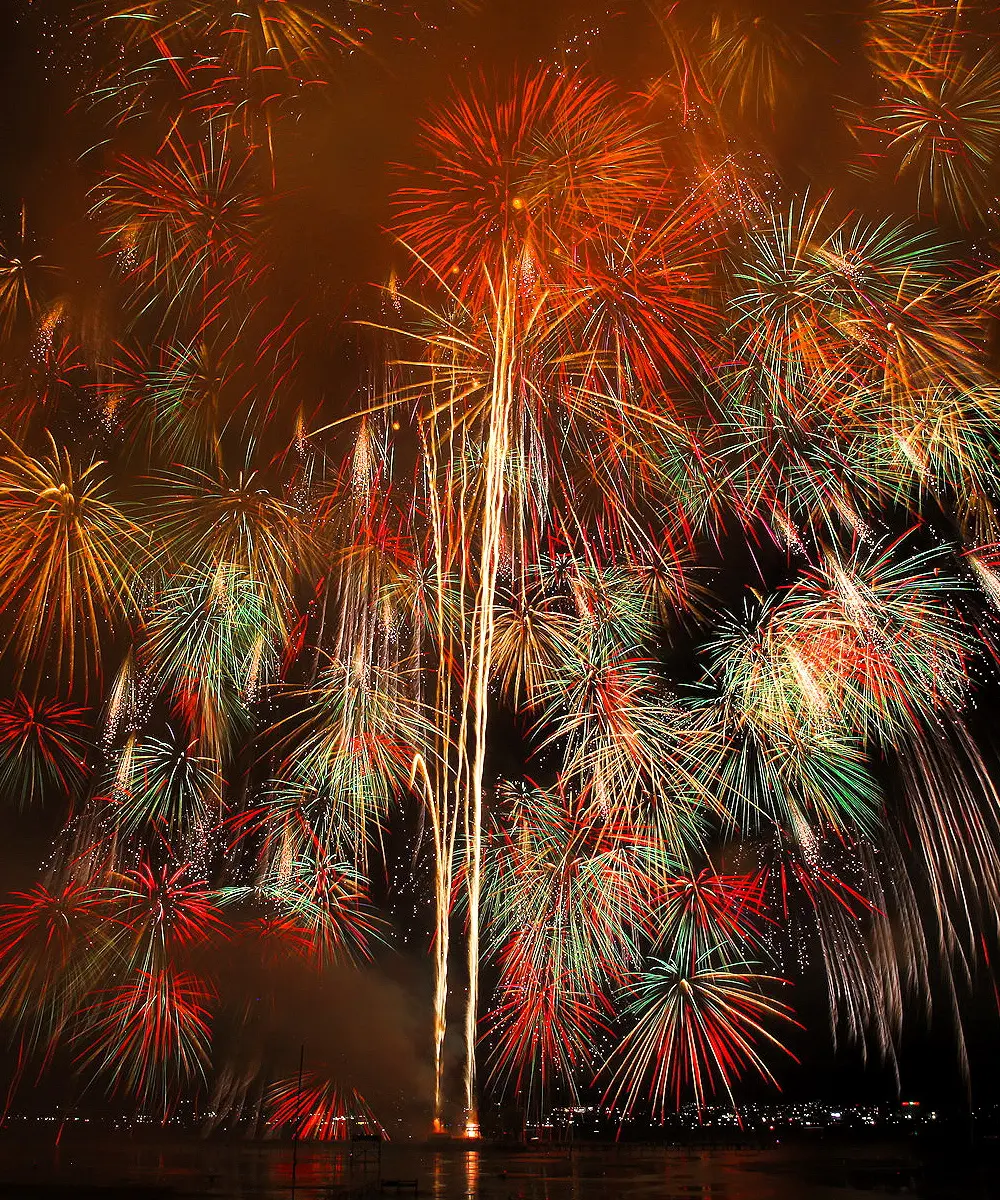
Coloring next weekend's night sky! Here is a list of major fireworks festivals to be held on August 15 and 16, 2026.
Introducing fireworks festivals held during the Obon season, featuring Suwako Festival's 40,000 fireworks. High crowds are expected, and despite potential typhoons, we check the details.
Despite being during the mid-August Obon period, Japan's night sky is vividly colored by giant flowers of light in various parts of the country. Next week, August 15 and 16, are special two days (or used to be; recently they are being dispersed) when many people visit using their homecoming or holidays. We summarize large-scale festivals with 10,000 or more fireworks (since there are too many...) coloring the Obon season (Suwa Lake in Nagano, Kisarazu in Chiba, Yoshino River in Nara, etc.) in an easy-to-understand list format, and pick up the "Suwako Festival Lake Fireworks" in Suwa City, Nagano Prefecture, which boasts one of the largest numbers of fireworks in Japan, to thoroughly explain its overwhelming charm and highlights. Furthermore, we deliver comprehensive useful information to make summer night memories the best, from scale comparison with other festivals to a local survival guide to survive midsummer crowds and intense heat.
List of Major Fireworks Festivals Held on August 15 and 16, 2026#
Centering on large-scale fireworks festivals with 10,000 or more fireworks held during the Obon two days next week, we organized notable festivals nationwide in the table below. Please use it for your outing plans and comparisons.
| Festival Name (Main Venues) | Festival Date | Number of Fireworks | Highlights and Main Features |
|---|---|---|---|
| Suwako Festival Lake Fireworks (Suwa City, Nagano) |
August 15, 2026 (Sat) | Approx. 40,000 | Overwhelmingly the largest number of fireworks in Japan. Water starmines coloring the lake surface, loud sound echoed by mountains on four sides, and a 2km waterfall setup. |
| Yoshinogawa Festival Cooling Fireworks (Gojo City, Nara) |
August 15, 2026 (Sat) | Approx. 30,000 | One of the largest scale in Kansai. Dynamic light show where music, laser beams, and fireworks are completely synchronized. |
| Maebashi Fireworks (Maebashi City, Gunma) |
August 15, 2026 (Sat) | Approx. 15,000 | Shot at the vast riverbank of Tone River. Aerial Niagara and creative fireworks themed on Gunma's specialties are popular. |
| Kisarazu Port Festival Fireworks (Kisarazu City, Chiba) |
August 15, 2026 (Sat) | Approx. 13,000 | Dynamic port fireworks set in Tokyo Bay. Collaboration of one of the largest starmines in Kanto and giant double-layered shells. |
| Little Edo Kawagoe Fireworks (Kawagoe City, Saitama) |
August 15, 2026 (Sat) | Approx. 10,000 | Enjoy while feeling the old streets and atmosphere of Kawagoe. Message fireworks for precious people and giant starmines. |
Thus, the fireworks festivals held on August 15 are all megascale exceeding 10,000 fireworks, and they are all major events attracting hundreds of thousands of tourists from all over the country. Among them, the fireworks shot at Lake Suwa in Nagano Prefecture reign supreme in terms of the number of fireworks.
Largest Scale Pickup: Wonders of the 78th Suwako Festival Lake Fireworks#
Among the two days, the one boasting the largest number of fireworks is the "Suwako Festival Lake Fireworks" held every year on August 15 in Suwa City, Nagano Prefecture. The number of fireworks is practically about 40,000, which is outstanding among all fireworks festivals in Japan. We explore why Lake Suwa's fireworks are so special from three charms.
The first charm is the "production on the vast lake" with no obstacles. Fireworks are shot toward both the night sky and the lake surface from the launching pad set in the middle of Lake Suwa. Especially, the famous water starmine "Kiss of Fire" is a romantic and powerful production where semi-circular fireworks are shot alternately coloring the lake surface in red, gradually getting closer and merging.
The second charm is the "natural surround sound" unique to Lake Suwa. Since Lake Suwa is a basin surrounded by high mountains on four sides, the exploding sound of fireworks echoes off the mountains, reaching the audience as a low-frequency shockwave that vibrates the bottom of the stomach. This sound power is a privilege unique to Lake Suwa that can never be experienced in flatlands or beach fireworks festivals.
And the third charm is the "great Niagara waterfall" of about 2km in total length that decorates the finale. The threads of light hung over the lake become a dazzling wall of white light and pour down to the lake surface, illuminating the summer night instantly like midday.
Comparison of Scale and Heat with Other Large-scale Festivals and Events#
Fireworks festivals have different characteristics as part of major summer festivals or as independent events. Here, we compare the scale and atmosphere of the Suwako Festival Lake Fireworks with other representative Japanese festivals (traditional events) to explain the difference in heat.
For example, Kyoto's "Gion Matsuri" and Tokushima's large-scale "Awa Odori" are "long-distance" traditional events where excitement continues in the city over several days. Hundreds of thousands to over a million tourists visit, but people move around the town, enjoying dances and floats over a long time. In contrast, large-scale fireworks festivals represented by the Suwako Festival Lake Fireworks are "ultra-high density and instant excitement" events where 40,000 fireworks are exploded in a very short time of only 2 to 3 hours, and about 500,000 spectators concentrate at one point. Therefore, the degree of concentration during launching and the heat put into an instant are top-class among many Japanese summer events. It might be said that this aesthetics of the moment is the essential reason why Japanese people have loved fireworks since ancient times. Coupled with the national character of loving cherry blossoms, the depth of affection for fleeting things is surely the highest in the world.
For Tourists: Survival Guide to Enjoy Midsummer Fireworks Festivals Safely#
Large-scale fireworks festivals during the Obon period come with heavy crowds and the intense heat of midsummer nights. To avoid falling ill or getting caught in confusion of coming and going, check the local survival guide below in advance.
【Midsummer Large-scale Fireworks Festival Comfortable Viewing Survival Guide】
1. Thorough preparation for heatstroke and dehydration:
Even after the sun goes down, the area around the venue becomes very hot and humid due to the heat of the asphalt and the crowd. Alcoholic beverages do not supply water. Be sure to prepare sports drinks, oral rehydration solution, and salt tablets, and consume them frequently as instructed before launching. Portable handy fans and cooling sprays are also essential.
2. Checking toilet locations and early use:
At venues where hundreds of thousands of people gather, long lines (sometimes 1-hour wait) form at temporary toilets. Since they become very crowded right before launching or immediately after finishing, the iron rule is to check toilet locations first when arriving at the venue and use them while lines are still short.
3. Congestion countermeasures for returning and advance ticket arrangement:
The biggest obstacle of fireworks festivals is the "returning station." Since people rush to the station all at once to evacuate immediately after finishing, entry restrictions are placed at the station, and you may not be able to move for more than 2 hours. Be sure to charge enough money for the round trip on your IC card (Suica, PASMO, etc.) or purchase the return ticket at arrival. Also, "early retreat" starting to leave slightly before the finale to avoid congestion is a wise choice.
4. Preparation of insect repellent and mats:
When viewing at riverbeds or lakesides, mosquitoes and other insects occur in very large numbers. Be sure to bring insect repellent spray and medicine for insect bites. Also, prepare thick leisure sheets to prevent heat from the ground and keep clothes clean, and carry extra towels to wipe wet places for peace of mind.
Conclusion: Instant Twinkle Weaving Summer Memories and Vitality for Tomorrow#
Large flowers blooming in the night sky, and the loud sound echoing after silence. Fireworks shot during the Obon period have long had the meaning of sending fires for Obon ancestor worship, and even today, they are special light rituals that blow away daily stress and give us vitality for tomorrow. These fireworks festivals held during the two days of August 15 and 16, 2026, are all world-class entertainments supported by long history and people's passion. Prepare countermeasures in advance, and go experience the magic of summer nights in perfect physical condition. There awaits unforgettable moving moments and irreplaceable moments shared with precious people.
It might not be directly related to the beauty of the fireworks, but Kuro-Usagi was deeply moved by the PDF booklet published on the official page (I wonder where they distribute it?). I imagined a huge number of people are involved, but I cannot hide my surprise that they even make such a booklet. Near Lake Suwa, there is the soba restaurant that won No.1 in Kuro-Usagi's 1st National Soba Tour, which makes it even more emotional for me. I will put the PDF link here, so please take a look! suwako-hanabi.comhttps://suwako-hanabi.com/wp-content/uploads/2026/07/78pg.pdf↗
【Sources】#
1. Suwako Festival Lake Fireworks Official Website "Outline and Highlights"2. Kisarazu City Official Website "Schedule and Guidance of Kisarazu Port Festival Fireworks"
3. Yoshinogawa Festival Executive Committee "History and Program of Yoshinogawa Festival Cooling Fireworks"