Hachioji Matsuri: Floats & Folk Dance Festival
Discover Hachioji Matsuri, Tokyo's premier summer festival. We introduce its history, the 19 gorgeous wood-carved floats, the Guinness World Record mass dance, and logistics.
Hachioji Matsuri, which many people have seen on station posters but surprisingly few know in detail, is held annually for three days starting on the first Friday of August in Hachioji, Tokyo. It is one of the leading float festivals in the Kanto region and one of the largest urban summer events in Japan. A variety of events unfold along a 2-kilometer stretch of the Koshu Kaido road: spectacular float parades, musical competitions (Ohayashi), powerful portable shrine (Mikoshi) processions, and traditional folk dancing (Minyo Nagashi) where thousands of dancers fill the street. We introduce the appeal of Hachioji Matsuri—known as the "festival of floats and folk dance"—detailing its historical background, highlights, and comparisons with other regions.
History and Origin: Fusion of Taga Shrine and Hachiman-Yakumo Shrine Festivals#
The history of Hachioji Matsuri dates back to the late Edo period, when the annual grand festivals (Reitaisai) of two major shrines began. These are the Reitaisai of Taga Shrine (the upper festival, Kami-no-Matsuri) located west of Hachioji Station, and the Reitaisai of Hachiman-Yakumo Shrine (the lower festival, Shimo-no-Matsuri) to the east. Originally, these two festivals were held independently, with their own Mikoshi processions and float parades in the post towns along the Koshu Kaido road (such as Yokoyama-shuku and Yokaichi-shuku). The upper festival was organized by the "upper district" and the lower festival by the "lower district," competing in a friendly spirit and deeply rooting the celebrations in the local community.
In 1961, these traditional festivals and local events were unified into the "Three Grand Citizen Festivals," which eventually became the current "Hachioji Matsuri" in 1968. This integration beautifully fused the solemn shrine traditions with a modern civic event that anyone can join. Furthermore, the long-standing efforts to preserve the traditional float culture and local performing arts were highly evaluated: in 2003, Hachioji Matsuri received the "Grand Prize for Regional Traditional Performing Arts," solidifying its status as one of Japan's representative traditional festivals.
A shrine's grand festival (Reitaisai) is the largest and most important annual event for that shrine, and is commonly referred to as "Reisai."
"Moving Artworks": The Splendor of 19 Elaborate Wood-Carved Floats#
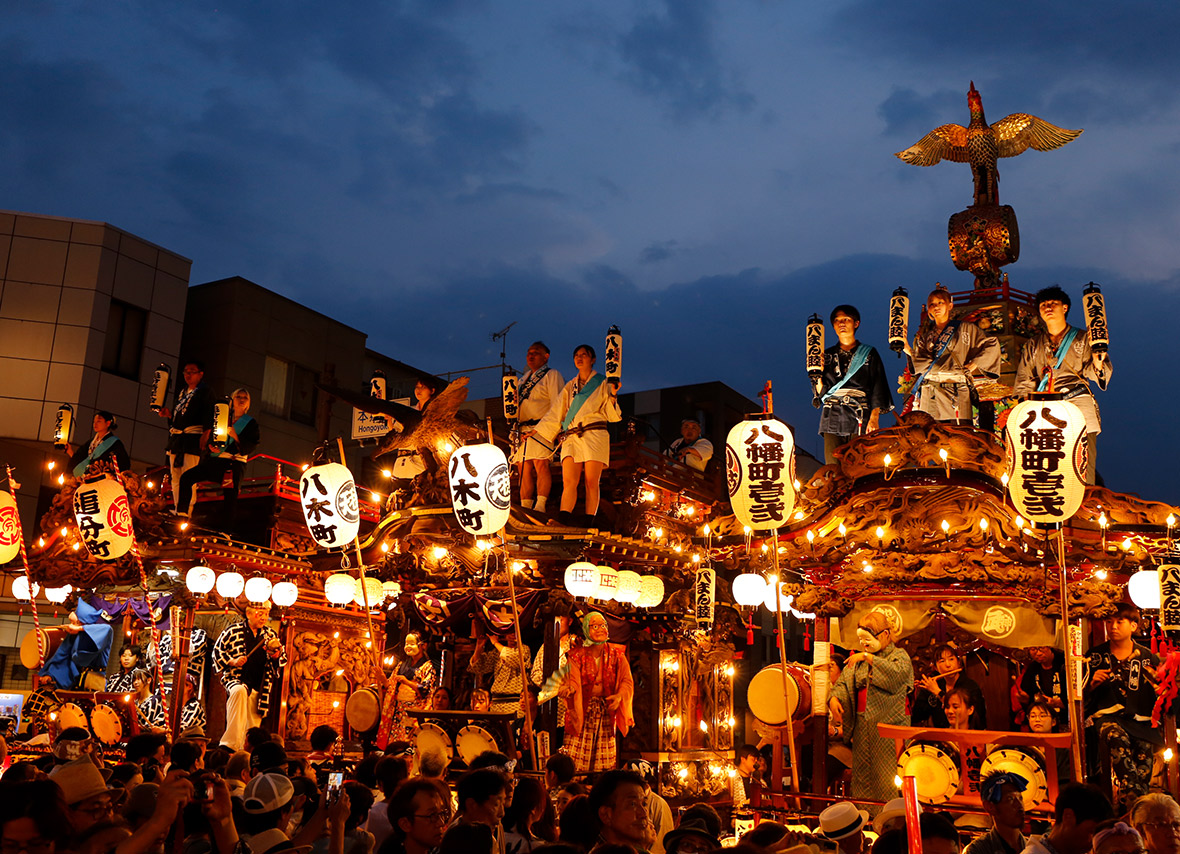
The true protagonists of Hachioji Matsuri are the 19 floats designated as tangible cultural properties of the city. They are often described as "moving artworks" because they are fully decorated with masterly wood carvings. The floats of Hachioji are historical masterpieces constructed from the Meiji to early Showa periods by renowned craftsmen, and each neighborhood association maintains and cares for them with great pride.
There are a total of 19 floats: 10 from the "upper district" (Taga Shrine) and 9 from the "lower district" (Hachiman-Yakumo Shrine). The list of neighborhood associations that own these floats is summarized below.
| District | Float-Owning Neighborhood Associations | Main Features and Historical Value |
|---|---|---|
| Upper District (Kami-no-Matsuri) |
Hachimancho 1st & 2nd Chome, Hachimancho 3rd & 4th Chome, Yokamachi 1st & 2nd Chome, Yokamachi 3rd & 4th Chome, Oiwakecho, Sennincho 1st Chome, Sennincho 2nd Chome, Motoyokoyamacho, Honcho, Hiraokacho (10 floats total) | Characterized by outstanding wood carving by master sculptors like Kodake or Kitahara. The Honcho float in particular dates back to the Meiji period and holds immense historical value, preserving Edo and Meiji craft culture. |
| Lower District (Shimo-no-Matsuri) |
Yokoyamacho, Shinmachi, Oyokocho, Hongōcho, Minamishinmachi, Minamicho, Teramachi, Okomoncho, Uenomachi (9 floats total) | In addition to their magnificent wood carvings, many floats stand out for their architectural beauty, such as the curved Karahafu gable roofs. At night, illuminated by lanterns, their appearance is magical. |
At night, the floats are lit with hundreds of lanterns, making the details of the carvings glow fantastically in the darkness. The slow progress of these illuminated structures along the Koshu Kaido road immediately transports viewers to the atmosphere of the Edo period.
The Festival Climax: The "Buttsuke" (Tsujiawase) Musical Showdown#
The moment when the excitement of the spectators reaches its peak is the "Buttsuke" (Tsujiawase). This is a traditional event where floats meet at intersections or along Koshu Kaido, approach extremely close face-to-face, and compete in their music (Ohayashi) and dancing. Intense rhythms of drums and flutes echo through the night sky, while on the float stages, dancers in fox, lion, Okame, or Hyottoko masks dance wildly.
The main rule of Buttsuke is to not lose tempo to the opponent's rhythm, playing one's own Ohayashi accurately until the end. The group that loses its rhythm or gets confused is considered defeated, and the winner plays with even more vigor to declare victory. The powerful sound of instruments and the cheers of the crowd merge into an electric vibration that travels through the entire street. Witnessing this showdown at various points of the street at night is a thrilling experience.
"Minyo Nagashi" Fills the Street with Thousands of Dancers and Shines in the Guinness Book#
The counterpoint to the floats' energy is the second great theme of the festival: folk dance (Minyo). In the "Minyo Nagashi" held on the second day, thousands of dancers from different neighborhoods fill the Koshu Kaido road (made pedestrian-only for the occasion) for 2 kilometers, wearing beautiful summer kimonos (Yukata). To the rhythm of the traditional "Hachioji Ondo" and the popular citizen song "City of the Sun" (Taiyo no Machi), participants advance with fluid and perfectly coordinated movements in a spectacular scene.
On the occasion of the Hachioji municipal centennial in 2016, the Minyo Nagashi parade attempted the world record for the "largest traditional Bon dance (Largest Kuni-dance / Bon dance)". Under strict verification rules, a total of 2,130 participants wearing Yukata and traditional sandals (Zori) danced together for 5 minutes, officially securing the world record. This achievement remains a local pride, demonstrating the cohesion and love for traditional culture.
One of the best features of Minyo Nagashi is that visitors can not only watch, but also spontaneously join the dance circles. This dance unites elegance with the pure joy of living of Hachioji residents, attracting new generations every year.
The Sengan Mikoshi: The Impressive and Powerful Grand Portable Shrine#
The energy of Hachioji Matsuri is not limited to floats. On the final day, the procession reaches its absolute climax when the "Sengan Mikoshi," the main portable shrine of Taga Shrine, is carried. With a base width of approximately 1.2 meters and a total weight of about 3 tons, it is one of the heaviest and most massive portable shrines in all of Tokyo.
To transport this grand structure, about 1,600 vigorous carriers from Hachioji and other areas gather. Upon appearing on Koshu Kaido, the Sengan Mikoshi moves swaying to the chants "Seiya! Seiya!". Sweat glints on the faces of the carriers who advance shoulder-to-shoulder under the massive weight, supported by applause and cheers from the crowd. The gigantic scale and disciplined beauty fascinate all spectators.
At the same time, the "Miya Mikoshi" of Hachiman-Yakumo Shrine and other local portable shrines parade through the streets. The interaction between the physical strength of the carriers and the elegance of the 19 floats that advance alternatively creates the fantastic energy of Hachioji Matsuri.
Comparison of Float Culture: Hachioji Matsuri vs. Kawagoe Matsuri#
| Comparative Aspect | Hachioji Matsuri | Kawagoe Matsuri |
|---|---|---|
| Float Structure and Stage | Wood-Carved Floats & Fixed Stage The structures are decorated with highly detailed wood carvings depicting mythological stories. The musicians' stage is fixed forward. To face each other, the pullers must manually turn the entire float with effort. |
Puppet Floats & Rotating Stage Large historical doll figures stand on top. The musicians' stage can rotate 360 degrees, allowing them to face opponents without moving the vehicle. |
| Buttsuke (Showdown) Style | Rhythmic Duelle Floats position close to each other. It is a sonic battle where musicians avoid adopting the opponent's Ohayashi tempo. Dancers also interact dynamically. |
"Hikkawase" Rotating stages face each other to compete musically. A very colorful spectacle where participants raise their lanterns high. |
| Hybrid Character of Festival | Shrine and Floats Together Combines the force of the immense 3-ton Sengan Mikoshi with the traditional elegance of the 19 artistic floats. |
Focus on Floats The vehicle parade and its musical/dance performances are the absolute heart; Mikoshi processions are minor. |
While Kawagoe Matsuri stands out for the elegance of its rotating stages, Hachioji Matsuri highlights the weight of its traditional wood carvings and the vigor of the 3-ton Mikoshi, achieving an optimal fusion of power and tradition. Both events reflect the local pride and craftsmanship of their communities.
Visitor Guide 2026: Access and Code of Conduct#
To attend Hachioji Matsuri, it is important to check transportation and conduct guidelines due to the massive volume of public. Please note the following recommendations for a safe and pleasant visit.
| Recommendation | Details and Measures |
|---|---|
| Public Transport Highly Recommended | During the festival, Koshu Kaido and surrounding roads have severe traffic restrictions. No parking is available, and massive congestion occurs. Avoid driving. The site is easily accessible on foot from JR Hachioji (north exit) or Keio Hachioji stations. |
| Footwear and Safety in Crowds | Crowds peak on Saturday and Sunday evenings during the Buttsuke and Mikoshi processions. Keep children close and wear comfortable athletic shoes to prevent trips or injuries on uneven road surfaces. |
| Hydration and Cleanliness | Held in hot August, regular hydration is essential even after sunset. To preserve the festival environment, dispose of trash at designated stations or carry it home. |
Conclusion: The Civic Bond of Hachioji—Preserving the Past, Shaping the Future#
Late at night on the final day, when the floats' lights fade and the last musical sounds dissolve, a pleasant fatigue and satisfaction settle over Koshu Kaido. From its Edo origins and post-war reconstruction to the Guinness record and regional cultural prizes, this event has always been Hachioji's beating heart. More than entertainment, it represents a living commitment to guard local history and pass it on with pride. Experience this touching and spectacular atmosphere in person!