Autumn Mackerel Season Is Here! 2026 Catch Trends & Gourmet Cooking Guide
Explore Japan's autumn mackerel: landing rankings across major ports, 2026 catch quotas and price trends, delicious home recipes, and scientific Anisakis prevention.
Mackerel (Saba) is an essential staple of the Japanese dining table. From autumn into winter, Chub Mackerel reaches peak fattiness and flavor, celebrated nationwide as "Aki-saba" (Autumn Mackerel). Packed with rich umami, high nutritional value (such as DHA and EPA), and historically affordable pricing, it has long been cherished as a people's fish. However, this popular fish faces unprecedented challenges today. From supermarket prices nearly doubling this year to major port landing rankings, distinct species profiles, master home recipes, and scientific Anisakis prevention guidelines, here is a comprehensive guide for every mackerel enthusiast.
Nationwide Catch Volumes and Major Landing Port Rankings#
Mackerel caught in Japanese waters (primarily Chub Mackerel and Blue Mackerel) are landed along both the Pacific and Sea of Japan coasts using large-scale purse seine nets. According to the "Marine Fisheries Production Statistics Survey" and regional distribution data from the Ministry of Agriculture, Forestry and Fisheries (MAFF), the leading ports driving Japan's mackerel landings are ranked below:
| Rank | Major Port | Location | Key Species, Characteristics & Brands |
|---|---|---|---|
| #1 | Choshi Port | Choshi City, Chiba Prefecture | Eastern Japan's premier landing base boasting massive volume. Renowned for high-fat chub mackerel like "Choshi Gokujo Saba". |
| #2 | Matsuura Port / Nagasaki Port | Matsuura City & Nagasaki City, Nagasaki Prefecture | Western Japan's largest hub. Known for firm, flavorful mackerel nurtured in the Tsushima Current, including "Nagasaki Herb Saba". |
| #3 | Hachinohe Port | Hachinohe City, Aomori Prefecture | Northern Japan's signature mackerel base. "Hachinohe Maeoki Saba", which rapidly accumulates fat in cold waters, enjoys nationwide fame. |
| #4 | Ishinomaki Port | Ishinomaki City, Miyagi Prefecture | Home to the famed "Kinka Saba" from rich Sanriku offshore grounds, attracting large, thick southward-migrating chub mackerel. |
| #5 | Sakaiminato Port | Sakaiminato City, Tottori Prefecture | The key hub on the Sea of Japan. Purse seine fleets deliver ultra-fresh chub and blue mackerel throughout the year. |
By prefecture, Nagasaki Prefecture in western waters and Miyagi, Ibaraki, Chiba, and Aomori Prefectures along the Pacific consistently top the charts. The peak landing season naturally shifts from north to south following the seasonal migration route of mackerel around Japan.
Mackerel Species and Recent Catch Trends#
Three main types of mackerel circulate in the Japanese market: Chub Mackerel, Blue Mackerel (Spotted Chub Mackerel), and Atlantic Mackerel imported from Northern Europe.
- Chub Mackerel (Masaba): Features vivid blue-green arabesque patterns across its back and a spotless silvery-white belly. From autumn into winter (October to February), falling water temperatures drive its fat content up to 20%–30%, earning it praise as fatty "Aki-saba" (autumn) and "Kan-saba" (winter).
- Blue / Spotted Chub Mackerel (Gomasaba): Distinguished by countless tiny dark spots across its belly. With less seasonal variation in fat content than chub mackerel, its quality remains high even during summer, making it prized from spring through summer. Its firm flesh is ideal for sashimi and marinades.
- Atlantic Mackerel (Norway Saba): Characterized by bold, clearly defined dark tiger stripes across its back. It consistently maintains very high fat content and is widely used across supermarkets for salted fillets and cured fish.
[Recent Catch Conditions and Stock Trends]
In recent years, mackerel catches in Japanese coastal waters have declined sharply due to changing marine environments (rising sea surface temperatures and shifting currents like the Oyashio and Kuroshio) as well as growth overfishing (purse seine nets capturing immature fish before spawning) conducted by Japanese and Chinese fishing vessels. Catches at major domestic landing ports face persistent, severe shortages; landings at Choshi Port have dropped to one-tenth of historic levels.
While Norwegian mackerel previously offset domestic shortfalls, coastal nations in the Northeast Atlantic agreed to resource management measures that reduced the 2026 catch quota by nearly 50% year-on-year (to approximately 79,000 tons). This caused import volumes into Japan to plunge, driving retail prices from roughly 400 yen up to 1,000 yen per fish—transforming this humble staple into a luxury item.
Furthermore, Japan's Fisheries Agency lowered the total allowable catch (TAC) for Pacific chub and blue mackerel by approximately 19% (to 112,000 tons) for the July 2026–June 2027 period to promote stock recovery, capping port landings and placing further upward pressure on prices.
Chef-Approved Guide! Delicious Mackerel Recipes
With rich umami and luscious fat, mackerel excels across grilling, simmering, deep-frying, and soup preparations. Here are five classic recipes perfected for home kitchens.
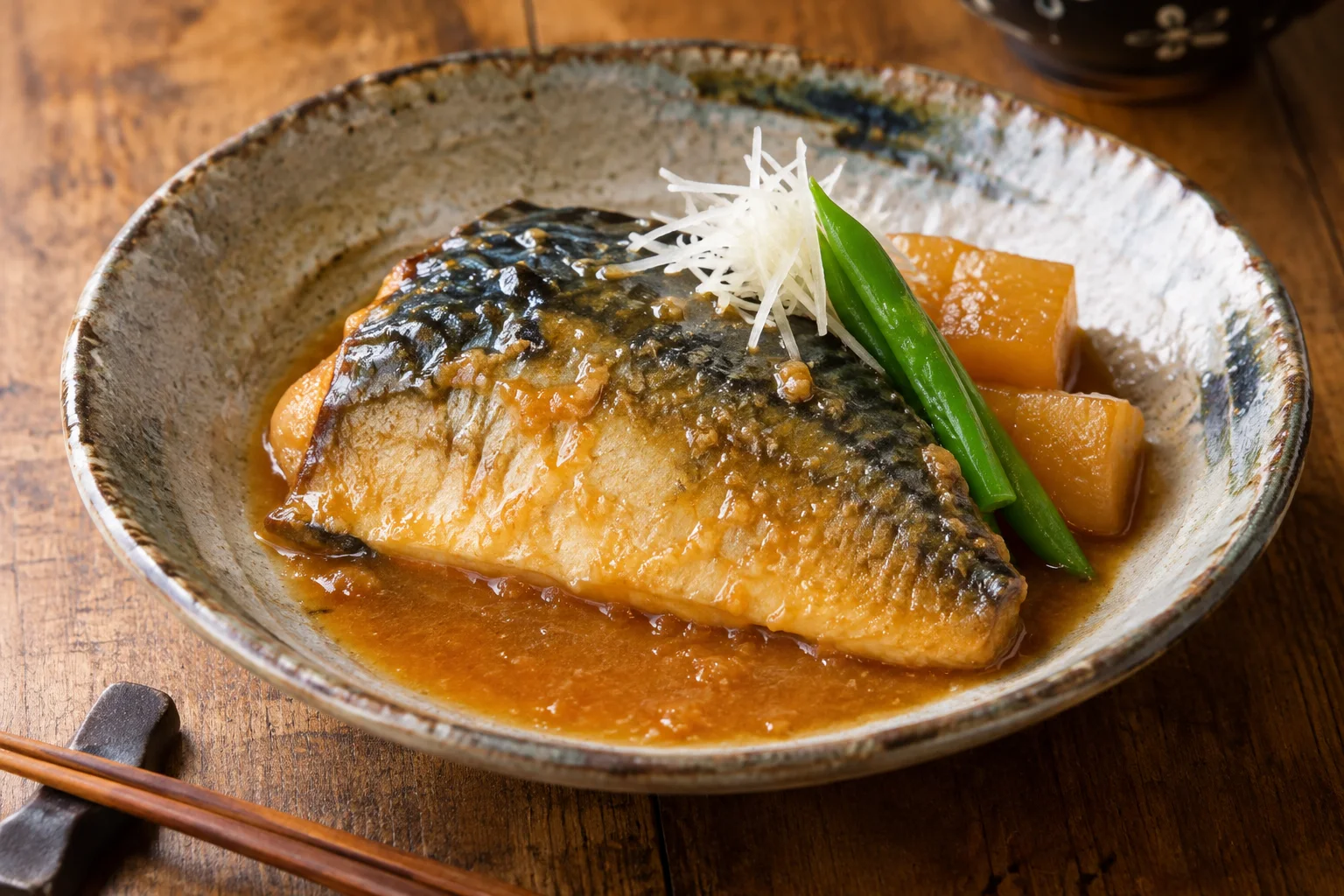
1. Golden Ratio Saba no Misoni (Simmered Mackerel in Miso)#
The pinnacle of Japanese home cooking. The key to tender flesh without any fishy odor lies in "parboiling (pouring boiling water and rinsing in cold water)" and "adding miso in two separate stages".
- Score a cross on the skin side, pour boiling water over fillets, and gently wash off surface slime and remaining bloodlines.
- Simmer over medium heat with sake, water, mirin, sugar, and sliced ginger using a drop lid (otoshibuta).
- Once cooked through, dissolve half the miso into the broth; when the sauce thickens, add the remaining miso at the end for fresh aroma.
2. Crispy & Aromatic Saba no Shioyaki (Salt-Grilled Mackerel)#
Simplicity reveals true quality. Salt the fillets 15 to 20 minutes before cooking to draw out moisture and odors, then wipe thoroughly with paper towels. Grill over medium-high radiant heat until the skin is golden and crispy while the interior stays tender and juicy.
3. Hakata Specialty Gomasaba (Sesame-Marinated Mackerel)#
A famous regional delicacy from Fukuoka. Fresh mackerel sashimi (or properly deep-frozen sashimi-grade fish) is tossed in a sauce of ground sesame seeds, dark soy sauce, mirin, and sake, garnished with green onions, shredded nori, and wasabi. Outstanding served over warm rice or paired with sake.
4. Crispy & Juicy Saba Tatsuta-age (Deep-Fried Mackerel)#
Marinate mackerel pieces in soy sauce, sake, grated ginger, and garlic, coat in potato starch, and fry until golden and crisp. The aromatic seasonings eliminate fishiness, delivering a crunchy shell with juicy, flaky meat beloved by kids and adults alike.
5. Osaka Traditional Semba-jiru (Mackerel & Radish Clear Soup)#
An Osaka classic simmered from mackerel bones and julienned daikon radish seasoned with salt and sake. The rich broth extracted from the fish bones harmonizes with the gentle sweetness of daikon, finished with a pinch of black pepper for an exquisite accent.
Important Safety Guide: Anisakis Food Poisoning#
Pelagic blue-skinned fish like mackerel carry a known risk of food poisoning caused by the parasite Anisakis.
[Danger] Acute Gastric Anisakiasis
When live Anisakis larvae penetrate the lining of the stomach or intestine, they trigger severe epigastric pain, intense nausea, and vomiting within a few to several hours after eating. If symptoms occur, do not hesitate to seek prompt medical attention at a gastroenterology clinic for endoscopic removal.
Characteristics and Behavior of Anisakis#
Anisakis larvae are slender, thread-like white worms measuring 2 to 3 cm in length and 0.5 to 1 mm in width. They primarily inhabit the visceral surface of mackerel, saury, squid, sardines, and horse mackerel. However, as fish freshness degrades after death, the larvae tend to migrate from the viscera into the muscle flesh.
Scientifically Proven Prevention vs. Ineffective Myths#
| Preventative Measure | Effectiveness | Details & Scientific Rationale |
|---|---|---|
| Heat Treatment | ◎ 100% Inactivation | Heated to a core temperature of 60°C or higher for at least 1 minute (or 70°C+ instantly) reliably kills the larvae. Grilled, simmered, and fried fish are completely safe. |
| Freezing Treatment | ◎ 100% Inactivation | Frozen at -20°C (-4°F) or below for at least 24 hours completely inactivates larvae. Most commercially sold mackerel for sashimi undergoes this process. |
| Prompt Evisceration | ○ Prevents Migration | When handling whole fresh fish, remove internal organs promptly while strictly fresh, and never consume raw viscera. |
| Visual Inspection & Scoring | ○ Physical Removal | Inspect fillets under bright illumination, remove visible worms with tweezers, and score flesh finely with knife cuts to sever any hidden larvae. |
| Vinegar Curing / Salting (Shime-saba) | × Does Not Kill | [Caution: Common Myth] Anisakis larvae can survive for days in typical culinary concentrations of vinegar acid or salt. Vinegar curing alone is not sufficient for safety. |
| Wasabi, Soy Sauce, Ginger, Sake | × Does Not Kill | [Caution: Common Myth] Condiments and alcohol do not kill Anisakis larvae. Simply chewing thoroughly is also insufficient to prevent accidental infection. |
When enjoying raw mackerel or homemade cured mackerel (shime-saba), the golden rules are: "Use mackerel frozen at -20°C for at least 24 hours" or "Purchase sashimi-grade mackerel handled and certified by reputable specialists."
Old Fisherman's Tale (Unreliable Advice)
Kuro-usagi once heard an old tale: because Anisakis lives in the gut of live fish causing discomfort, fish rub their bellies against the seabed, leaving belly scratches on heavily infected fish. In reality, even a single worm causes severe poisoning, so relying on thermal cooking or deep-freezing remains the only dependable safeguard.
Conclusion: Enjoy In-Season Mackerel Safely and Deliciously#
Mackerel is one of Japan's greatest culinary treasures delivered from lively fishing ports across the country. By choosing cooking methods matched to the rich fat of chub mackerel or the firm texture of blue mackerel, and maintaining strict Anisakis prevention (heating, freezing, and careful inspection), you can savor exquisite, safe seafood meals right at home.
Why not bring the flavors of seasonal autumn mackerel to your dinner table tonight?