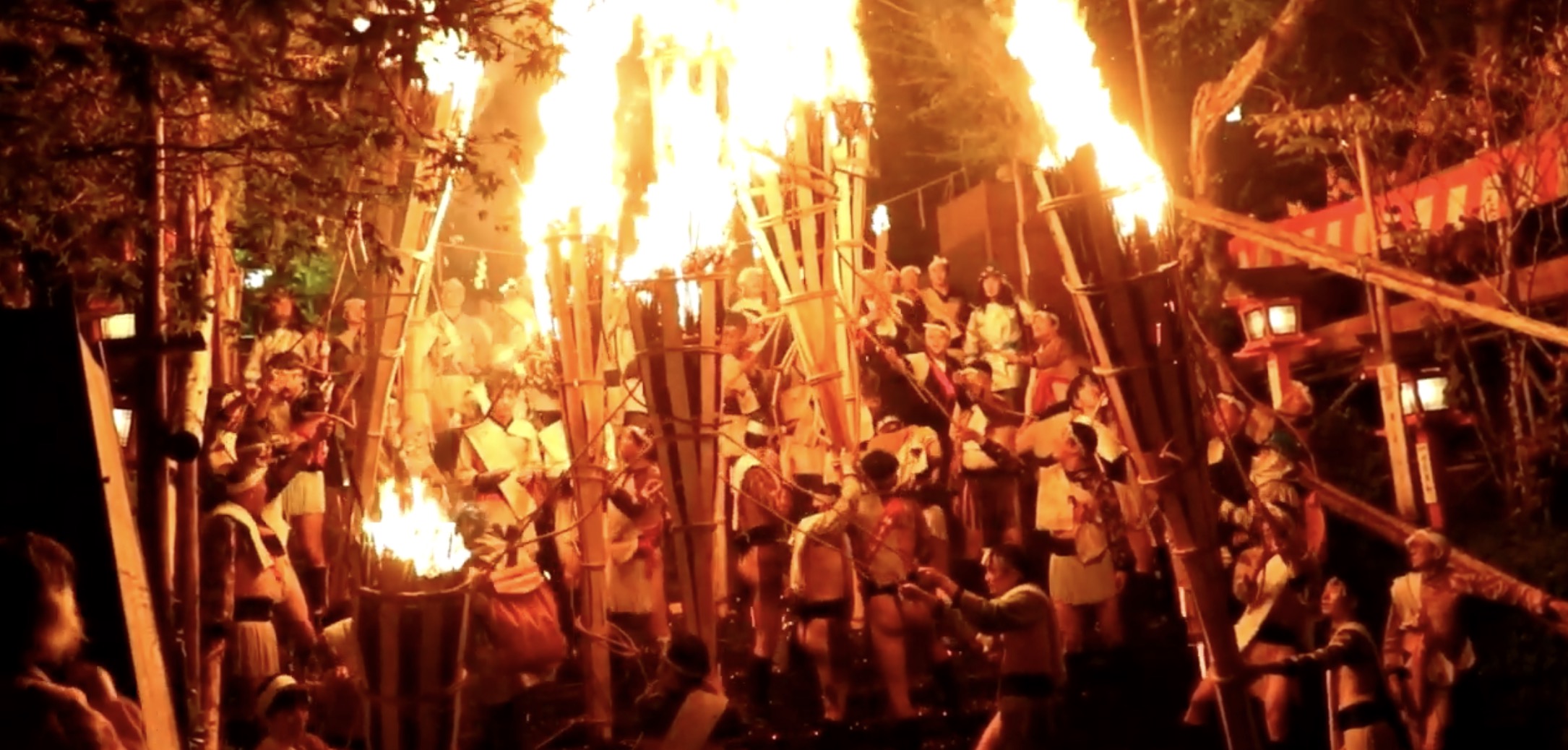
As late October wraps the ancient capital of Kyoto in deep autumnal mystery, blazing pillars of fire illuminate the nocturnal skies over the northern mountain hamlet of Kurama. Annually held on October 22 as the annual festival (Reisai) of Yuki Shrine (Kurama-honmachi, Sakyo Ward, Kyoto), the "Kurama Fire Festival" stands proudly as one of Kyoto's Three Great Curious Festivals—alongside the Yasurai Festival of Imamiya Shrine and the Bull Festival of Koryu-ji—and ranks among Japan's Three Great Fire Festivals.
Mount Kurama is deeply tied to the legend of Minamoto no Yoshitsune, who was spared execution in his childhood as Ushiwakamaru on condition of entering the Buddhist priesthood and was cloistered at Kurama-dera Temple, where he reportedly mastered swordsmanship from a mythical Tengu. Nestled within these sacred precincts lies Yuki Shrine.
On that very same date of October 22, the elegant and tranquil Jidai Matsuri (Festival of the Ages) winds through downtown Kyoto from the Imperial Palace to Heian Shrine in a graceful historical pageant. Yet as twilight settles over the capital, Mount Kurama awakens to a starkly contrasting realm of raw, primal flame and solemn prayer. What has drawn travelers to this fiery rite since the mid-Heian period in 940 AD? Here is the definitive guide to its historical origins, esoteric rituals, and practical advice for visitors.
[Kyoto Kurama Fire Festival 2026 (Yuki Shrine Reisai) Event Overview]
- Event Name: Yuki Shrine Reisai - Kurama Fire Festival
- Date: Thursday, October 22, 2026 (Held rain or shine)
- Festival Hours: Approx. 18:00 (Herald call & lighting) to past 24:00 (Kanko-sai return ritual on the morning of Oct 23)
- Location: Yuki Shrine Grounds and Kurama Kaido Highway (1073 Kurama-honmachi, Sakyo Ward, Kyoto City)
- Admission: Free viewing (Kurama-dera mountain maintenance fees or festival contributions may apply)
- Nearest Transit: Directly adjacent to Kurama Station on the Eizan Electric Railway Kurama Line (Approx. 6 min walk to Yuki Shrine)
- Traffic Restrictions: Full vehicle closure along Kurama Kaido from 15:00 onwards (No private cars, taxis, or rentals allowed; strictly no parking)
- Last Train: Eizan Railway Kurama Station departing for Demachiyanagi: Final train at 23:24 (Boarding restrictions apply during peak congestion)
A Torrent of Flame Piercing the Night! Highlights of Kurama Fire Festival 2026#
The Kurama Fire Festival commences with a dramatic transformation as a serene mountain village is instantly enveloped in roaring crimson flames. At 6:00 PM, a herald adorned in traditional Heian-period kariginu robes raises the rhythmic cry: "Shinji ni mairasshare!" (Come forth to the sacred rites!). With this proclamation, the piles of pine firewood known as "Eji" (hearth bonfires) stacked at the eaves of every house along Kurama Kaido are ignited all at once.
Columns of fire burst forth along both sides of the street, piercing the darkness and filling the crisp autumn air with cedar smoke and crackling heat. First into the fray are young boys dressed in traditional shimeshi (loincloths), hoisting small torches called tokkuri torches while shouting clear, high-pitched chants of "Sairei, sairyo!" (Sacred festival!). As anticipation mounts, local young men take to the streets hoisting colossal "O-taimatsu" (great torches).
These massive torches measure nearly a meter in diameter at the base, stretch three to four meters in length, and weigh between 80 and over 100 kilograms. Bearing these flaming behemoths upon their shoulders and showering in red-hot embers, the muscular youths present an awe-inspiring spectacle. The thundering shouts of "Sairei, sairyo!" harmonize with the deep cadence of wardrums echoing through the valley, driving spectator excitement to its peak.
The festival reaches its supreme climax shortly after 8:00 PM. Dozens of monumental torches converge from across the village upon the steep stone stairway leading to the Sanmon Gate of Kurama-dera Temple. The packed stone steps become a veritable "wall of fire" illuminating the autumn canopy in brilliant scarlet. Amid this overwhelming conflagration, the festival pivots from flaming torches to the sacred palanquins.
Over a Millennium Since Tengyo Chaos! Yuki Shrine Guarding the Capital's Gateway#
The fervent devotion and solemn atmosphere of the Kurama Fire Festival stem from dramatic events in early medieval history. Let us turn the clock back over a millennium to the mid-Heian period in the year 940 (Tengyo 3).
At that time, the Imperial Court in Heian-kyo (ancient Kyoto) trembled under unprecedented social turmoil. In the east, warlord Taira no Masakado launched an uprising declaring himself the "New Emperor," while Fujiwara no Sumitomo rebelled across the Seto Inland Sea in the Tengyo Rebellion. Plagued by devastating earthquakes and ominous celestial portents, citizens feared the downfall of the realm. To pacify these upheavals, Emperor Suzaku decreed that the guardian deity Yuki Daimyojin, traditionally enshrined within the Imperial Palace, be relocated to the northern demon gate (Kimon) in Kurama to guard the capital against evil spirits.
On the night of September 9, 940, the grand nocturnal relocation took place. Reed torches bundled from the banks of the Kamo River illuminated the dark pathways, while bonfires burned along the mountain trails as court nobles and warriors processed in a solemn imperial cortege spanning ten cho (roughly one kilometer). Deeply moved by this divine spectacle, the villagers of Kurama resolved to preserve the sacred memory of the procession and the protection of Yuki Daimyojin. This reenactment blossomed into the Kurama Fire Festival we witness today.
During the Momoyama period, warlords continued to revere the shrine. In 1607, Toyotomi Hideyori reconstructed the main hall and the distinctive Haiden (Worship Hall). This hall features an open central passageway known as "Wari-haiden" (split worship hall), a masterpiece of Momoyama architecture designated as an Important Cultural Property of Japan. Furthermore, the shrine's sacred Komainu (guardian lions) are uniquely depicted cradling lion cubs—a rare feature in Japan that attracts worshippers praying for safe childbirth, healthy offspring, and protection from fire.
Passage Rites and Safe Childbirth! The Esoteric Choppen Ceremony and Mikoshi Descent#
The Kurama Fire Festival is far more than a visual spectacle of flames; woven into its core are male rites of passage and sacred prayers by village women for safe childbirth and continuous lineage.
Once the immense torches assemble before the stone staircase of the Sanmon Gate, the "Shimenawa-kiri" (sacred rope-cutting ritual) is solemnly executed. At the cue of a drumroll, the sacred shimenawa rope strung between green bamboo stalks is severed with a ceremonial sword, breaking the boundary between sacred and secular realms. At this signal, the torches are extinguished and the festival transforms dynamically from flame to divine palanquins, as two mikoshi—bearing the deities Hassho Daimyojin and Yuki Daimyojin—begin their descent down the sheer stone steps.
It is during this dramatic moment that the festival's most iconic ritual unfolds: the "Choppen Ceremony." As the mikoshi navigates the steep stairs, two young men cling to the tips of the front carrying shafts (naga-e), spreading their legs wide in an inverted "V" position. Supported from beneath by fellow bearers while village maidens pull brake ropes from behind to prevent runaway descents, this perilous ordeal has long served as a coming-of-age test marking a youth's transition into full adulthood in the Kurama community. The resolute faces of the young men and the gasps of the onlookers fill the air with palpable tension.
Equally remarkable is the trailing procession of village women holding the long ropes attached to the back of the mikoshi. Because descending the steep, slippery incline requires immense control, local maidens have traditionally hauled these trailing ropes as human brakes. An ancient folk belief holds that pulling this divine rope guarantees easy and safe childbirth, prompting unmarried women and newlyweds to grip the ropes firmly. The convergence of masculine fire and feminine prayers for the continuation of life elevates the Kurama Fire Festival to incomparable cultural beauty.
Comparative Analysis: Three Great Fire Festivals and Curious Festivals of Japan#
While Japan boasts countless fire festivals and eccentric rituals, the Kurama Fire Festival is one of the few celebrations honored both as one of Kyoto's Three Great Curious Festivals and Japan's Three Great Fire Festivals. The table below highlights its distinctive anthropological character in comparison with related celebrations.
| Comparison | Kurama Fire Festival (Kyoto / Yuki Shrine) |
Imamiya Yasurai Matsuri (Kyoto / Imamiya Shrine) |
Nachi Fire Festival (Wakayama / Kumano Nachi) |
|---|---|---|---|
| Character | Three Great Fire & Curious Festival (Imperial relocation & demon warding) |
Kyoto Three Great Curious Festival (Cherry blossom pestilence warding) |
Japan Three Great Fire Festival (Kumano waterfall purification ritual) |
| Date | Annually October 22 (Night) | Second Sunday of April | Annually July 14 |
| Primary Symbols | 100 kg great torches Two mikoshi & Choppen ritual |
Red & black demon dances Floral umbrellas & chanter drums |
12 giant pine torches (50+ kg) 12 sacred fan shrines (6 m high) |
| Ritual Setting | Narrow Kurama mountain street & stone stairs (Wall of fire in intimate hamlet) |
Murasakino city streets to shrine grounds (Urban procession under spring blooms) |
Primeval Nachi forest & 133 m waterfall (Immense natural sanctuary) |
| Participant Roles | Boys with small torches, youths with giant poles, maidens pulling brakes | Local youth acting as demons and canopy bearers to ward off plagues | White-clad ascetic men purifying the sacred fan shrines with fire |
| Folkloric Beauty | Raw primeval energy, nocturnal imperial memory, and youth initiation | Graceful urban ritual capturing wandering spirits beneath floral canopies | Integration of Shinto nature worship, Shugendo ascetics, and water-fire fusion |
Whereas the Yasurai Festival at Imamiya Shrine features an elegant, subtle magic luring wandering pestilence spirits into flower-adorned canopies during spring, the Kurama Fire Festival represents an imposing, martial nocturnal rite designed to transport palace deities into rugged northern peaks. Moreover, unlike the Nachi Fire Festival held before a pristine primeval waterfall, Kurama's ceremony unfolds directly beneath the eaves of wooden homes. This breathtaking intimacy—where everyday residential lanes transform into a mythical river of flame—constitutes the quintessential charm of Kurama.
Mastering Crowd Control and Safety! Essential Rules for Attendees#
While tens of thousands of visitors flock to the Kurama Fire Festival annually, the venue along Kurama Kaido is a narrow mountain corridor merely a few meters wide. In recent years, strict security measures and directional pedestrian controls have been enforced to guarantee public safety. Here are vital tips to ensure an enjoyable and trouble-free visit.
[Essential Safety Guidelines and Rules for Kurama Fire Festival Viewers]
- Strictly No Private Vehicles or Rentals: Beginning at 15:00, all roads surrounding Kurama Kaido are closed to general vehicular traffic. There are zero public parking lots, and illegal parking is strictly impounded. Travel exclusively via the Eizan Electric Railway.
- No Stopping and Strict One-Way Flow: Police and festival marshals enforce a strict, continuous one-way pedestrian routing throughout the village. Lingering in one spot, moving backward, or setting up camera tripods is strictly prohibited. Keep moving smoothly along with the crowd flow.
- Clothing Protection Against Embers: Because spectators walk in close proximity to massive flaming torches, sparks and red-hot embers rain down constantly. Synthetic fabrics (nylon, polyester, fleece) melt instantly upon contact with sparks. Wear natural, flame-resistant materials such as heavy cotton, denim, or wool, and wear a hat or hood.
- Cold Weather and Sturdy Footwear: In late October, Mount Kurama is 4 to 5 degrees Celsius colder than downtown Kyoto, with temperatures dropping near freezing after dark. Dress in warm thermal layers and wear comfortable walking shoes or sneakers suited for steep stone stairs and slopes.
- Return Trip Congestion and Final Trains: Kurama Station faces massive queues of several thousand people after 21:00, with waits exceeding 1 to 2 hours to board. While the last train from Kurama to Demachiyanagi departs at 23:24, station entry restrictions may leave lategoers stranded. Departing between 21:00 and 21:45 is strongly advised.
Access relies on the Eizan Electric Railway Kurama Line from Demachiyanagi Station, which connects directly with the Keihan Main Line. While trains run frequently under a special "Fire Festival Timetable," long boarding lines form at Demachiyanagi from mid-afternoon. Arriving in Kurama between 15:00 and 16:00 is ideal for avoiding the worst transit crushes.
Gateway Flavors and Autumn Delights! Local Delicacies and Sacred Sights#
Along with the thrill of fiery rites, Kurama offers rustic mountain delicacies and serene autumn heritage nurtured by pristine mountain waters.
Kurama's signature gourmet delicacy is "Kinomedaki" (simmered kelp with sansho pepper buds). Crafted by simmering kombu kelp and young Japanese pepper buds over gentle flame, Kinomedaki balances savory umami with a refreshing, tingling aroma—an exquisite accompaniment to warm rice or sake. Traditional tsukudani shops with centuries of history line Kurama Kaido, welcoming visitors in search of authentic local gifts.
Around the entrance to Kurama-dera, charming teahouses serve chilled handmade zaru soba, tender yuba (tofu skin), and freshly toasted Tochimochi (horse chestnut rice cakes). Arriving early in the afternoon allows travelers to explore the sacred halls of Kurama-dera and the mysterious Okunoin Mao-den—where young Ushiwakamaru trained—before traversing the cedar root trails leading over the mountain to Kifune Shrine for an unforgettable Kyoto autumn experience.
[Sources]#
- Kyoto Kurama Yuki Shrine Official Website: "Annual Festival - Kurama Fire Festival"
- Kyoto City Tourism Association: "Kyoto Tourism Navi - Kurama Fire Festival"
- Eizan Electric Railway Co., Ltd. Official Notice: "Train Operations and Safety Guidelines for Kurama Fire Festival"