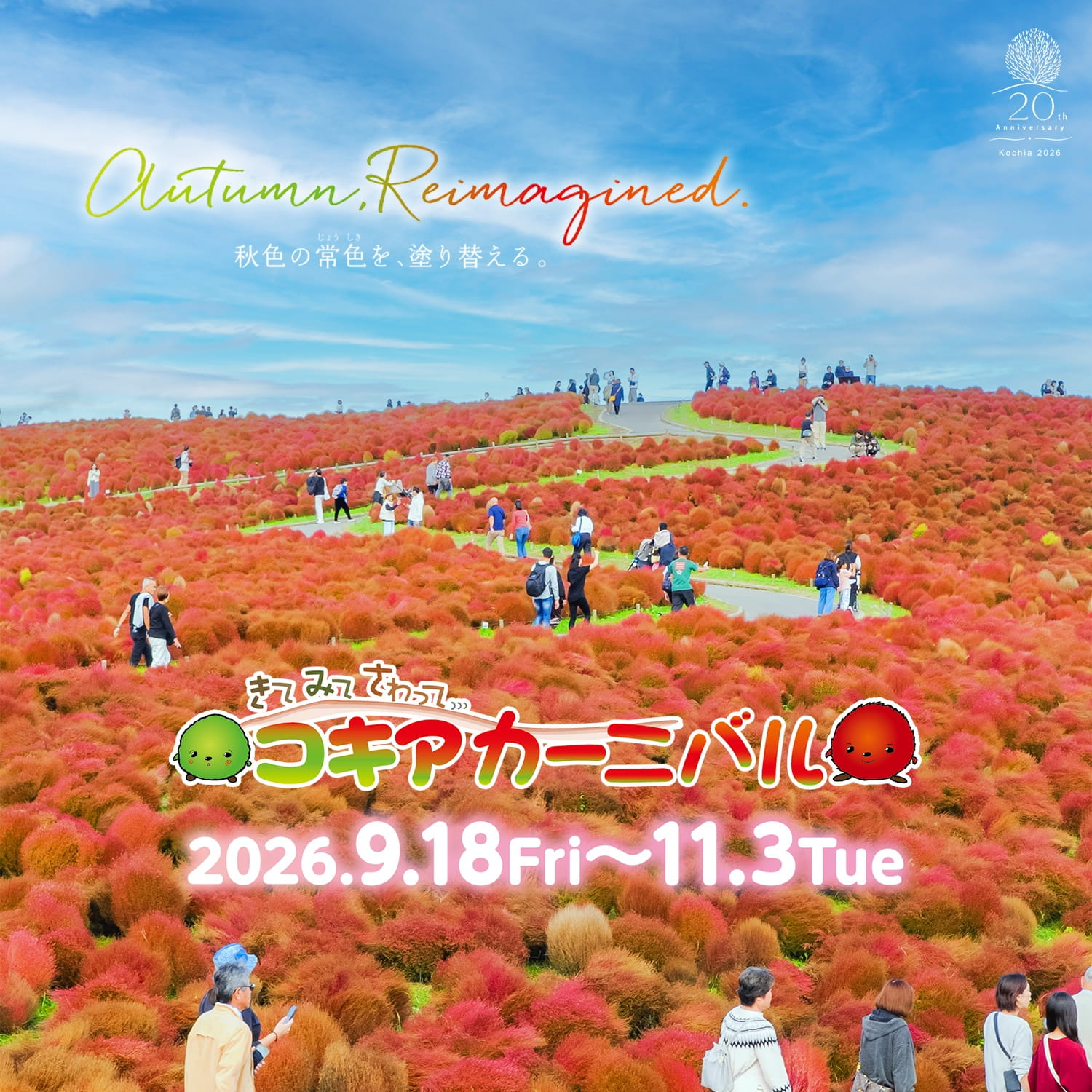
A breathtaking autumn hallmark illuminating Hitachinaka City, Ibaraki Prefecture, the "Come, See, Touch: Kochia Carnival 2026" at Hitachi Seaside Park is currently held from Friday, September 18 to Tuesday (National Holiday), November 3, 2026. While the lush green kochia of September is charming, nothing compares to mid-October, when the vast Miharashi Hill is blanketed in vivid crimson by round, adorable kochia under clear autumn skies—welcoming the most awe-inspiring scenic season of the year.
In particular, 2026 marks a monumental milestone: the 20th anniversary since experimental kochia planting first began in the autumn of 2005. From refreshing lime green in early summer, to gentle green-and-red gradients in early autumn, and finally fiery crimson at peak season, kochia transforms dramatically by the day. Behind this grand panorama lies the solemn history of land reborn from a military bombing range into a beacon of peace, and the passionate dedication of park staff cultivating roughly 40,000 seedlings entirely by hand.
[Hitachi Seaside Park Kochia Carnival 2026 Event Overview]
- Event Name: Come, See, Touch: Kochia Carnival 2026
- Event Period: Friday, September 18, 2026 – Tuesday (National Holiday), November 3, 2026 *Open every day during the event
- Operating Hours: 9:30 AM – 5:00 PM (Gates may open earlier depending on weather and crowds)
- Peak Foliage Period: Crimson peak around Saturday, October 10 – Tuesday, October 20; golden amber gradient from late October
- Location: Hitachi Seaside Park, Miharashi Hill & Miharashi Village (605-4 Onuma, Mawatari, Hitachinaka City, Ibaraki Prefecture)
- Admission (Seasonal Rate Period: Oct 9 – Nov 3): Adults (high school and older) 800 yen, Seniors (65+) 560 yen, Junior high and younger Free
- Regular Admission: Adults 450 yen, Seniors 210 yen, Junior high and younger Free
- Parking Fee: Standard vehicles 600 yen/day (West Parking is closest to Miharashi Hill)
Crimson Earth Miracle! Highlights of Kochia Carnival 2026#
The park's iconic "Miharashi Hill" stands at an elevation of approximately 58 meters, making it the highest point in Hitachinaka City. Climbing the hill while feeling refreshing ocean breezes from the Pacific, an overwhelming world of autumn color unfolds before your eyes with roughly 40,000 kochia bushes. This fluffy crimson ocean rolling seamlessly from your feet toward the horizon enchants travelers from around the globe.
The greatest highlight of the 2026 Kochia Carnival is the commemorative new layout celebrating 20 years of planting. The planted area has been expanded seamlessly from the slopes of Miharashi Hill down into the traditional farmstead area of "Miharashi Village" (if memory serves, buckwheat was planted there in the past). This allows the red carpet of kochia to rise dynamically from rustic village scenes all the way to the hill's summit, offering a panoramic vista with unprecedented depth and scale.
Another captivating feature of kochia is its kaleidoscopic color transition. From refreshing green in late summer, leaf tips begin blushing red in late September, forming an intriguing mosaic of red and green. By mid-October, the entire hill erupts in flaming scarlet, and between late October and early November, the bushes turn to warm amber and golden brown under setting sunbeams (fans of Nausicaä would surely want to photograph this saying, "Alight upon a golden field!"). Whichever timing you choose, a once-in-a-lifetime encounter with nature awaits.
Furthermore, do not miss the companion blooms painting the foot of the hill. Around 2.7 million golden-yellow and orange cosmos, accompanied by pink and white garden cosmos and pure white buckwheat flowers, frame the kochia fields. The vivid contrast between crimson kochia, radiant golden cosmos, delicate white blooms, and clear blue autumn skies creates scenery worthy of a master painting.
From Military Range to Symbol of Peace! The Tumultuous History of Miharashi Hill#
Today, visitors from across Japan and abroad gather with smiles to admire radiant floral displays, but the ground beneath Hitachi Seaside Park holds deep scars and memories of wartime conflict.
In 1938 (Showa 13), the Imperial Japanese Army established the Mito Army Airfield (Mito Higashi Airfield) on this site. Functioning as a major military hub for aviation training and pilot instruction, it witnessed fierce wartime air strikes toward the end of World War II. Following Japan's defeat in 1946 (Showa 21), the installation was requisitioned by the Allied Forces and transformed into the US Military Mito Air-to-Ground Bombing Range.
Throughout the Cold War, fighter jets and bombers conducted relentless strafing runs and dummy bombing drills over the range daily. Deafening roar, tremors, and the constant threat of errant bombs or misfires terrified nearby residents for decades, shattering peaceful life. Amid these hardships, local citizens rallied together, launching a persistent civil movement demanding the removal of the bombing range and the return of their ancestral homeland to regain peaceful living.
Following half a century of struggle, on March 15, 1973 (Showa 48), the Mito Bombing Range was finally returned in full to the Japanese government. Following the return, local communities united behind a heartfelt pledge: "Let this scarred land, once struck by explosives and blanketed in smoke, never become an instrument of war again; transform it into a symbol of peace where citizens can find solace and celebrate the radiance of life." Through a Cabinet decision, construction of a premier national park began.
Miharashi Hill, where kochia now blooms triumphantly, is itself a monument to peace. Originally flat coastal dunes pockmarked with bomb craters, roughly 200,000 large dump truck loads of surplus construction soil from Ibaraki public works were brought in, sculpted over approx. 25 years! to create this 58-meter artificial hill. Rising above wartime shadows to overflow with greenery and flowers, the hill stands as an enduring beacon of peace and hope.
Craftsmanship and Civic Bonds! 40,000 Seedlings with Passion#
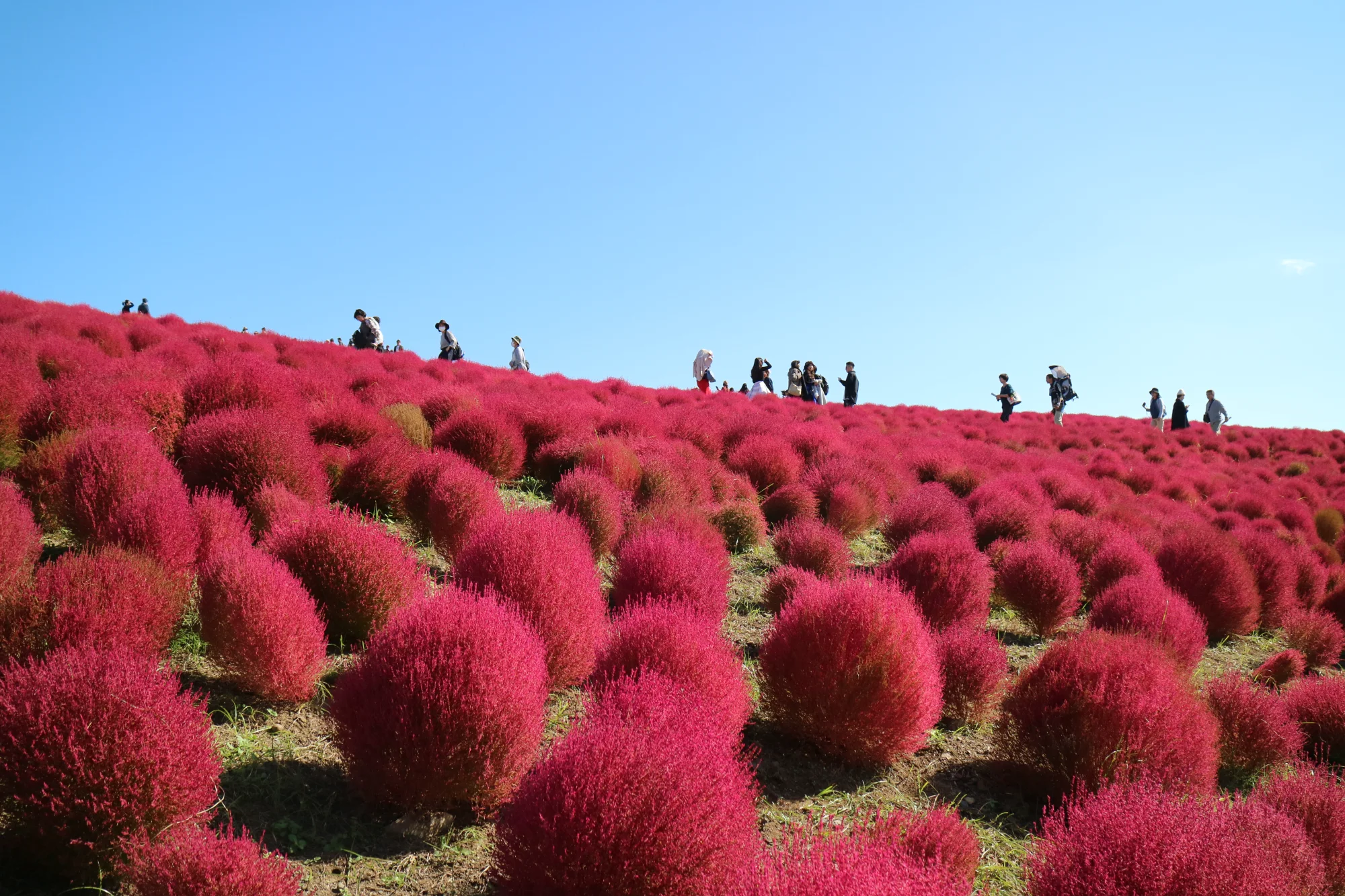
While celebrated alongside springtime blue nemophila, kochia cultivation is relatively recent in the park's history. With extensive black pine forests dominating the coastal grounds, few trees turned red in autumn, posing an aesthetic challenge for seasonal expression. Dedicated park staff sought to offer visitors the joy of autumn's onset, setting their sights on vibrant kochia.
In autumn 2005, the project commenced with an experimental planting of just 4,500 seedlings on the eastern slope of Miharashi Hill. In coastal sandy soil exposed to harsh sea winds and drought, staff experimented tirelessly with cultivation methods, organic fertilizer blends, and soil conditioning. Their diligence flourished, expanding to a 50,000-bush display in 2007, and now celebrating 20 years in 2026.
Behind Miharashi Hill's grandeur lies meticulous craftsmanship rather than automated machinery. In early summer, between June and early July after nemophila concludes, the soil is tilled. All 40,000 kochia seedlings are planted one by one by hand by park staff, volunteers, and local school children.
Guide ropes are stretched across slopes at 70-centimeter intervals to map precise positions, ensuring harmonious sweeping contours as they grow. Notably, the park's kochia naturally forms neat spherical domes because of a unique variety specially bred for the park by a seed company, rather than manual topiary clipping. Seedlings measure merely 15 cm when planted. Since kochia is remarkably drought-tolerant, staff thoroughly water plants during initial planting but withhold subsequent watering to foster robust natural roots. Under scorching summer heat, staff weed manually across vast slopes and shield seedlings from typhoons. The resulting plush green spheres reaching 70–100 cm in autumn are a masterpiece of fine botanical breeding and human love.
※The photo shows kochia from a few years ago under glorious clear skies—absolutely splendid!
Autumn Floral Spectacles in Kanto: Kochia, Red Spider Lily, and Cosmos Compared#
Autumn in Japan is a celebratory season when diverse flora blossom across regions. In the Kanto area, three iconic floral wonders draw nationwide admiration: Hitachi Seaside Park's Kochia, Kinchakuda's Red Spider Lilies (Manjushage) in Hidaka City, Saitama, and Showa Kinen Park's Cosmos in Tachikawa City, Tokyo.
| Feature | Hitachi Seaside Park (Kochia) |
Kinchakuda Park (Red Spider Lily) |
Showa Kinen Park (Cosmos) |
|---|---|---|---|
| Location | Hitachinaka, Ibaraki | Hidaka, Saitama | Tachikawa / Akishima, Tokyo |
| Primary Flora | Kochia (Bassia scoparia) | Red Spider Lily (Lycoris radiata) | Cosmos & Yellow Cosmos |
| Scale / Count | Approx. 50,000 plants (~2.0 ha) | Approx. 5,000,000 blooms (~5.3 ha) | Approx. 4,000,000 blooms (3 fields) |
| Peak Viewing | Mid-October (Green, Red, Gold) | Mid-Sept – Early Oct | Late Sept – Late Oct |
| Topographic Depth | ★★★★★ (58m hill & ocean panorama) |
★★★☆☆ (Flat groves along Koma River) |
★★★★☆ (Expansive open plains & knolls) |
| Color Harmony | Crimson carpet & golden cosmos | Mystical scarlet beneath tree shade | Gentle pink, white, and yellow sheets |
| Core Charm | Spherical 3D form & color change | Enchanting shapes & tranquil river | Superb access from central Tokyo |
Comparing these three reveals unique attractions. Kinchakuda's 5 million red spider lilies bloom along the curves of the Koma River (which Kuro-usagi covered on this blog as well, haha!), creating a mystical realm in dappled sunlight. Showa Kinen Park's cosmos fields offer convenient Tokyo access and breezy open vistas favored by families and couples.
Hitachi's kochia stands apart through unmatched three-dimensional depth and dynamic color shifts. Nestled along the rolling contours of Miharashi Hill against blue skies, views transform with every step and elevation. Each plant acts as an independent fluffy sculpture, producing rolling crimson waves rarely matched anywhere in the world.
Savor Autumn in Ibaraki! Kochia Sweets and Regional Delicacies#
After strolling Miharashi Hill, indulging in park-exclusive autumn treats is essential. Park cafes serve photogenic menus inspired by crimson kochia.
The runaway favorite is the Marukoro Kochia Soft Cream. Replicating round kochia, its tart strawberry flavor offers refreshing zest, topped with traditional puffed rice sweets (oiri) for delightful crunch and colorful charm.
Autumn desserts celebrating Ibaraki specialties abound. Lakeside Cafe at the West Gate serves Hitachi Sweet Potato Soft Cream, topping rich Hokkaido dairy cream with bite-sized local sweet potato cubes. Visitors can also enjoy Ibaraki Andes Melon Cream Soda celebrating Japan's top melon producing prefecture, and fresh-baked sweet potato baumkuchen.
Beyond the park, culinary delights await. Just 10 minutes away by car, Nakaminato Fish Market offers fresh seasonal Pacific catches, autumn bonito, and massive fresh rock oysters on the half shell. Farm-raised Hitachi Wagyu beef steaks and sweet dried potato (hoshi-imo) farm shops allow visitors to savor the bounty of food-rich Ibaraki.
※Heading a bit further south brings you to Oarai Seafood Market, which Kuro-usagi frequents quite often, though it is slightly further away.
Visitor Guide: Navigating Crowds and Transportation#
During peak autumn foliage, hundreds of thousands of guests visit the park. Planning ahead is key to a smooth, relaxing excursion.
[Key Tips and Etiquette for Visitors]
- Parking Choice: West Gate / West Parking is closest to Miharashi Hill. Using West Parking drastically reduces walking time to kochia fields.
- Optimal Timing: Peak congestion occurs between 11:00 AM and 2:00 PM. Visiting right at opening (9:30 AM) or after 3:00 PM when kochia glows golden in late afternoon light is highly recommended.
- Park Transit: The park spans an expansive area equal to 46 Tokyo Domes. Take advantage of the Seaside Train (1-day pass) or rental bicycles for effortless exploration.
- Footwear: Miharashi Hill features gentle inclines. Comfortable walking sneakers are strongly advised.
For train travelers, JR Katsuta Station on the Joban Line is the main gateway. Frequent shuttle buses run from Katsuta Station East Gate directly to the park's West Gate in roughly 15 minutes. On select autumn weekends, JR East operates non-stop limited express trains such as the "Zekkei Aka-Kochia" directly from major Tokyo metropolitan stations.
For drivers, the park is directly accessible from Hitachi Seaside Park IC via the Kitakanto Expressway and Hitachinaka Toll Road. During peak October weekends, expect traffic near highway exits; consider taking the Hitachinaka IC exit or arriving early in the morning for seamless transit.
[Sources & References]#
- Hitachi Seaside Park Official Website
- Hitachi Seaside Park: Flora Guide - Kochia
- Ibaraki Tourism Guide: Hitachi Seaside Park Kochia Special