Kyoto Gozan Okuribi 2026: History & Viewing Guide
Discover Kyoto Gozan no Okuribi (Daimonji) on August 16, 2026. Learn its historical origins, the five mountain symbols, Goma wooden strips, and best viewpoints.
Held every year on August 16, "Kyoto Gozan no Okuribi" (Daimonji) is an essential traditional event marking the end of summer in Kyoto. While it is widely known alongside the Aoi and Gion festivals as a classic summer feature, it is not merely a tourist event. It is a solemn Buddhist ritual designed to guide the spirits of ancestors (Oshorai-san) back to the spirit world (the afterlife). The crimson flames lighting up the quiet ancient capital invoke ancestral gratitude and the preciousness of life. This guide details its history, the characteristics and schedule of the five mountains, the passion of the preservation societies, recommended viewing spots, and spectator manners for the 2026 event.
History and Origin: Mysterious Beginnings and Devotion
The origins of Gozan no Okuribi are wrapped in mystery due to the loss of historical records. Various theories exist, including its start by Buddhist priest Kobo Daishi (Kukai) in the early Heian period, by Shogun Ashikaga Yoshimasa to mourn his deceased son in the Muromachi period, or using calligraphy by Konoe Nobutada in the early Edo period.
Historical documentation clearly mentions Okuribi from the mid-Edo period. Guidebooks and diaries from that time depict citizens lighting fires on hills to send off spirits. Historically, people in Kyoto viewed mountains as boundaries between this world and the next, believing that ancestral spirits would follow the light of Okuribi to return safely to the afterlife.
Despite modernization, the tradition was carefully preserved through the Meiji, Taisho, and Showa eras, surviving a temporary suspension during World War II due to blackout regulations. Today, led by preservation societies, local residents and volunteers protect this intangible cultural asset as a vital piece of Kyoto's identity.
During the Daimonji lighting, a traditional custom involves reflecting the light of the fire in a bowl of cold water. Drinking it is believed to ward off illness, a practice called "Daimonji no Kagemizu."
The Five Mountains and Lighting Sequence: Sacred Symbols in the Night Sky
Gozan no Okuribi features six symbols (characters and shapes) lit sequentially on five mountains surrounding Kyoto. Each mountain has its own preservation society, and the shapes carry deep religious and cultural meanings.
| Seq | Mountain & Symbol | Time | Significance and Background |
|---|---|---|---|
| 1 | Daimonji (Nyoigadake) |
20:00 | 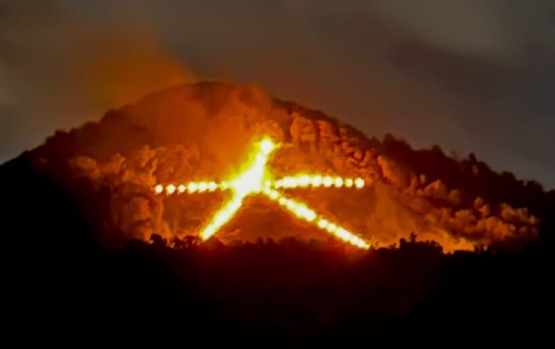 The most famous symbol, forming a giant "Dai" (large) character on Mt. Nyoigadake in Higashiyama. The fire spreads from the center ("Kanashira") to fill about 75 firebeds with flames. |
| 2 | Matsugasaki Myoho (Nishiyama/Higashiyama) |
20:05 | 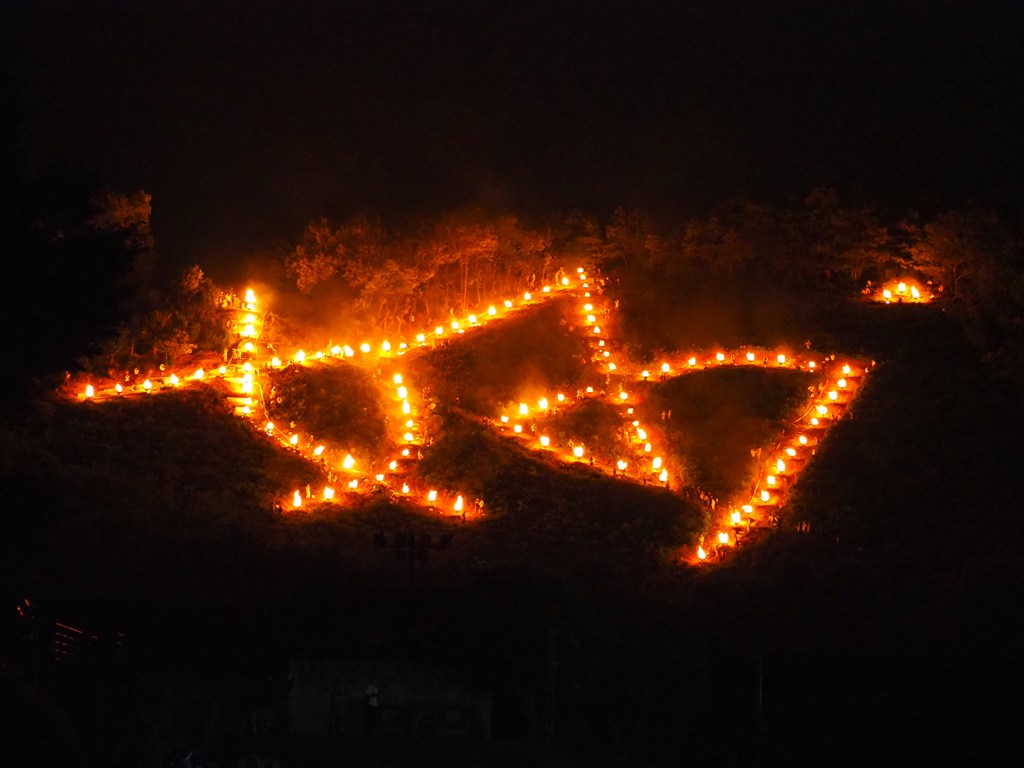 The characters "Myo" (on Nishiyama) and "Ho" (on Higashiyama) are lit as a pair. Based on Buddhist teachings, it started in the Kamakura period when villagers lit fires while dancing and chanting. |
| 3 | Funagata (Mt. Mantoro) |
20:10 | 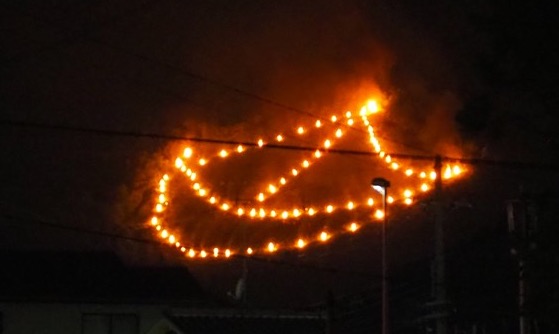 A ship-shaped fire appears on Mt. Mantoro in Kitayama. This represents the ship that brought Buddhist master Jikaku Daishi (Ennin) back safely from China under the protection of Aizen Myoo, symbolizing a vessel carrying spirits back to the afterlife. |
| 4 | Hidari Daimonji (Mt. Okitayama) |
20:15 | 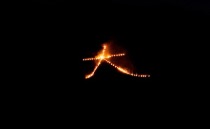 Located northwest of Kinkaku-ji temple, Mt. Okitayama lights up with a second "Dai" character. Firebeds arranged on the steep slope are lit quickly using torches carried up from a temple below. |
| 5 | Toriigata (Mt. Mandara) |
20:20 | 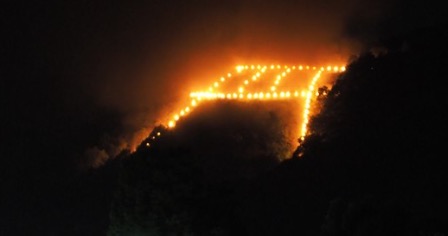 Mt. Mandara in the west shines with the shape of a Shinto torii gate. Modeled after the gateway to Atago Shrine, it represents the entrance to the spiritual world, appearing highly mystical due to its westernmost location. |
The lightings begin at 8:00 PM at 5-minute intervals. Once all mountains are lit, the night sky of Kyoto transforms into a solemn space of prayer. Each fire burns for about 30 minutes before slowly fading into the night.
Preservation Societies and Goma Wood: Columns of Fire Carrying Prayers
Maintaining this large-scale traditional event is the work of preservation societies. Composed of local families who have inherited the rights and management of the hills, they work with young volunteers for months. Carrying heavy pine firewood ("Matsu-wariki") up the mountains and maintaining firebeds requires immense effort.
Citizens and tourists can participate by writing prayers (for health, safety, etc.) or names of ancestors on wooden strips called "Goma-gi." These strips are burned together with the pine firewood on August 16. The prayers rise into the night sky as columns of fire, reaching the ancestral spirits.
2026 Viewing Guide: Recommended Spots and Features
Because Kyoto is in a basin, the fires can be seen from many areas. However, it is geographically impossible to view all fires from a single spot. It is essential to select a spot in advance based on which character you wish to view.
The main viewing locations and their visible symbols are listed below:
| Viewing Spots | Visible Symbols and Features |
|---|---|
| Kamogawa Banks (Marutamachi to Demachiyanagi) |
Daimonji (Higashiyama) The most popular spot, which gets very crowded. The reflection in the river and the dynamic view of Daimonji are stunning. |
| Kitayama Street (Shimogamo-nakadori to Matsugasaki) |
Myo & Ho A close-up view of the "Myo" and "Ho" characters. Viewing them from the north side of the street looking upward is highly impressive. |
| Nishiooji Street (Kinkakuji to Saiin) |
Hidari Daimonji Perfect for looking up at Hidari Daimonji. The burning "Dai" character appearing between the buildings of Nishiooji is powerful. |
| Misonobashi & Kamigamobashi |
Funagata An excellent area to view the ship shape clearly from the front. From Kamigamobashi, you can also see Daimonji in the distance. |
| Arashiyama Togetsukyo & Hirosawa Pond |
Toriigata & Lantern Floating In Arashiyama, floating lanterns illuminate the water while the "Toriigata" shines on Mt. Mandara, creating a highly mystical scene. |
Manners and Safety Measures for 2026
While Okuribi is a popular sightseeing attraction, its essence is a solemn religious ritual. Spectators are asked to observe the following rules:
First, flash photography is prohibited, as it ruins the solemn visual atmosphere and disturbs others. Drone photography is strictly banned to prevent forest fires and avoid interfering with the lighting. Large-scale traffic restrictions apply across Kyoto, causing heavy road congestion. Please take your trash home and respect the local neighborhood.
For 2026, daytime heat is expected to be intense. Even for evening viewing, stay hydrated to prevent heatstroke. We invite you to spend a quiet evening witnessing the fires while reflecting on ancestral connections.