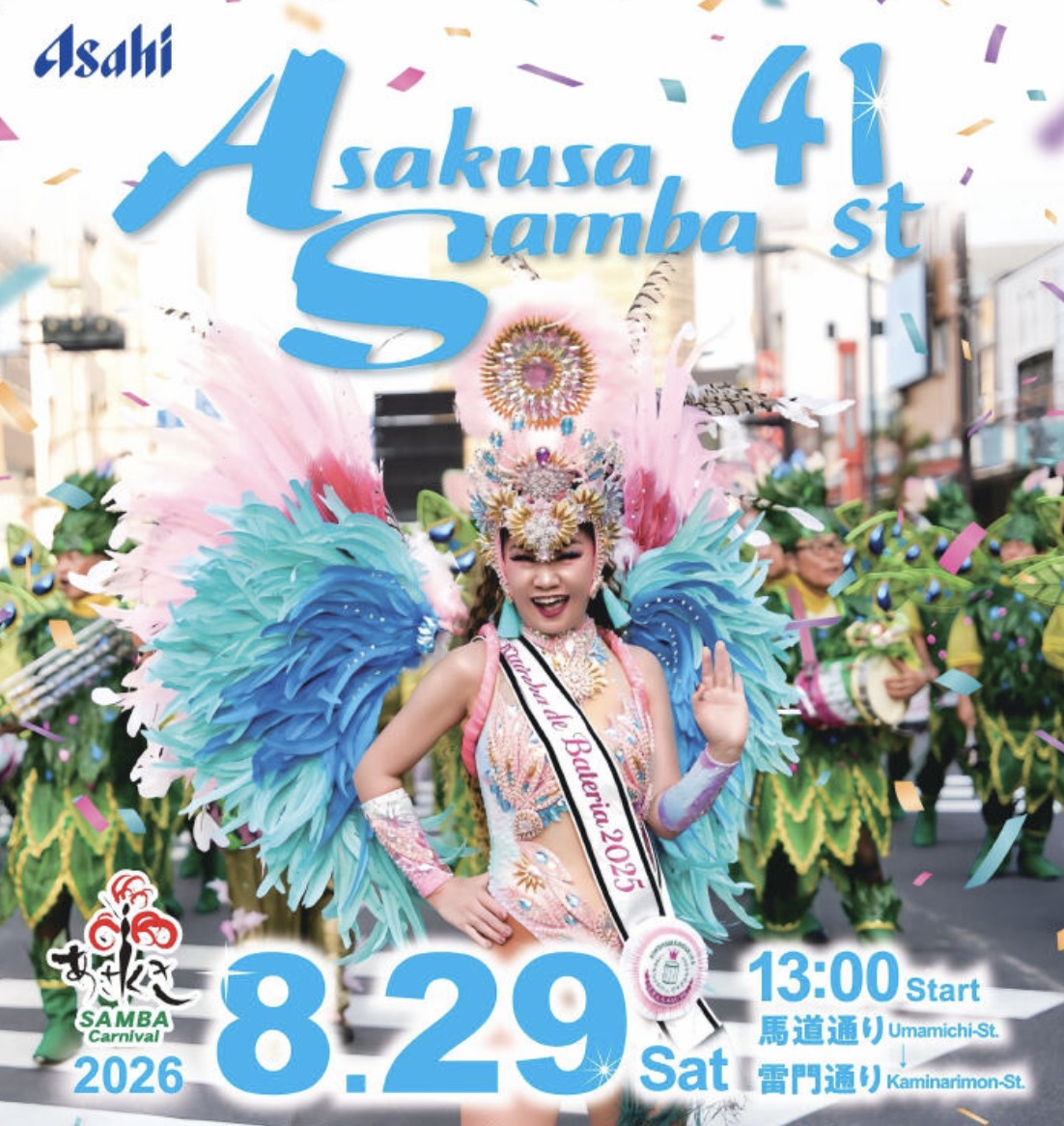
Exciting Asakusa Samba Carnival 2026! Held on August 29!
The 41st Asakusa Samba Carnival—which Kurousagi watched almost every year when living right behind Senso-ji Temple for 7 years—will be held on Saturday, August 29, 2026!
As a regular event marking the end of summer in Tokyo's Asakusa, the Asakusa Samba Carnival Parade Contest, known as one of the largest samba festivals in the Northern Hemisphere, will be held on August 29, 2026. Again this year, set against the main streets from Umamichi-dori to Kaminarimon-dori, elite samba teams gathered from all over the country will display gorgeous costumes, passionate music, and dynamic dances, wrapping Asakusa in a peak summer fever. We will introduce the historical trajectory of this unique festival, the latest news on the 2026 event, and key highlights of the parade contest.
Asakusa Samba Carnival 2026 Overview and Highlights
The 41st Asakusa Samba Carnival Parade Contest in 2026 is scheduled to start the parade sequentially from 1:00 PM on Saturday, August 29, with the main parade contest starting at 1:30 PM. The route goes through the heart of Asakusa from Umamichi-dori to Kaminarimon-dori, reaching a peak of excitement right in front of Kaminarimon Gate. Drawing roughly 500,000 spectators along the streets every year, this is not just a simple festival, but a serious competition where elite teams from all over Japan compete with pride and honor.
The main attraction of this year's contest is the unique world built by each team according to their theme, the "Enredo." Themes range from history and myths to science and daily events, with everything from song selection to costumes and float decorations woven into a single story. The quality of the giant float, the "Alegoria," crafted with passion by each team, and the amazing steps of top dancers who trained in Brazil, are breathtaking sights.
Rising from decline: The History of the Carnival's Birth#
The history of the Asakusa Samba Carnival is a story of rebirth and recovery of the old town of Asakusa. From the 1960s to the 1970s, due to the rapid spread of television and the diversification of leisure, visitors quickly drifted away from Asakusa's theaters and cinemas, which had been the center of Japanese entertainment. Seeking to revive the town, the mayor of Taito Ward at the time, Eiichi Uchiyama, stepped forward.
Mayor Uchiyama consulted with Junzaburo Ban, a popular comedy actor closely connected with Asakusa. In their talks, a highly unique idea emerged: "How about introducing a samba carnival as Asakusa's new specialty?" Combining the energetic, cheerful samba of Brazil with Asakusa, a historic town of old Edo atmosphere, faced opposition initially. However, the open spirit of Asakusa people to accept new cultures and turn them into entertainment supported the challenge.
In 1980, a research group visited Rio de Janeiro to study the real carnival, absorbing samba music theory, steps, float structures, and team organization. The very first Asakusa Samba Carnival took place the following year, in 1981. After early trials, Japanese samba lovers learned the culture deeply and merged it with Japan's precise staging, building it into the massive, globally acclaimed carnival we see today.
The S1 and S2 League System and Contest Structure#
The main driver of the carnival's intensity is its strict contest format and league system with promotions and demotions. Teams are classified into the top S1 League and the S2 League based on scale and skill, judged under rules modeled on Rio's system. Jurors include musicians, dancers, designers, and cultural figures, scoring theme expression, costume design, musical performance, and dance dynamics.
[Viewing Tips] Differences between S1 and S2 Leagues
The S1 League consists of large teams and mandates running a giant float, the "Alegoria." Each team displays high narrative value and dramatic staging. The S2 League features smaller, community-focused teams with close spectator contact, showing high agility and warmth without float requirements.
The table below summarizes the basic requirements and features of each league.
| League | Team Size | Key Features and Rules |
|---|---|---|
| S1 League | 150 to 300+ members | The highest league. Requires live performance of original theme songs and the creation of a giant Alegoria float. The lowest team is demoted to S2. |
| S2 League | 50 to 150 members | An amateur and community league. No float required, offering a cozy and free-style parade. The winner is promoted to S1. |
Roles in the Parade: Dancers and Musicians#
Knowing the specific roles in a samba team will make your parade viewing much more enjoyable. A team is not just a group of random dancers, but a highly structured unit advancing in perfect order.
- Passista: The stars of the team. Top solo dancers wearing gorgeous feather ornaments, captivate the crowd with high-speed steps.
- Bateria: The heartbeat of the samba, the percussion band. Instruments like the Surdo (bass drum), Caixa (snare), Tamborim (small frame drum), and Chocalho (shaker) unite to shake the ground.
- Puxador: The main vocalist singing the theme song from the sound system on the float, leading the entire parade with a powerful voice.
- Porta-Bandeira & Mestre-Sala: The couple carrying the team's flag (Porta) and her escort (Mestre), performing elegant steps with high evaluation scores.
- Baiana: A group of women wearing large round white skirts, representing the roots of samba from Bahia in northeast Brazil, spinning and dancing with respect to tradition.
A Bridge between Rio de Janeiro and Asakusa#
The Asakusa Samba Carnival faithfully brings Rio de Janeiro's culture to Japan while adapting it uniquely. In Rio, the carnival is held in a giant dedicated stadium, the "Sambadrome," with strict division between parade and spectators. In Asakusa, the streets serve as the stage, allowing the crowd to feel the breath and vibration of the dancers up close.
The acceptance and continuation of this South American festival in the temple town of Senso-ji for over 40 years shows the incredible diversity of Asakusa. The traditional spirit of the Sanja Festival and the samba fever coexist, making Asakusa a powerful tourist attraction for visitors from all over the world.
Safe Viewing, Heat Protection, and Etiquette#
Outdoor festivals are basic, so as severe heat is expected in late August in Tokyo, proper heat protection is essential. Wear hats and use parasols, and stay hydrated. Large traffic controls will be in place around Asakusa, so please follow staff directions.
When taking photos with cameras or smartphones, please respect other spectators and avoid blocking views, maintaining proper manners and privacy protection for dancers. Do not miss this great summer finale in Asakusa.