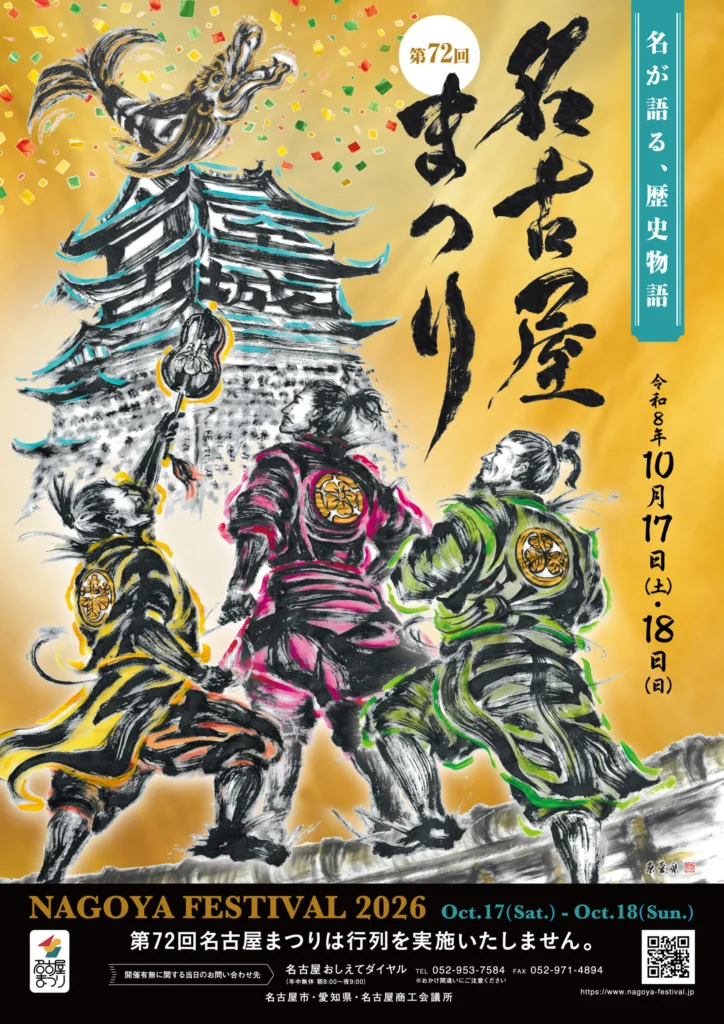
The 72nd Nagoya Festival, Owari Nagoya's largest and most celebrated autumn cultural extravaganza, will be held across two festive days on October 17 (Sat) and October 18 (Sun), 2026.
Tracing its heritage back over 70 years to the 1955 Nagoya Commercial and Industrial Festival, the Nagoya Festival celebrates the region's legendary Three Great Heroes—Oda Nobunaga, Toyotomi Hideyoshi, and Tokugawa Ieyasu—while showcasing the rich cultural legacy of the Owari Tokugawa clan. In 2026, as the schedule coincides with the Opening Ceremony and Torch Relay of the Aichi-Nagoya 2026 Asian Para Games, the traditional road parade will be suspended for safety and security. Instead, the festival will transform into an immersive, park-centered festival hosted at Hisaya-odori Park (Edion Hisaya Plaza and Angel Plaza).
This comprehensive guide details the special 2026 exhibition programs, historic origins, venue attractions, and free admission information for iconic local landmarks.
72nd Nagoya Festival (2026) Overview and Key Program Updates#
To ensure top-tier security and hospitality during the concurrent international games, the 2026 festival shifts from a street-marching parade to a concentrated park festival packed with interactive exhibits and cultural demonstrations.
・Dates: October 17 (Sat) – October 18 (Sun), 2026
・Main Venue: Hisaya-odori Park (Edion Hisaya Plaza, Angel Plaza, Ai Plaza, Sakae Hiroba)
・Additional Venues: Nagoya Castle and cultural facilities throughout Nagoya City
・Organizer: Nagoya Festival Promotion Association (Aichi Prefecture, Nagoya City, Nagoya Chamber of Commerce, etc.)
・Important Notice: The street parade (including the Three Great Heroes Procession) and open auditions for heroes will not take place in 2026. Consequently, no wide-area road closures for parades will occur.
Iconic highlights that traditionally delighted parade onlookers have been brought directly into Hisaya-odori Park for close-up viewing, photography, and interactive cultural appreciation.
| Feature | 2026 Special Program Details |
|---|---|
| Street Parade | Suspended (prioritizing safety and security for the Asian Para Games) |
| Three Heroes Floats | Special Exhibit in Hisaya-odori Park (up-close viewing and photo ops with Nobunaga, Hideyoshi, and Ieyasu floats) |
| Flower Cars | Park Display & Photo Spots (vibrantly decorated floral vehicles open for public viewing) |
| Traditional Dashi & Karakuri | Live Karakuri Puppet & Kagura Music Demonstrations (master artisan performances on stage) |
| Stage Events | Celebrity guest talk shows, Bon Odori dance gatherings, and samurai warrior troupe performances |
Origins and Heritage: From Post-War Recovery to Samurai Pride#
The Nagoya Festival originated in mid-20th-century Nagoya as the city rebuilt itself from wartime devastation.
1. Born as a Post-War Commercial Revival Festival#
In 1955, Aichi Prefecture, Nagoya City, and the local Chamber of Commerce jointly organized the "Nagoya Commercial and Industrial Festival" to revitalize local industry and uplift civic pride. The massive parades along Nagoya's grand boulevards were an enormous success, leading to the festival's renaming as the "Nagoya Festival" in 1956 and establishing it as Nagoya's premier autumn tradition.
2. The Legacy of the Three Great Samurai Unifiers#
Nagoya holds an unrivaled historical connection to the three warlords who unified feudal Japan: Oda Nobunaga was born in Nagoya Castle's predecessor (Nagoya Castle site/Nagoya area), Toyotomi Hideyoshi hailed from Nakamura, and Tokugawa Ieyasu constructed Nagoya Castle and the surrounding castle town. The festival's signature "Procession of the Three Heroes" features hundreds of armored warriors, samurai princesses, and foot soldiers.
3. Roots in Edo-Period Festivals: Toshogu, Wakamiya, and Tennosai#
The cultural foundation of the Nagoya Festival draws directly from the three grand Edo-period festivals sponsored by the Owari Tokugawa clan: the Toshogu Festival, Wakamiya Festival, and Sannomaru Tennosai. Intricately carved festival floats (Dashi) with mechanical clockwork puppets (Karakuri) and sacred Kagura music remain central to Nagoya's vibrant living heritage.
Hisaya-odori Park Main Venue Highlights & Special Attractions#
Throughout Hisaya-odori Park (Edion Hisaya Plaza, Angel Plaza, Sakae Hiroba), visitors can experience an array of continuous live entertainment and cultural festivities.
| Area & Program | Key Highlights and Program Details |
|---|---|
| Edion Hisaya Plaza Main Stage |
・Special talk show by Festival Ambassador Asaka Seto ・Live vocal performance by Special Supporter Kaori Mizumori ・Historical drama guest sessions (including Ukon Onoe) ・Martial arts demonstrations by the Nagoya Omotenashi Bushotai (Samurai Troupe) |
| Three Heroes Floats & Flower Car Display |
・Exclusive close-up display of the dedicated Three Heroes floats ・Elaborately decorated flower car photo spots ・Commemorative visitor photo zones |
| Traditional Culture Plaza (Angel Plaza) |
・Artisanal Karakuri mechanical puppet demonstrations ・Traditional Shinto Kagura flute and drum musical performances ・Grand evening community Bon Odori folk dance gatherings |
| Interactive Zones |
・Children's traditional festival game stalls and fair booths ・Historical mystery-solving puzzle rally: "The Ancient Scroll of the Three Heroes" ・Nagoya gourmet kitchen cars serving famous local cuisine (Nagoya-meshi) |
Free Admission to Nagoya Castle & City Cultural Facilities#
During festival weekend, Nagoya City offers free admission to its premier historical, cultural, and natural landmarks as a gesture of civic hospitality.
・Nagoya Castle (Honmaru Palace and Ninomaru Gardens) ※Regular adult admission ¥500 is FREE
・Higashiyama Zoo and Botanical Gardens (One of Japan's largest zoological parks) ※Regular adult admission ¥500 is FREE
・Tokugawaen (Classic Japanese stroll garden connected to the Owari Tokugawa family)
・Shirotori Garden (Expansive traditional Japanese garden in central Japan)
・Yoki-so Villa (Historic villa and heritage residence of Matsuzakaya's founder)
・Higashiyama Sky Tower
※Please check official facility websites for precise opening hours and guidelines.
Access and Visitor Guide#
1. Public Transportation Recommended#
Hisaya-odori Park is directly accessible from Nagoya Municipal Subway Sakae Station (Higashiyama and Meijo Lines), Yabacho Station (Meijo Line), and Meitetsu Sakaemachi Station. While no street closures for parades will take place in 2026, surrounding parking facilities fill rapidly, making subway transit the most convenient option.
2. Recommended Autumn Sightseeing Tour#
After enjoying live performances, Karakuri demonstrations, and regional culinary delights at Hisaya-odori Park, head over to the freely opened Nagoya Castle or Tokugawaen garden for an unforgettable autumn journey through samurai history.
【Sources】