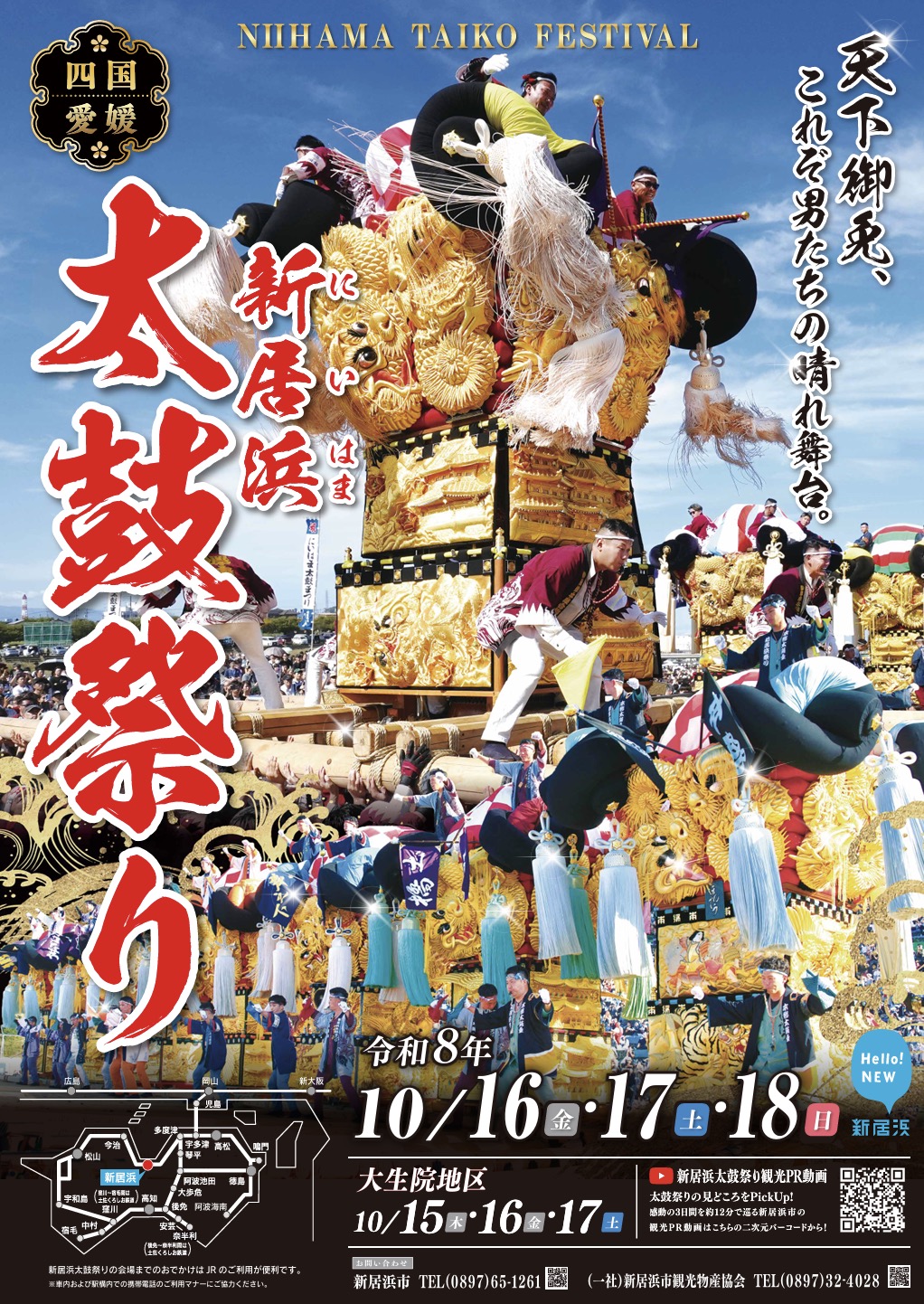
Ranked alongside Tokushima's Awa Odori and Kochi's Yosakoi as one of Shikoku's Three Great Festivals, the breathtaking autumn celebration of Ehime Prefecture, the Niihama Taiko Festival 2026, will be held across 3 exhilarating days from October 16 (Fri) to October 18 (Sun), 2026 (with festivities in the Oshima district on Oct 15–16).
Featuring 54 colossal drum floats called "Taikodai" adorned in elaborate 3D gold and silver embroidery depicting dynamic dragons and tigers, each float stands approximately 5.4 meters high and weighs nearly 3 tons. Known affectionately as the "Men's Festival" (Otoko Matsuri), teams of roughly 150 stalwart bearers known as "Kakifu" join forces to hoist these behemoths overhead in competitive tests of strength and unity called "Kakikurabe". This comprehensive guide explores the festival's heritage, structural artistry, venue schedules, and essential visitor tips.
What is the Niihama Taiko Festival? Heritage Born from the Besshi Copper Mine#
The origins of the festival date back to the Heian and Kamakura periods as an autumn harvest thanksgiving ritual offering prayers for bountiful crops and safe maritime hauls. While floats initially began as humble decorated carts escorting sacred Shinto palanquins (Mikoshi), they transformed drastically during the late Edo and Meiji eras.
The catalyst for the floats' modern magnificence was the development of the Besshi Copper Mine, once one of the world's most productive copper deposits, which catalyzed immense industrial prosperity under the Sumitomo enterprise. Wealthy merchants and spirited neighborhood youth competed fiercely in craftsmanship and prestige, embellishing their floats with thick gold bullion thread relief tapestries and masterwood carvings to create the moving museum pieces seen today.
・Dates: October 16 (Fri) – October 18 (Sun), 2026 (Oshima: Oct 15–16)
・Location: Across Niihama City, Ehime (Kawanishi, Kawahigashi, Jobu, Kawahigashi-Seibu, Ojoin, and Oshima districts)
・Total Floats: 54 Taikodai floats across all districts
・Key Highlights: Yamane Ground Grand Assembly, Ichinomiya Shrine Kakikurabe, Kokuryo Riverbed Assembly, Hachiman Shrine Finale
Anatomy of a Taikodai: Moving 3-Ton Masterpieces of Japanese Craftsmanship#
A Niihama Taikodai is a masterclass in traditional woodwork and textile embroidery. Constructing or restoring a single float can cost tens of millions to over 100 million yen.
| Component | Structure, Symbolism & Artistic Details |
|---|---|
| Tenmaku (Canopy) | The arched top curtain featuring red-and-white or blue-and-white sunburst stripes, symbolizing the heavens, clouds, and the cosmos. |
| Kukuri (Cushion Ring) | A massive cylindrical black padded ring wrapped directly beneath the canopy, stabilizing the float's high center of gravity during movement. |
| Fusa (Tassels) | Giant white decorative tassels hanging from the four corners, measuring 1.5 meters in length, swaying gracefully with every heave of the float. |
| Uwamaku & Kouranmaku (Embroidered Curtains) | Heavy relief tapestries woven with genuine gold and silver threads, depicting fierce dragons, tigers, eagles, and legendary warrior epics like the Genpei War. |
| Kakibou (Carrying Poles) | Four giant pine or cypress timber logs spanning 12 to 14 meters in length, shoulder-borne by 150 synchronized bearers. |
The Climax: The Power and Thrill of "Kakikurabe"#
The true essence of the festival is Kakikurabe, where teams detach transport wheels and lift the 3-ton structure entirely by human muscle power.
1. The Breathtaking "Sashiage" Overhead Hoist#
To the accelerating tempo of interior drums and whistles, bearers channel collective momentum to lift the 3-ton float from their shoulders directly overhead with locked arms. Sustaining this lift while swaying, pivoting, or throwing it momentarily into the air commands thunderous applause from the crowd.
2. United Multi-Float "Yose-Taiko" Lifts#
Neighboring teams lock their massive carrying poles tightly together to perform synchronized simultaneous lifts of 2 or 3 floats at once, displaying community pride and brotherhood.
Due to the immense 3-ton weight and rapid directional shifts during Kakikurabe, visitors must always remain behind security fences and follow marshals' instructions. Never cross active float transit lanes, and keep children close at all times.
Major Venues and Kakikurabe Schedule (October 16–18, 2026)#
The festival unfolds across multiple scenic venues including historic shrine grounds, riverbanks, and stadium arenas:
| Date | Key Venues & Events | Highlights & Participating Districts |
|---|---|---|
| Oct 16 (Fri) | Hagyu Temple, Aeon Mall Niihama & Naigu Shrine | Kicks off at dawn with sacred shrine departures, followed by nighttime illuminated float parades in commercial districts. |
| Oct 17 (Sat) | Yamane Ground Grand Assembly (Jobu District) | All 20 floats of the Jobu district gather on a natural grass arena. Simultaneous overhead lifts viewed from tiered hillside stands provide an unforgettable spectacle. |
| Oct 17 (Sat) | Kokuryo Riverbed Kakikurabe (Kawahigashi District) | Floats line the wide riverbanks at twilight, creating a dazzling display of golden lanterns reflecting off the river. |
| Oct 18 (Sun) | Ichinomiya Shrine Grand Finale (Kawanishi District) | The dramatic climax as Kawanishi floats enter sacred grounds beneath towering ancient camphor trees in an explosion of energy. |
| Oct 18 (Sun) | Hachiman Shrine Kakikurabe (Kawahigashi District) | Final passionate showdown among eastern district floats in the shrine precinct to conclude the three-day festival. |
Comparing Niihama to Japan's Other Legendary Festivals#
While Japan boasts countless traditional festivals, Niihama stands apart through its sheer physical scale and emphasis on pure carrying endurance:
- Contrast with Saijo Festival (Ehime): Neighboring Saijo features roughly 150 delicate wooden Danjiri floats accompanied by lantern processions and river-crossing rituals focusing on refined elegance, while Niihama focuses on heavy muscular power and vivid gold embroidery.
- Contrast with Kishiwada Danjiri (Osaka): While Kishiwada thrills spectators with high-speed cornering drifts, Niihama showcases raw stamina, maintaining a 3-ton float high above bearers' heads for extended durations.
Visitor Guide: Access & Real-Time Tracking App "Dondoko"#
・Train Access: JR Yosan Line to "Niihama Station". Dedicated shuttle buses connect directly to major festival arenas.
・"Dondoko" Float Tracking Web App: Access real-time GPS locations of all 54 active Taikodai floats directly on your smartphone.
・Accommodations: Hotels in Niihama fill up months in advance; consider staying in nearby Saijo, Imabari, or Matsuyama with JR express train connections.
Conclusion: Feel the Thunderous Energy of Shikoku's Premier Fall Festival#
From the booming cadence of massive drums to the fervent shouts of carriers and the gleaming radiance of gold embroidery, the Niihama Taiko Festival 2026 is an unforgettable embodiment of Japanese regional spirit and living cultural heritage.
【Sources】