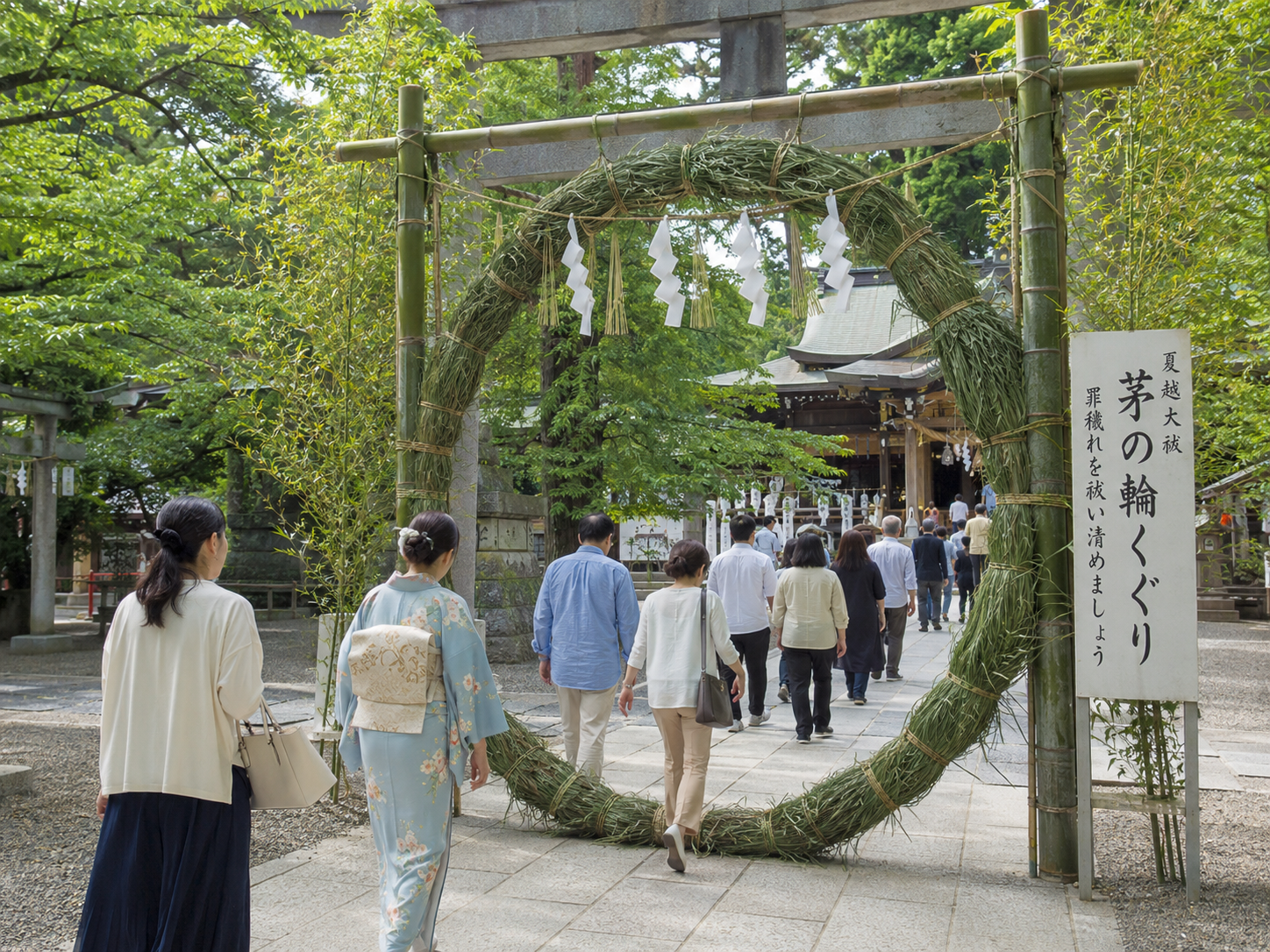
Do You Know Nagoshi no Harae? Secrets of the Shinto Cleansing Ritual
Shinto ritual Nagoshi no Harae is held on June 30 to cleanse impurities. Learn the history of Somin Shorai, the etiquette of Chinowa-kuguri, Hitogata-nagashi, and eating traditional Minazuki.
What is Nagoshi no Harae? A Traditional Shinto Ritual to Cleanse Half a Year of Impurities#
Nagoshi no Harae (夏越o祓) is an ancient and important Shinto purification ritual (Oharai) observed at shrines throughout Japan on June 30th, marking the exact midpoint of the year.
Since ancient times, Japanese people believed that daily life inevitably accumulates "kegare" (spiritual and physical impurities, literally meaning "withered spirit/energy") as well as unconscious sins and errors. Nagoshi no Harae is a ritual to cleanse these accumulated impurities from the past six months, restoring the soul to its pure and vibrant state known as "tokowaka" (eternal youthfulness), in order to endure the severe summer heat and pray for good health for the remaining half of the year.
This article provides a comprehensive and multifaceted guide to Nagoshi no Harae, detailing its origins in ancient Japanese mythology, the correct etiquette for "Chinowa-kuguri" (reed ring passage) and "Hitogata-nagashi" (paper doll release), the origins of the traditional sweet "Minazuki," comparisons with other purification rites, and its psychological significance in modern society.
【What is Oharai (Great Purification)?】
It is the general term for Shinto purification rituals performed on the last day of June and December each year. The ritual on June 30th is called "Nagoshi no Harae," and the one on December 31st (New Year's Eve) is called "Toshikoshi no Harae."
Historical Background and Legends: The Bond Between Susanoo-no-Mikoto and Somin Shorai#
The history of Nagoshi no Harae is incredibly ancient, tracing back to Japan's mythological era. In the Nara period, when the ritsuryo legal system was established, it was designated as an official court event held on June 30th and December 31st, subsequently spreading to the general public during the medieval period.
The origin of the "Chinowa" (reed ring), the iconic symbol of Nagoshi no Harae, is deeply tied to the legend of Susanoo-no-Mikoto and Somin Shorai.
According to an anecdote in the Bingo no Kuni Fudoki (ancient regional records), when Susanoo-no-Mikoto was seeking a place to stay during his travels, a wealthy man named Kotan Shorai coldly refused him, while his impoverished brother, Somin Shorai, welcomed him warmly despite his poor living conditions. To reward Somin Shorai for his kindness, Susanoo-no-Mikoto instructed him, "If a plague breaks out, wear a ring made of cogon grass (kaya) around your waist, and you will escape the disaster."
Later, when a deadly plague indeed swept through the area, Kotan Shorai's entire family perished, but Somin Shorai's family, wearing the reed rings, survived and thrived for generations. This legend evolved over time; the small reed rings worn around the waist eventually became the giant rings that people walk through at shrines today, developing into the modern Shinto ritual of "Chinowa-kuguri."
【Amulet of Somin Shorai】
Even today, in many regions and shrines, particularly in the Ise area, wooden amulets or paper charms reading "Somin Shorai Shison Nari" (I am a descendant of Somin Shorai) are distributed. Hanging this amulet at the entrance of a house is believed to ward off disasters and ensure family safety.
The Shrine's Role: Correct Etiquette and Chants for "Chinowa-kuguri"#
As Nagoshi no Harae approaches, giant "Chinowa" rings made of bundled chigaya (cogon grass) are erected in the precincts of shrines nationwide. The fresh green aroma of the reeds is believed to possess the power to ward off evil, and walking through it purifies the accumulated misfortune of the past half-year.
Passing through the Chinowa follows a specific Shinto protocol (circling left, right, and left in a figure-eight pattern). Below, we explain the correct etiquette and the "Tonaekotoba" (chants) to recite during the ritual.
■ Step-by-Step Procedure for Chinowa-kuguri#
Begin by standing in front of the Chinowa ring, bow once, and step through to circle around.
- Round 1: Bow once in front of the ring, step through starting with your left foot, circle left (counterclockwise), and return to the front.
- Round 2: Bow once, step through starting with your right foot, circle right (clockwise), and return to the front.
- Round 3: Bow once, step through starting with your left foot, circle left, and return to the front.
- Final: Bow once, step through starting with your left foot, and walk straight ahead to the altar to offer prayers.
■ Chants to Recite While Passing Through#
While passing through the ring, you should recite the following waka poem or chant quietly or in your head. The most famous one, included in the Shui Wakashu (Imperial anthology), is:
“Minazuki no Nagoshi no Harae suru hito wa, Chise no inochi nobu to iu nari”
【Meaning】It is said that those who perform the June Nagoshi no Harae will extend their lifespan by a thousand years (live a long and healthy life).
Other simpler chants are also commonly used, such as:
“Haraetamae, Kiyometamae, Mamoritamae, Sakiwaetamae”
(Purify me, cleanse me, protect me, and bring me happiness)
| Round | Starting Foot | Direction | Chant / Poem Part |
|---|---|---|---|
| Round 1 | Left Foot | Circle Left (Counterclockwise) | “Minazuki no / Nagoshi no Harae suru hito wa” |
| Round 2 | Right Foot | Circle Right (Clockwise) | “Chise no inochi / Nobu to iu nari” |
| Round 3 | Left Foot | Circle Left (Counterclockwise) | “Somin Shorai, Somin Shorai” or “Haraetamae, Kiyometamae” |
| Final | Left Foot | Straight (To Altar) | Bow and offer prayers at the altar |
"Hitogata-nagashi": The Proxy Ritual of Transferring Impurities#
Another vital component of Nagoshi no Harae is "Hitogata-nagashi" (or Katashiro-nagashi). Based on the ancient concept of surrogate purification (substitution faith), participants transfer their sins and impurities to paper cutouts shaped like human silhouettes (Hitogata/Katashiro). Releasing these papers into a river or sea, or burning them at the shrine, purifies the individual.
■ Correct Etiquette for Hitogata-nagashi#
- Writing: Write your name and age (or birthdate) on the paper doll.
- Rubbing: Gently stroke your body (head, chest, shoulders, limbs) with the paper. This transfers physical ailments, evil energy, and impurities to the doll. If you have a specific body part causing discomfort, stroke it with extra care.
- Blowing: Blow gently onto the paper doll three times. This transfers inner spiritual impurities and accumulated stress to the doll.
- Submitting: Place the doll in an envelope and submit it to the shrine. Shrines collect these dolls to float them down a river in a "purifying flow" ceremony or burn them in a sacred bonfire.
【Environmental Considerations】
While dolls were historically cast directly into rivers or the sea, modern shrines generally collect them and either dissolve them (using special water-soluble paper) or burn them to protect the environment. Avoid throwing paper dolls into public rivers yourself; submit them according to the shrine's guidelines.
Eating "Minazuki": A Custom to Ward Off Summer Heat and a Touch of Common Wisdom#
On June 30, the day of Nagoshi no Harae, a special seasonal wagashi (traditional Japanese sweet) called "Minazuki" (水無月) is traditionally eaten in Kyoto, across the Kansai region, and increasingly nationwide.
Minazuki consists of a white uirou (steamed rice flour cake) base topped with sweet boiled azuki beans, cut into triangles. Its distinctive shape and ingredients hold fascinating historical meanings rooted in the wisdom of commoners.
■ Symbolic Meanings of Minazuki's Shape and Ingredients#
- Triangle Shape (Mimicking Ice): During the Muromachi period, aristocrats in the imperial court and shogunate celebrated "Hiyomi no Sekku" (Festival of Ice) on the 1st day of the 6th lunar month. They consumed natural ice cut from "Himuro" (icehouses/caves) in the mountains of Kyoto to ward off the summer heat. However, preserving and transporting ice until summer was an arduous task, making ice an ultra-luxury item equivalent to gold or silver. Commoners had no access to it. Thus, they devised a clever alternative: "If we cannot get real ice, let's eat a sweet that looks like ice." The triangular shape of the uirou represents sharp shards of cut ice.
- Red Azuki Beans (Warding Off Evil): The sweet red azuki beans densely layered on top of the uirou are a traditional talisman. Since antiquity, the color red has symbolized the sun and fire, believed to repel negative energies, illness, and evil spirits.
- White Uirou (Purity and Summer Refreshment): The white color of the uirou signifies cleanliness, purity, and the coolness of ice. Its chewy texture and the gentle sweetness of the azuki beans also served a practical purpose: providing a quick energy boost to a body exhausted by the intense summer heat.
Comparisons with Other Purification and Oharai Events#
In Japan, purification and exorcism rituals are performed multiple times a year. Where does Nagoshi no Harae stand among them? Let's compare it with "Toshikoshi no Harae" held on December 31st.
| Comparison Item | Nagoshi no Harae | Toshikoshi no Harae |
|---|---|---|
| Date | June 30 (Mid-year mark) | December 31 (New Year's Eve / Year-end) |
| Seasonal Context | Prior to midsummer (Preventing plagues/heatstroke) | Prior to severe winter (Preparing for the new year) |
| Symbols | Chinowa (reed ring), Minazuki | Toshikoshi soba, Joya no Kane (New Year bells) |
| Key Intentions | Exorcising summer plagues, good health, heat protection | Gratitude for a safe year, inviting good fortune |
Furthermore, while Western religious concepts like "confession/penance" or "baptism" represent logical and ethical approaches asking for forgiveness for committed sins, Japanese "Harae" is an eco-centric approach. It uses natural forces (the vitality of cogon grass and running water) to visually and intuitively "wash away" the spiritual cloudiness (kegare) that naturally accumulates in body and mind without conscious intent.
The Psychological and Spiritual Value of Nagoshi no Harae in Modern Society#
Although modern life has mitigated physical threats like summer epidemics and extreme heat thanks to air conditioning, we live in an environment where mental stress and information overload from social media easily accumulate as "modern-day kegare" (mental fatigue and negativity).
From a psychological standpoint, the structure of Nagoshi no Harae—taking a moment on June 30th to look back on the past six months, resetting the mind and body, and starting the next half of the year fresh—is exceptionally effective for mental healthcare, acting as a form of mindfulness or spiritual detox.
Recently, younger generations have shown a renewed interest in Nagoshi no Harae as a lifestyle choice, visiting shrines to walk through the lush green Chinowa to refresh themselves. The ancient wisdom of creating temporal boundaries or "milestones" plays a significant role in stabilizing the modern mind.
Conclusion: Resetting Mind and Body for the Second Half#
Nagoshi no Harae is more than just a historical religious ceremony. It is a beautiful cultural tradition that concentrates Japanese lifestyle wisdom, urging us to self-reflect during seasonal transitions and live healthily.
This June 30th, why not visit a local shrine to pass through the Chinowa, savor some "Minazuki" with cold green tea at home, and take your first step into the second half of the year feeling completely refreshed in body and spirit?
【References】