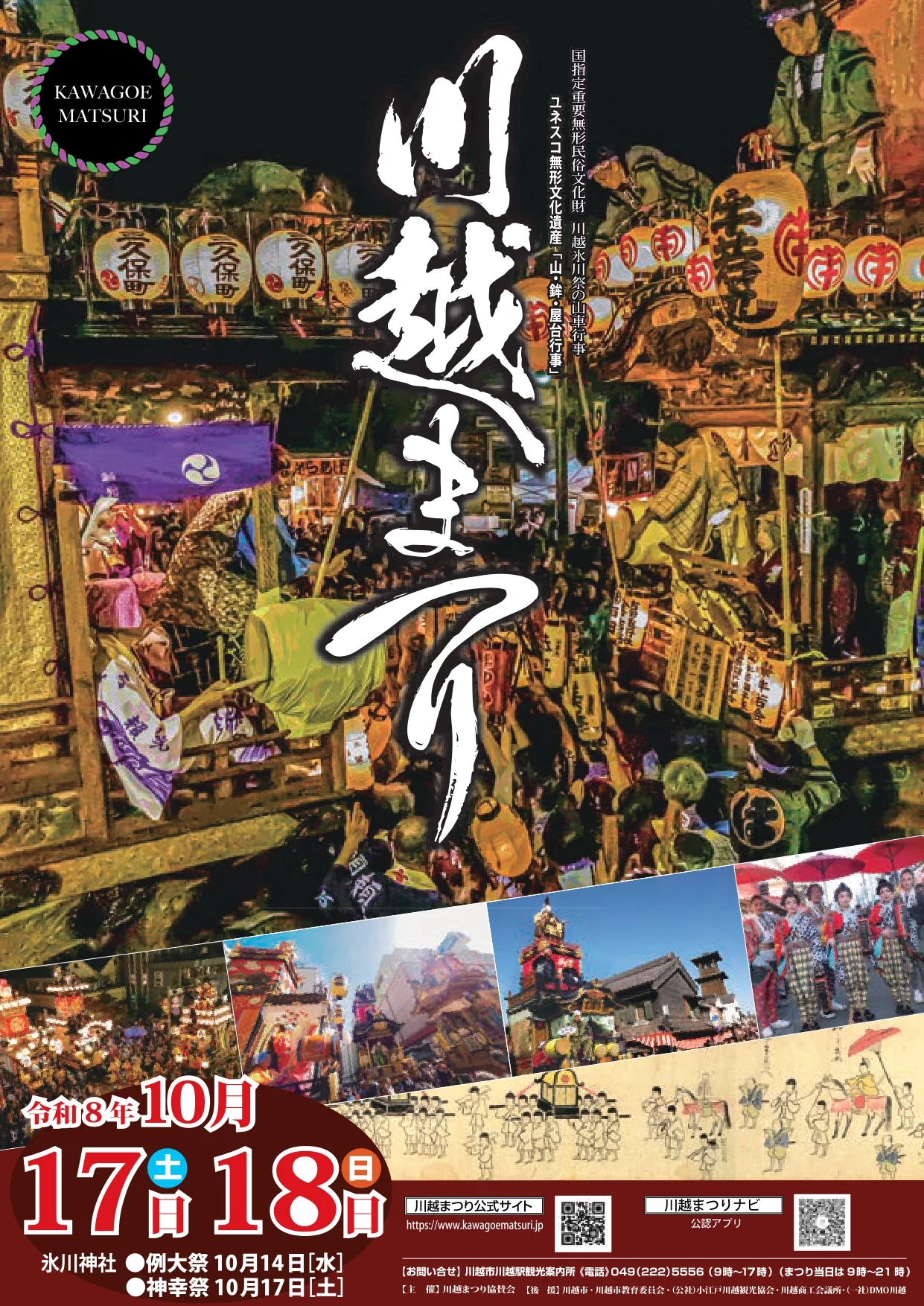
One of the Kanto region's most magnificent autumn celebrations, the Kawagoe Festival 2026 (Kawagoe Hikawa Festival Float Event), will take place over two thrilling days on October 17 (Sat) and October 18 (Sun), 2026.
Designated as a National Important Intangible Folk Cultural Property and inscribed on the UNESCO Intangible Cultural Heritage list (as part of Japan's "Yama, Hoko, Yatai float festivals"), the Kawagoe Festival boasts over 370 years of unbroken tradition dating back to 1648. Against the historic backdrop of "Little Edo" (Koedo) Kawagoe's clay-walled Kurazukuri warehouse district, towering Edo-style floats (Dashi) topped with legendary warrior figures navigate the streets. At night, the festival reaches its fever pitch with "Hikkawase", where facing floats compete in intense musical duels of flutes, drums, and masked dancers amidst roaring cheers.
This comprehensive guide details the 2026 event schedule, its historical connection to the legendary "Tenka Matsuri" of old Edo, the unique mechanics of the double-tiered floats, and essential visitor tips.
Kawagoe Festival 2026 Overview & Event Schedule#
Held annually on the third Sunday of October and the preceding Saturday, the festival fills the entire city center—from Kawagoe and Hon-Kawagoe Stations to the historic Kurazukuri Zone (Ichiban-gai)—with vibrant festive energy.
・Dates: October 17 (Sat) – October 18 (Sun), 2026
・Location: Downtown Kawagoe City, Saitama (Kurazukuri Zone, City Hall Plaza, Hon-Kawagoe Station Area)
・Origin Sanctuary: Kawagoe Hikawa Shrine (Annual Festival on Oct 14; Shinkosai & Float processions on the weekend)
・Cultural Heritage: National Important Intangible Folk Cultural Property / UNESCO Intangible Cultural Heritage
・Key Highlights: Shinkosai Holy Procession (Sat afternoon), Yoiyama & Float Lineup (Sat evening), City Hall Float Procession (Sun afternoon), Nighttime Hikkawase (Both nights)
| Schedule & Time | Event Program | Highlights & Cultural Features |
|---|---|---|
| Oct 17 (Sat) Around 13:00~ |
Shinkosai (Sacred Procession) | The sacred deity of Hikawa Shrine travels in a grand palanquin accompanied by an ancient procession in classical Heian/Edo ceremonial attire. |
| Oct 17 (Sat) 18:00~21:00 |
Yoiyama & Hikkawase | Hundreds of paper lanterns illuminate the stationed floats as musical troupes perform, leading into nighttime encounters at intersections. |
| Oct 18 (Sun) 13:30~16:00 |
City Hall Float Procession | Magnificent floats gather before Kawagoe City Hall, offering spectators a daylight view of masterwood carvings and historical statues. |
| Oct 18 (Sun) 18:30~21:00 |
Night Hikkawase Finale (Climax) | The festival reaches its ultimate fever pitch as multiple floats confront each other at intersections, battling with flutes, drums, and waving lanterns. |
370 Years of Living Heritage Preserving Old Edo's "Tenka Matsuri"#
The origins of the Kawagoe Festival date back to 1648 (Keian 1) during the early Edo period. The celebrated feudal lord of Kawagoe Castle, Matsudaira "Chie-Izu" Nobutsuna, donated sacred palanquins (Mikoshi), lion masks, and ceremonial drums to Kawagoe Hikawa Shrine, encouraging the townsfolk to establish an annual festival.
From 1651, the Hikawa Shrine procession began winding through the castle town. Connected to Edo via bustling river transport along the Shingashi River, Kawagoe's wealthy merchants eagerly embraced the float culture and accompanying performance pageantry of Edo's two grand celebrations—the "Tenka Matsuri" (the Kanda Festival of Kanda Shrine and the Sanno Festival of Hie Shrine).
While modernization and overhead electric power cables caused Tokyo (former Edo) to replace its towering floats with portable shrines (Mikoshi), Kawagoe dedicated itself to preserving the tradition by elevating its power lines. Today, the Kawagoe Festival stands as a living cultural treasure, miraculously preserving the lost grandeur of the original Edo Tenka Matsuri float processions.
Double-Tiered Towers & 360-Degree Revolving Stages: Edo Float Mechanics#
The towering floats (Dashi) of Kawagoe, measuring approximately 8 meters in height and weighing several tons, showcase masterful Edo carpentry and ingenious mechanical engineering.
| Structure & Part | Engineering & Artisan Highlights |
|---|---|
| Nijuhoko (Double-Tiered Structure) | A two-tier telescoping system. The upper tier and giant statue can be smoothly lowered into the lower body like an elevator to navigate under low wires and castle gates. |
| Dashi Ningyo (Historical Statues) | Life-sized masterpieces crowning the top of each float, depicting legendary figures such as Tokugawa Ieyasu, Oda Nobunaga, Susanoo, Benkei, and Amenouzume. |
| Mawari-butai (Revolving Stage) | A 360-degree rotating stage mechanism. While the heavy four-wheeled base stays in position, the musical stage and upper float can rotate instantly to face rival floats during "Hikkawase". |
| Wood Carvings & Gold Tapestries | Intricate 3D wood relief carvings of dragons, waves, and mythical lions (Karajishi), complemented by heavy curtains woven with genuine gold and silver embroidery. |
Igniting the Autumn Night: The Thrill of "Hikkawase"#
The supreme climax of the Kawagoe Festival occurs after dusk at street crossroads during "Hikkawase".
When two or more floats cross paths at an intersection, they rotate their stages to face each other just meters apart. On each stage, the "Kawagoe Hayashi" musical troupe (flutes, drums, and gongs) plays furiously while masked dancers dressed as foxes, raccoons, lions, and Hyottoko clowns dance dynamically.
Bearers on the ground vigorously hoist high lanterns (Takabari-chochin) while chanting "Sore! Sore!" in deafening unison. The float whose musicians lose rhythm or yield their tune must respectfully yield the road.
As darkness falls, hundreds of paper lanterns flicker against the black-lacquered Kurazukuri merchant houses. The competing rhythms of overlapping festival music and enthusiastic roars transform the ancient city into a breathtaking nocturnal spectacle.
Access and Practical Tips for Visitors#
1. Transportation & Nearest Stations#
The festival area is exceptionally accessible via multiple train lines from central Tokyo:
- Hon-Kawagoe Station (Seibu Shinjuku Line): Directly at the festival zone.
- Kawagoe Station (JR Kawagoe Line / Tobu Tojo Line) East Exit: 10–15 min walk through the Crea Mall shopping street.
- Kawagoe-shi Station (Tobu Tojo Line): 10–15 min walk to the festival center.
・Use Public Transit: Broad vehicular traffic restrictions are enforced across downtown Kawagoe. Driving is strongly discouraged.
・Experience Both Day and Night: Appreciate the intricate carvings and statues against historical buildings in daylight, then witness the glowing lanterns and music of Hikkawase at night.
・Savor Local Delicacies: Enjoy Kawagoe's famous sweet potato treats and traditional food stalls along Ichiban-gai and shrine approaches.
【Sources】