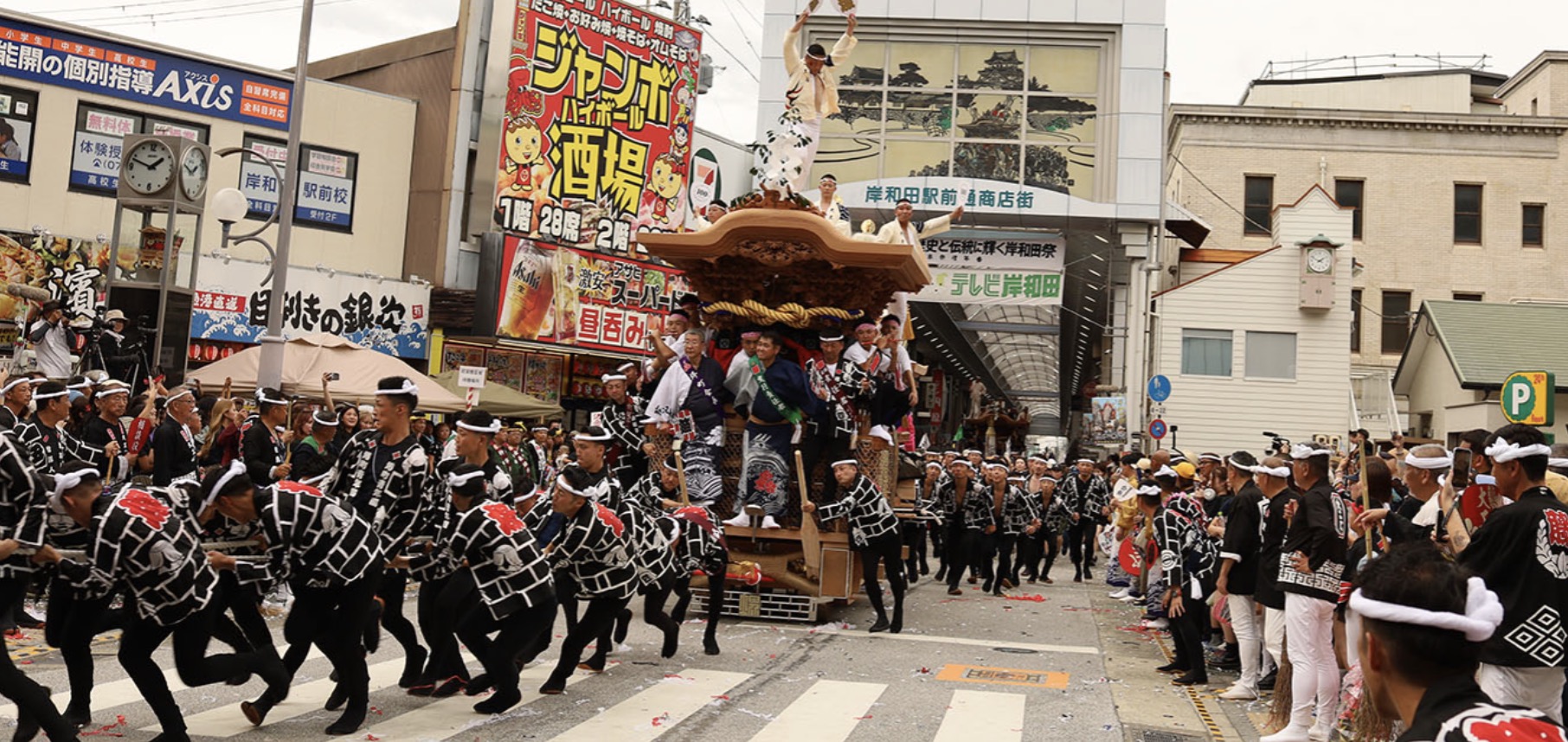
Thrilling Speed & Tradition: Kishiwada Danjiri Festival & Yarimawashi
Experience the pulse-pounding Kishiwada Danjiri Festival in Osaka. Discover the iconic 'Yarimawashi' high-speed 90-degree turns of 4-ton wooden shrines, master woodwork, and over 300 years of livin...
As the refreshing breezes of early autumn arrive in mid-September, Kishiwada—a historic castle town in southern Osaka—is swept up in its most exhilarating and passionate days of the year. From the distance comes the rhythmic melody of gongs, taiko drums, and bamboo flutes, accompanied by the thunderous roar of rushing footsteps and resounding shouts of "Sorya! Sorya!" With every turn of the street, an electrifying energy sweeps through the crowds, setting every spectator's pulse racing.
Among Japan's countless traditional celebrations, none rivals the sheer velocity, daring bravery, and theatrical spectacle of the Kishiwada Danjiri Festival. When a colossal 4-ton hand-carved wooden float (danjiri) charges full speed into a narrow 90-degree corner in the signature maneuver known as Yarimawashi, the surrounding streets erupt in deafening cheers and applause. Yet the true essence of this festival transcends thrill alone; it embodies over 300 years of unyielding civic pride, unbreakable neighborhood bonds, and world-class woodworking mastery.
Cornering at Breakneck Speed: The Artistry and Mastery of "Yarimawashi"#
The undisputed pinnacle of the Danjiri Festival is Yarimawashi. Sprinting down straightaways at breathless velocity, the enormous float hurtles into sharp street corners without deceleration, pivoting instantaneously around tight intersections in a breathtaking display of collective precision.
This dynamic turn is far from reckless momentum. It represents a sublime collective art form achieved only through millimeter-perfect synchronization and unspoken trust among hundreds of pullers and master artisans across specialized roles.
The Five Vital Roles Controlling the Danjiri
- Daikugata (Roof Dancer): Perched atop the soaring curved roof, wielding dual round fans (uchiwa), leaping with acrobatic grace while signaling directional shifts.
- Maeteko (Front Lever Operators): Inserting stout wooden levers directly into the front wheels at the precise moment of turning to steer and control the inner radius.
- Ushiroteko (Rear Lever Operators): Maneuvering long trailing ropes with immense collective muscle power to stabilize the turning radius and straighten out the exit path.
- Tsunahiki (Rope Pullers): Hundreds of youth and community members pulling the forward ropes with explosive strength to drive the massive float forward.
- Narimono (Musicians): Seated inside the belly of the float, playing drums, gongs, and flutes to dictate the tempo and rhythm of the entire team.
As the Daikugata leaps high into the air against the open sky and the lever teams execute their split-second maneuvers below, hundreds of pullers surge forward simultaneously. In that single unified instant, the 4-ton giant carves a razor-sharp arc around the corner. The triumphant roar that erupts upon a flawless turn leaves an indelible impression on everyone present.
Over 300 Years of Heritage: From Feudal Prayers to Community Autonomy#
The origins of the Kishiwada Danjiri Festival trace back to 1703 (Genroku 16) during the middle Edo period. Lord Okabe Nagayasu, ruler of Kishiwada Domain, enshrined Kyoto's Fushimi Inari deity within the castle's Third Bailey (Sannomaru) to pray for bountiful harvests in the Inari Matsuri.
Though initially inaugurated as a samurai-led ceremony, the thriving merchants and local townspeople of the castle town soon began building their own distinct floats, infusing the celebrations with artisan ingenuity. Over generations, the event blossomed into a self-governed festival of the common people.
"The danjiri is the historic crystallization of a festival granted by feudal lords and elevated by townspeople into their own supreme pride. The spirit of self-governance, forged through mutual competition and community solidarity, remains the beating heart of the festival today."
— Folklorist & Kishiwada Cultural Heritage Conservator
Through the turbulent transitions of the Meiji, Taisho, and Showa eras, the people of Kishiwada never allowed the flame of this tradition to be extinguished. The famous local saying—"We live an entire year just for the festival"—reflects a cultural soul passed down unbroken for over three centuries.
"Rolling Museums": All-Zelkova Craftsmanship & Intricate Wood Carvings#
A danjiri is equally mesmerizing when standing still. Built entirely from hand-selected Japanese zelkova (keyaki) trees spanning centuries in age, these "Lower Danjiri" floats are assembled without a single iron nail using traditional interlocking wood joinery, granting extraordinary durability and flexibility under intense kinetic strain.
Every wooden surface is adorned with breathtakingly intricate three-dimensional carvings. Beneath the gabled eaves, along the railings, and across the structural bases, master carvers have chiseled legendary battle scenes from the Chronicles of the Three Kingdoms, Tale of the Heike, and Taikoki with astonishing realism.
Artisanal Highlights of Danjiri Wood Carvings
- Multi-layered Depth: Warriors and warhorses carved across several overlapping planes, appearing poised to leap off the woodwork.
- Unique Town Pride: Each neighborhood commissions distinct mythological or historical themes and renowned master carving lineages.
- Lustrous Amber Patina: Polished zelkova wood deepens with each passing decade into a magnificent amber glow.
This striking duality—ferocious speed paired with exquisite craftsmanship—is why Kishiwada's floats are celebrated across the globe as "rolling works of art."
Day vs. Night: The Ethereal "Lantern Procession" (Hiire Eiko)#
As dusk settles and the ferocious daytime speed subsides, the festival undergoes a magical transformation. Adorned with approximately 200 glowing red paper lanterns (chochin), each float embarks on the serene nighttime procession known as Hiire Eiko.
Replacing the fierce daytime sprints, gentle melodies fill the night as families, children, and elders pull the glowing floats together in relaxed harmony. The warm lantern light swaying against the cool autumn darkness envelops the entire town in heartwarming warmth and nostalgia.
2026 Kishiwada Danjiri Festival: Schedule & Viewing Guide#
Here is the essential schedule and safety guidance for experiencing the festival. (Note: September 18 features test runs / Shiken-biki).
| Date & Time | Event | Highlights & Advice |
|---|---|---|
| Yoimiya: Sat, Sep 19 (6:00 AM–) | Hikidashi (Opening Pull) | The dramatic opening moment of the festival, unleashing the collective energy of all neighborhood teams. |
| Yoimiya: Sat, Sep 19 (1:00 PM–) | Parade & Afternoon Runs | Festive grand parade near Kishiwada Station shopping arcade with continuous rapid-fire Yarimawashi turns. |
| Honmiya: Sun, Sep 20 (9:00 AM–) | Miyairi (Shrine Procession) | Solemn, dignified procession of floats entering Kishiki Shrine and Kishiwada Tenjingu Shrine. |
| Both Days (7:00 PM–10:00 PM) | Lantern Procession (Hiire Eiko) | Enchanting illuminated night stroll featuring 200 lanterns per float, welcoming all generations. |
| Safety Precaution | Recommended Action |
|---|---|
| No Stepladders / Selfie Sticks | Intersection corners are densely crowded. Follow safety personnel instructions strictly to prevent accidents. |
| Comfortable Footwear | Wear sneakers or athletic shoes to move quickly in response to float directions. |
| Paid Reserved Seating | To view legendary high-speed turns at spots like the "Kankan-ba" safely, pre-booked grandstand seats are strongly advised. |
Conclusion: Where Community Soul Charges into the Future#
The Kishiwada Danjiri Festival is far more than a tourist spectacle; it represents the shared identity and lifeblood of the local people. Growing up listening to the music, pulling the ropes in youth, and eventually guiding the neighborhood—the profound bonds and devotion nurtured through this cycle have sustained the festival across centuries.
The roaring ground vibrations, flying wood chips, the wind-cleaving dance of the roof acrobat, and the resounding town-wide cheers will awaken all your senses. Come and witness Japan's most passionate traditional festival live under the autumn skies!