Millennia of Prayer! Kyoto Gion Matsuri Begins July 1
The Kyoto Gion Matsuri is held for the entire month of July. Discover its history originating in the Heian period, highlights like Yamahoko Junko, local roles, and visitor participation tips.
On July 1, 2026, Kyoto's Gion Matsuri, one of Japan's three major festivals, will begin its month-long celebration. Throughout July, downtown Kyoto is enveloped in solemn Shinto rituals and the lively sounds of Gion-bayashi (traditional festival music). Preserved for over a millennium by Kyoto's citizens (machishu) despite wars and disasters, the festival is registered as a UNESCO Intangible Cultural Heritage, attracting over a million visitors annually.
Gion Matsuri is more than a tourist attraction; its core is a deep prayer for the eradication of plagues. In this comprehensive guide, we explore the festival's historical origins, key events of the Saki-matsuri (early festival) and Ato-matsuri (late festival), the diverse roles of the organizers, and how visitors can participate.
Origin of Gion Matsuri: Prayers for Eradicating Plagues#
The festival traces its history back to the early Heian period in 869 (Jogan 11). At the time, deadly epidemics plagued the capital of Kyoto, while the Jogan Earthquake devastated northern Japan, spreading anxiety throughout society.
To appease the deities, the citizens offered prayers to Gozutennou (enshrined at Yasaka Shrine, then Gion-sha). They erected 66 halberds (hoko) representing the provinces of Japan at Shinsen-en Garden and sent portable shrines (mikoshi) to pray for the eradication of pestilence. This ritual, known as "Gion Goryo-e," is the direct origin of the Gion Matsuri.
During the Muromachi period, wealthy merchants (machishu) became the main patrons of the festival, competing to build increasingly magnificent floats called "Yamahoko." Although Kyoto was repeatedly devastated by wars like the Onin War and subsequent great fires, the citizens rebuilt the floats and revived the festival each time. This resilient spirit has kept Gion Matsuri alive for over a thousand years.
Moving Museums and Yoiyama Atmosphere: Key Dates and Highlights#
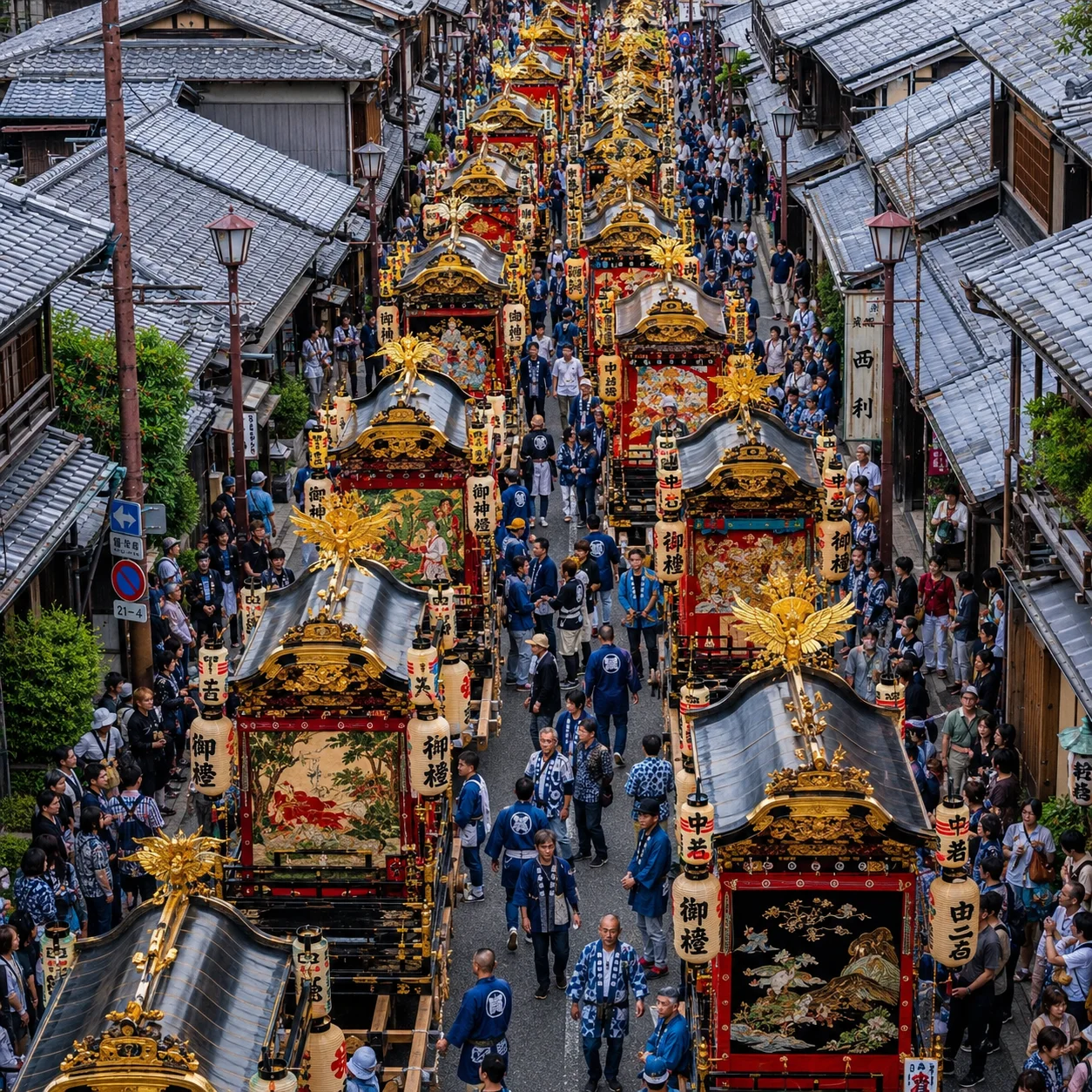
While Shinto rituals take place daily in July, the festival peaks during "Yoiyama" (evening festivals) and the grand "Yamahoko Junko" (float processions). Since 2014, the traditional split format of Saki-matsuri (early festival) and Ato-matsuri (late festival) has been fully restored.
| Period / Event | 2026 Dates | Highlights and Characteristics |
|---|---|---|
| Saki-matsuri Yoiyama | July 14–16 | The streets around Shijo-Karasuma turn into pedestrian-only zones adorned with glowing Komagata lanterns. Gion-bayashi music echoes, and numerous street food stalls create a festive atmosphere. |
| Saki-matsuri Procession | July 17 | A grand procession of 23 Yamahoko floats, often described as "moving museums," parading down major avenues. The "Tsujimawashi," where massive floats are turned 90 degrees at intersections, is spectacular. |
| Shinkosai (Mikoshi Procession) | July 17 (Evening) | After the floats purify the streets, three grand portable shrines (mikoshi) depart from Yasaka Shrine, carried by energetic local men to the Otabisho (temporary resting place). |
| Ato-matsuri Yoiyama | July 21–23 | No food stalls or pedestrian zones are set up, allowing visitors to enjoy the quiet, historic streetscape and the elegant floats in a traditional Kyoto atmosphere. |
| Ato-matsuri Procession | July 24 | A procession of 11 floats travels the reverse route of the early festival. The "Takayama," revived in 2022 after 190 years, is a key highlight. |
[Tsujimawashi Technique and Viewing Tips]
The massive floats, weighing up to 12 tons, have no steering mechanism. To turn at intersections, workers place split bamboo under the wheels, pour water on them, and pull the ropes in unison. This dramatic turning maneuver can be viewed at major intersections like Shijo-Kawaramachi. Arrive early or book paid spectator seats in advance due to extreme crowds.
Who Runs the Festival? The Roles of "Yamahoko" and "Mikoshi"#
Gion Matsuri revolves around two main pillars: the float procession (Yamahoko) and the portable shrine procession (Mikoshi).
1. Yamahoko and the Machishu
The Yamahoko floats serve to gather and absorb evil spirits and plagues from the streets before the deities' portable shrines pass through. Therefore, to prevent the gathered spirits from escaping, the floats are immediately disassembled after the procession. Each float is maintained by a "Yamahoko-cho" (neighborhood association) of local residents and preservation societies, who pass down the roles of musicians (hayashikata) and pullers (hikite).
2. Mikoshi and the San-ki Associations
After the floats purify the town, three portable shrines carrying the deities of Yasaka Shrine parade through the streets. Carried by energetic local associations (Sankikai), the mikoshi procession is full of raw energy and shouting men, contrasting with the elegant beauty of the floats.
How Visitors Can Participate and Enjoy Gion Matsuri#
Gion Matsuri offers several ways for tourists to experience the traditions firsthand.
1. Join the "Hikizome" (Float Pulling Practice)
On July 12–13 (Saki-matsuri) and July 20–21 (Ato-matsuri) afternoons, neighborhoods conduct test runs of the assembled floats. During Hikizome, anyone—including visitors, women, and children—is welcome to hold the ropes and help pull the massive floats, experiencing their immense weight.
2. Purchase "Chimaki" and Board the Floats
During Yoiyama, neighborhoods sell "Chimaki" (talisman bundles made of bamboo grass to hang on doorways for protection). Purchasing a chimaki often allows you to board and tour the interior of the floats, offering a rare view of Shijo Street from inside.
3. Visit the Byobu Matsuri (Folding Screen Festival)
During the early Yoiyama, traditional merchant houses in the neighborhood display their family heirlooms, such as antique folding screens and art, visible from the street.
Access and Guidelines for Visitors#
The main events take place along Shijo Street (between Karasuma and Kawaramachi) and Oike Street.
- Main Access Stations:
- Hankyu Kyoto Line: Kyoto-Kawaramachi or Karasuma Station
- Kyoto City Subway: Shijo, Karasuma-Oike, or Kyoto Shiyakusho-mae Station
- Keihan Main Line: Gion-Shijo or Sanjo Station
- Summer Heat and Crowds:
Kyoto in mid-July is extremely hot and humid. Be sure to stay hydrated, wear comfortable shoes, and prepare for massive crowds. Saki-matsuri Yoiyama (July 15–16) has pedestrian zones, but Ato-matsuri Yoiyama does not, so watch out for traffic.
Gion Matsuri is Kyoto's living history, uniting people, deities, and the community. Experience this beautiful summer festival while reflecting on its thousand-year-old prayers for health and safety.
[Sources]#
1. Gion Matsuri Yamahoko連合会 Official Website
2. Kyoto Travel Navi Gion Matsuri Special Page
3. Yasaka Shrine Official Website