Black Rabbit reports on the current status of the urinary stone based on a new CT scan. Exploring the three major hurdles and the real threat of bacterial infection.
Black Rabbit has tried various things like jumping and massaging the abdomen to move the stone down, and the conclusion is that it has 'descended quite a bit'. Whether this is due to those efforts, natural descent, or had little effect is unknown, but there was a hint in what the doctor told me. I will explain in detail in the section of the second hurdle.This time, I will explain in depth the three major hurdles of urinary stones and the constant state of danger that I heard about during the consultation.
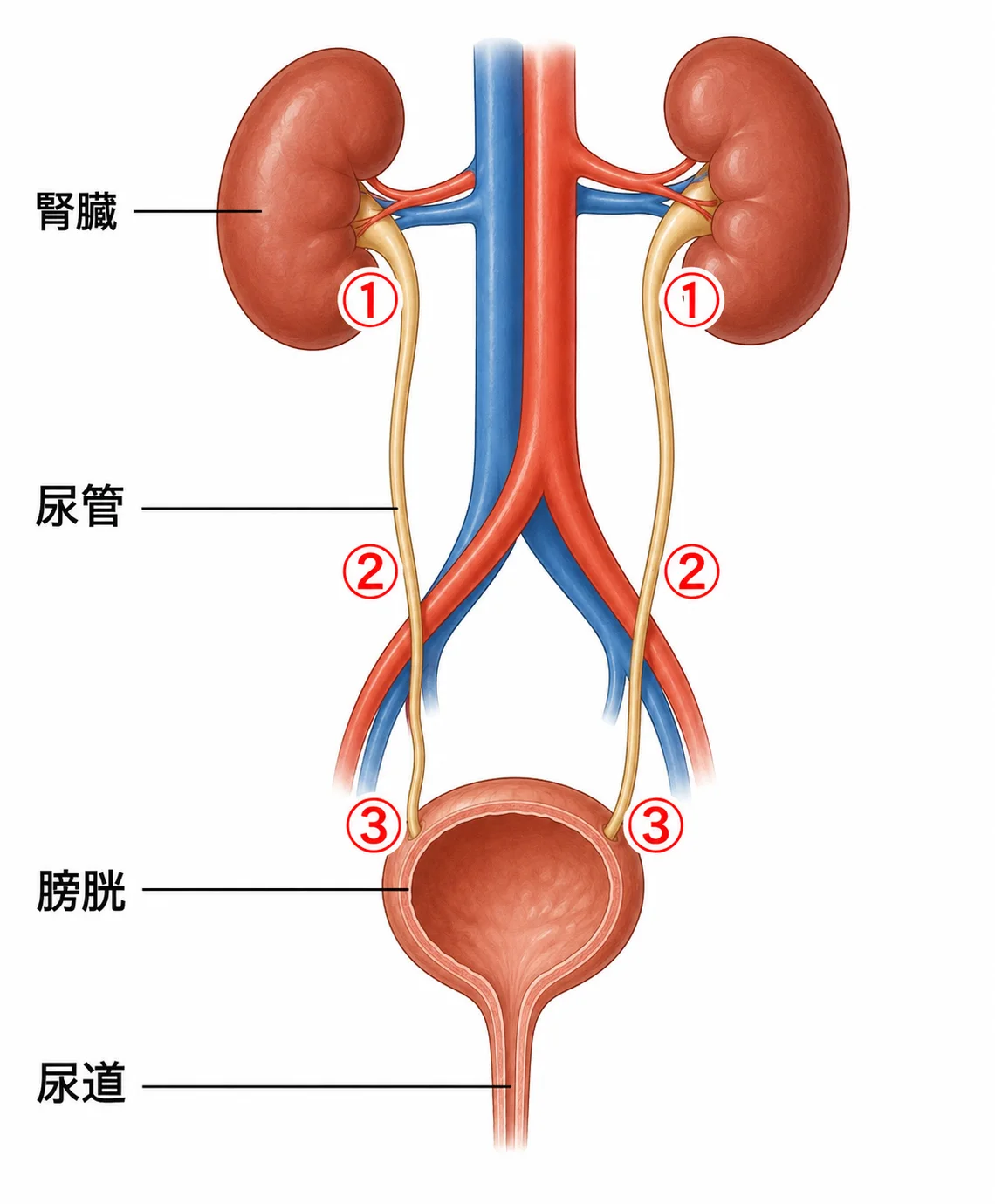
As explained in past articles, stones are formed in the urinary tract, but it seems they first get stuck at the point where thin tubes in the kidney gather and enter the ureter (Figure ①). Getting through here causes extreme pain. When Black Rabbit was curled up on the bed enduring the pain, it was the moment the stone was trying to enter the ureter (exit from the kidney side)—actually, I was 'writhing in pain' for about an hour, so it wasn't exactly a moment, but that was the time.
If you cannot pass this, urine stops flowing from the kidney, raising the pressure inside the kidney, which highly increases the chance of destruction or fibrosis. That leads to a life on dialysis. Because you cannot produce urine, water can only be removed through dialysis, which strictly limits daily water intake and significantly lowers the quality of life.
To begin with, stones are apparently jagged and do not pass smoothly through the ureter. Though there are individual differences, the ureter is about 4mm wide, while Black Rabbit's stone is 6mm, which is on the larger side. But if it's under 10mm, natural passage is possible. The ureter expands and contracts significantly; when I first went to the hospital and got a CT scan, the ureter above the stone was blocked and swollen to about 20mm wide.
画像の②の部分は、尿管全体ではなく中間あたりの大動脈・大静脈が大きく2つに分かれる場所を指しています。ここは尿管の近くを太い血管が2本通っているため、圧迫され結果的に結石が流れづらくなるらしく、The Second Hurdleと言われているそうです。
Also, the intestines are famous for 'peristalsis'. If you don't move your body, your intestines won't move (cannot move), so people who lack exercise tend to get constipated. The ureter is in the same lower abdomen and apparently moves together with the intestines. Therefore, rather than massaging by hand, performing a 30-minute brisk walk as aerobic exercise to trigger 'peristalsis' is a much more logical method. While jumping is not useless, the doctor said the stone moves more easily with the 'peristalsis' of the undulating ureter. Oh my...
The final hurdle is the ureter right before entering the bladder. Because this is the connection to the bladder, it is structurally less elastic than the upper ureter. Therefore, stones larger than the ureter tend to get stuck. On top of that, there is a valve mechanism to prevent backflow from the bladder, which makes it even harder for larger stones to pass.
Regardless of whether they are teenagers or elderly, some people simply cannot pass it here and end up needing surgery. In short, it's 'luck' lol. However, if it comes to surgery, it will cost a large amount of money as introduced in previous articles. If bacteria get in, it will be disastrous.
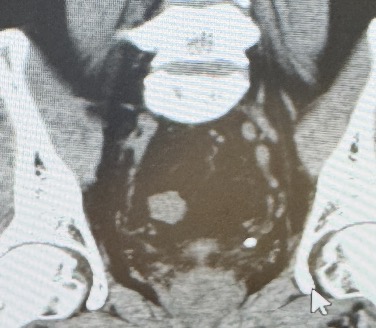
*The photo on the right shows the current CT result. The white dot on the bottom right is the stone, about 6mm. Is the one in the bottom middle the bladder?
Bacteria are the hidden major problem of urinary stones. If urine cannot pass at all and there is high pressure on the kidney, surgery is unavoidable. But even if urine is flowing past the side, once bacteria get inside and multiply, doctors cannot touch the stone, dramatically increasing the difficulty of surgery. Without infection, a procedure using ultrasound or laser would cost about 100,000 to 300,000 yen, but with infection, they have to open the abdomen, install an artificial ureter to bypass the infected area, and extract the stone without rupturing the infected part, which could easily push the cost into seven figures. If infected urine spills into the abdomen, it contaminates the body, leading to a much more critical condition. That is why it becomes a difficult surgery.
In other words, this bacterial issue is a danger that can occur no matter where the stone is located, meaning I live with that risk constantly. This, too, is 'luck'. It is truly terrifying. I wonder if alcohol disinfection with my favorite tequila would work lol.
Anyway, while aiming for a life with no regrets even if I die tomorrow, Black Rabbit still has many things I want to do. The current location of my stone has descended to the point of ③ in the diagram (as shown in the CT image). However, getting out of here seems to be a major obstacle, so to discharge it within the next month, I will try my best to drink more than 2L of water daily and do 30 minutes of aerobic exercise! I feel like I won't be able to, but I'll do it! When the time comes, if I can... I want to.
Next time, I want to end with an article where it has been resolved!