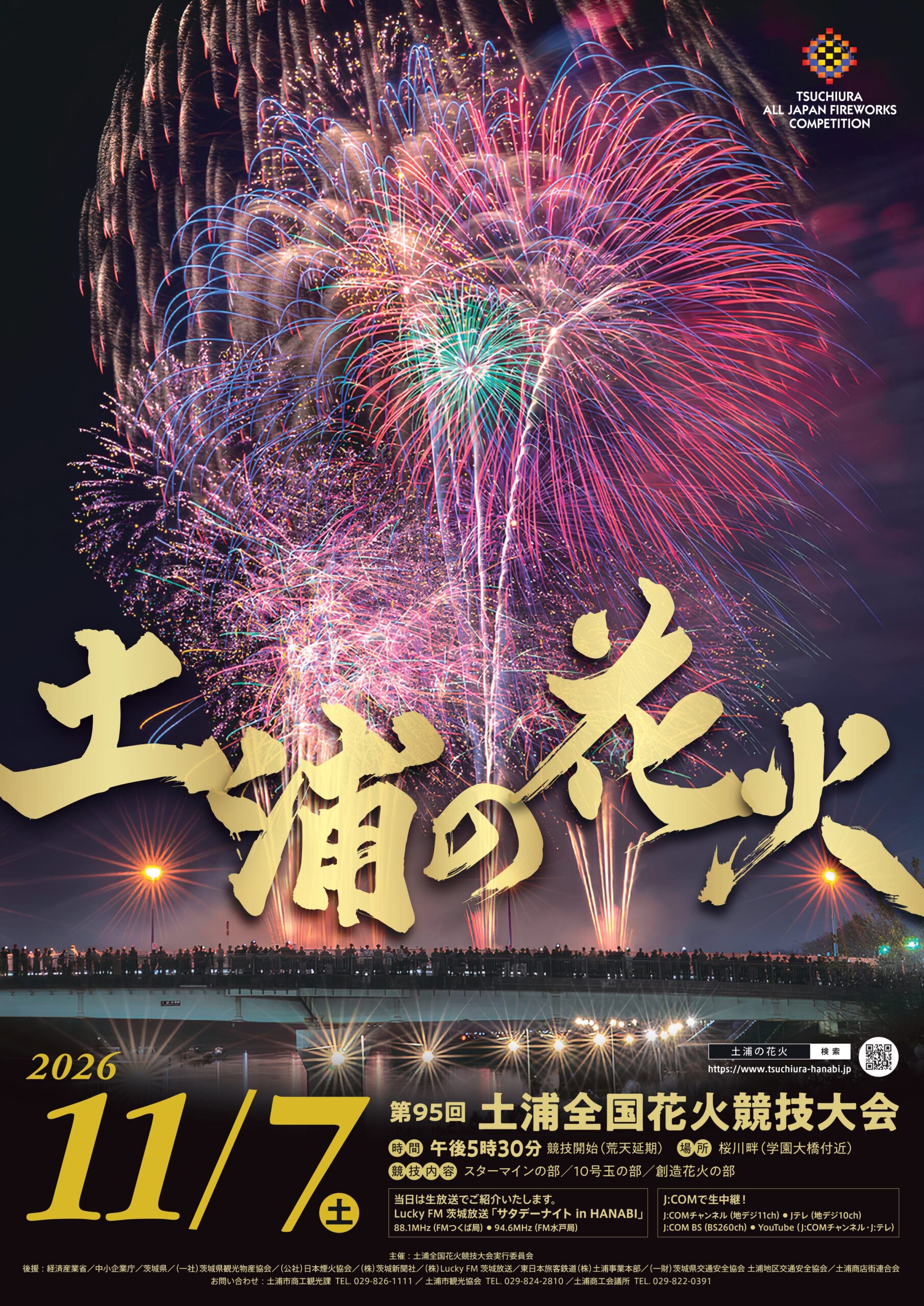
Tsuchiura Fireworks 2026: Japan's Premier Autumn Display
On Nov 7, 2026, the 95th Tsuchiura All Japan Fireworks Competition lights up Ibaraki. Top pyrotechnicians vie for the Prime Minister's Award with 20,000 shells, starmines, and rich history.
As autumn deepens and crisp, cool evening air embraces the city in early November, the night sky over Tsuchiura in Ibaraki Prefecture transforms into a breathtaking, colossal canvas illuminated by the brilliant lights and thunderous roars of Japan's greatest pyrotechnicians. Weaving a proud legacy spanning over a century since the Taisho era (with last year marking its momentous centennial), the 95th Tsuchiura All Japan Fireworks Competition will take place on Saturday, November 7, 2026. Alongside the famous "Omagari" in Akita, it stands as one of Japan's most prestigious competitive gatherings, conferring the supreme honor of the Prime Minister's Award.
Approximately 60 select pyrotechnic companies from across the nation converge here to compete with honor and pride. Extreme beauty is contested across three divisions: the signature "Starmine" (rapid-fire barrage) that originated in Tsuchiura and spread nationwide, the exquisite "Size 10 Shell" where the artisan's soul resides in an instantaneous perfect sphere, and "Creative Fireworks" where free sensibility sparks alongside cutting-edge color technology. From prayers of memorial and revitalization passed down since its founding in 1925, to an in-depth comparison with Omagari and Nagaoka, as well as practical cold-weather tips and viewing strategies, we present the complete guide to this spectacle of approximately 20,000 luminous bursts.
[Overview of the 95th Tsuchiura All Japan Fireworks Competition (2026)]
- Event Name: 95th Tsuchiura All Japan Fireworks Competition (2026)
- Date: Saturday, November 7, 2026 (*Postponed to Saturday, November 14 in case of stormy weather or high winds)
- Time: Competition starts at 5:30 PM – Scheduled conclusion at 8:00 PM
- Venue: Banks of the Sakura River, Tsuchiura City, Ibaraki Prefecture (near the downstream area of Gakuen Ohashi Bridge)
- Number of Fireworks: Approximately 20,000 shells (competition and special sponsored displays)
- Annual Attendance: Approximately 600,000 to 700,000 visitors
- Competition Divisions: Starmine Division, Size 10 Shell Division, Creative Fireworks Division (3 divisions total)
- Supreme Honor: Prime Minister's Award (bestowed upon the overall champion across all divisions)
- Ministerial Awards: Minister of Economy, Trade and Industry Award (Starmine winner), Director-General of Small and Medium Enterprise Agency Award (Size 10 Shell winner), Governor of Ibaraki Prefecture Award (Creative Fireworks winner)
- Organizers: Tsuchiura All Japan Fireworks Competition Executive Committee, Tsuchiura City, Tsuchiura Chamber of Commerce and Industry, Tsuchiura City Tourism Association
Japan's Supreme Light Competition Lighting Up Autumn Skies: The 95th Tsuchiura Fireworks#
Fireworks are quintessential symbols of Japanese summer. Yet, among seasoned connoisseurs and enthusiasts, it is widely believed that "the true essence of fireworks can only be fully appreciated under crisp autumn skies." Unlike summer conditions where heat, humidity, and smoke tend to linger, the cool November air heralds early winter with minimal humidity, drawing out colors to their utmost brilliance. Because smoke drifts away swiftly on seasonal breezes, every single particle of light paints a vivid, striking contrast against the jet-black night sky.
Reigning supreme at the pinnacle of autumn fireworks across Japan is the Tsuchiura All Japan Fireworks Competition, staged along the grassy floodplains of the Sakura River in Tsuchiura City, Ibaraki Prefecture. Pyrotechnic artisans from all over Japan gather with newly developed display shells nurtured throughout the year, releasing their supreme technique and artistic vision into the night without holding anything back.
The defining characteristic of this event is that it is not merely an entertaining spectacle for spectators, but a serious, high-stakes competition where fireworks manufacturers clash with immense professional pride. Not a single shell allows for compromise; each brief bloom lasting mere seconds encapsulates months or even years of trial and error. Spectators do not simply gaze upon radiant light—they judge the artistic perfection and composition of each shot from an evaluator's perspective, enveloping the entire venue in exhilarating tension and thunderous applause.
Over a Century of Legacy Begun from Prayers in 1925: Rev. Baiko Akimoto's Vision#
The origins of the Tsuchiura All Japan Fireworks Competition date back more than a century to Taisho 14 (1925). Its genesis stemmed from the profound compassion and regional devotion of a single Buddhist monk.
At the time, the late Reverend Baiko Akimoto, the 24th chief priest of Jinryu-ji Temple (a venerable Soto Zen temple in Bunkyo-cho, Tsuchiura), deeply mourned the aviators and service members who lost their lives in a series of aircraft accidents at the nearby Kasumigaura Naval Air Station. Furthermore, following the Great Kanto Earthquake of 1923 and subsequent financial panics, Tsuchiura's commercial districts and regional economy had suffered devastating blows, leaving farmers and merchants utterly exhausted.
"To console the departed spirits of brave young souls, bring smiles back to demoralized townsfolk, and honor farmers for their autumn harvest toil"—with this heartfelt devotion, Rev. Akimoto generously poured in his personal wealth to hold a grand fireworks festival on the shores of Lake Kasumigaura. This marked the historic first step of the Tsuchiura All Japan Fireworks Competition.
Entering the Showa era, the event was temporarily halted by World War II. However, in Showa 21 (1946), shortly after the war's conclusion, it was revived as the 14th edition, carrying the citizens' earnest prayers for postwar reconstruction. Ever since, it has grown in stature while overcoming numerous adversities.
The greatest watershed moment in Tsuchiura's history arrived during the 28th competition in Showa 34 (1959). At the time, rapid-fire starmines were regarded nationwide as mere interludes or mood-setters between major set-piece fireworks. Yet Tsuchiura recognized the unique competitive artistry of the starmine, establishing it as an independent competition division for the first time in Japan. This visionary decision directly spurred the dramatic evolution of the modern starmine, which now reigns as the star of contemporary Japanese fireworks displays.
Subsequently, the venue was moved from Lake Kasumigaura to the current Sakura River floodplains. In Heisei 12 (2000), the event achieved the distinction of conferring the Prime Minister's Award, an honor shared only with Akita's Omagari. What began as a regional prayer for memorial and revitalization has flourished into a world-class cultural treasure representing the pinnacle of Japanese traditional beauty.
Clash of Skill and Pride: Three Major Competition Divisions and the Prime Minister's Award#
At the Tsuchiura All Japan Fireworks Competition, meticulously selected pyrotechnicians from across Japan compete across three specialized divisions. Each division features distinct regulations and rigorous criteria that test the multifaceted mastery of the fireworks masters.
[Evaluation Points of Tsuchiura's Three Major Competition Divisions]
- Starmine Division (Minister of Economy, Trade and Industry Award): The hallmark of Tsuchiura. Hundreds of shells launched in rapid, exquisite succession. Judges comprehensively evaluate color harmony, launch rhythm, dramatic narrative structure, and the lavish crescendo of the finale.
- Size 10 Shell Division (Director-General of Small and Medium Enterprise Agency Award): Single shells measuring approx. 30 cm in diameter. Rising to an altitude of 330 meters and bursting into a giant floral sphere 300 meters across. Tests ultimate craftsmanship, including sphericity, balanced star opening ("suwari"), simultaneous color transitions, and crisp vanishing moments ("kieguchi").
- Creative Fireworks Division (Governor of Ibaraki Prefecture Award): A division breaking free from traditional round forms to showcase imaginative novel shapes, fresh color palettes, and synchronization with musical motifs. Evaluated highly on originality, unexpected staging, and compelling thematic storytelling.
From among all pyrotechnicians submitting entries to all three divisions, only one company demonstrating the most transcendent overall mastery is awarded the supreme crown: the Prime Minister's Award. Across all of Japan, the Prime Minister's Award is bestowed upon fireworks competitions in only two gatherings: Omagari in Akita and Tsuchiura in Ibaraki. Capturing this prize signifies the title of "Japan's Number One Fireworks Master," representing the lifelong aspiration of every Japanese pyrotechnic artisan.
Japan's Three Great Fireworks Festivals Compared: Tsuchiura vs. Omagari vs. Nagaoka#
Japan is home to three historic and monumental pyrotechnic celebrations known collectively as the "Three Great Fireworks Festivals": the Tsuchiura All Japan Fireworks Competition in Ibaraki, the All Japan Fireworks Competition (Omagari Fireworks) in Akita, and the Nagaoka Festival Grand Fireworks in Niigata. Despite sharing this prestigious title, their origins, purposes, and production philosophies differ remarkably.
| Comparison Item | Tsuchiura All Japan Fireworks (Ibaraki) | Omagari Fireworks (Akita) | Nagaoka Festival Fireworks (Niigata) |
|---|---|---|---|
| Timing | First Saturday of November (crisp autumn) | Last Saturday of August (late summer) | August 2 & 3 (midsummer) |
| Character | Competitive Tournament (Year-end pinnacle) Intense contest in crisp, clear autumn skies | Competitive Tournament (Summer summit) Comprehensive artistic contest of day and night fireworks | Memorial & Peace Festival Non-competitive massive display; prayer of citizens |
| Supreme Honor | Prime Minister's Award Minister of Economy, Trade & Industry Award, etc. | Prime Minister's Award Minister of Economy, Trade & Industry Award, etc. | None (No competition judging) Votive fireworks by citizens and sponsors |
| Signature Showcase | Rapid-Fire Barrage (Starmine) Special presentation "Tsuchiura Fireworks Galore" | Daytime Fireworks Contest Special wide starmine presentation | Sho-Sanshakudama & Giant Phoenix Consecutive launches across the wide Shinano River |
| Historical Roots | Naval aviator memorial and merchant revitalization Funded privately by Abbot Baiko Akimoto | Suwa Shrine festival entertainment Advancement of fireworks craft in Senboku | Memorial for Nagaoka Air Raid victims Prayers for Chuetsu Earthquake recovery |
| Access from Tokyo | Approx. 45 min by Limited Express from Ueno Extremely easy day-trip from Tokyo metro area | Akita Shinkansen (Omagari Station) Accommodations near venue extremely difficult to secure | Joetsu Shinkansen (Nagaoka Station) Directly connected via high-speed bullet train |
While Nagaoka represents a "solemn prayer festival" dedicated to victims of the wartime air raids and Chuetsu Earthquake recovery, and Omagari serves as the "supreme academy of pyrotechnics" featuring daytime colored-smoke contests and summer night artistry, Tsuchiura boasts the unmistakable identity of being the "Grand Finale of the Nationwide Fireworks Season" and the "Sacred Ground of Starmines." It brings together the finest techniques honed over the entire year, combined with unparalleled convenience just 45 minutes by train from central Tokyo.
A Jaw-Dropping Sky Spectacle! The Euphoria of "Tsuchiura Fireworks Galore"#
Amid the intense competitive tension, the greatest climax arrives around 7:00 PM with the festival's signature wide starmine presentation: "Tsuchiura Fireworks Galore" (Tsuchiura Hanabi Zukushi).
Stretching across hundreds of meters along multiple launch sites on the wide Sakura River floodplain, this special non-competitive program mesmerizes spectators with sheer volume and staggering scale that set it apart from individual competition entries.
Harmonized with resonant symphonic melodies reverberating through the crisp night, thousands of stars rocket into the heavens simultaneously. A multi-tiered tapestry of light in lower, middle, and upper elevations expands beyond the viewer's field of vision, while deep sonic booms shake the spectator's very core. In the breathtaking finale, an accelerated barrage of golden "Nishiki Kamuro" (brocade crown) willows transforms the pitch-black sky into shimmering daylight, raining golden sparks down toward the earth. The roaring applause and cheers that erupt across the riverbanks become unforgettable memories of Tsuchiura's autumn night.
Enjoying Crisp November Skies in Comfort: Model Itinerary, Warmth & Access Tips#
With November heralding early winter in Tsuchiura, thorough preparation is essential to experience the festival in warmth and comfort. Here is a recommended model itinerary and practical advice.
[Recommended Itinerary for Tsuchiura Fireworks Competition]
- 1:00 PM: Arrive at Tsuchiura Station & Savor Local Lotus Root Delicacies
Indulge in dishes made with Tsuchiura's top-producing lotus root or sample the famous local "Tsuchiura Zeppelin Curry." - 3:00 PM: Transfer toward Venue & Visit Jinryu-ji Temple
Stop by historic Jinryu-ji Temple, where festival founder Rev. Baiko Akimoto served as abbot, reflecting on the century-old legacy of peace and memorial. - 4:30 PM: Take Seats at Viewing Area & Prepare Cold-Weather Gear
Temperatures plummet rapidly after sunset. Settle into your viewing space before dusk and arrange warm layers and insulating mats. - 5:30 PM: Competition Commences
Starmines, Size 10 shells, and Creative fireworks launch in sequence. Enjoy evaluating the craftsmanship from an expert judge's vantage. - 7:00 PM: Experience the "Tsuchiura Fireworks Galore" Presentation
Immerse yourself in the overwhelming sound and light spectacle of the several-hundred-meter wide starmine. - 8:00 PM: Competition Concludes & Light Ceremony (Exchange of Cheers)
Following the finale, spectators wave smartphone flashlights and penlights, sending reciprocal cheers of gratitude to pyrotechnicians on the opposite bank.
Essential Cold-Weather Preparedness and Transportation Access#
In November, temperatures in Tsuchiura drop dramatically once the sun sets. With brisk river winds sweeping across the banks, the perceived temperature frequently falls below 10°C (50°F). Heavy winter down coats, windproof jackets, gloves, scarves, and disposable heat packs (kairo) are indispensable. To shield against ground chill, be sure to bring thick leisure sheets, foam insulation pads, and warm lap blankets.
For transportation, visitors using public transit can walk approximately 30 minutes from the East Exit of JR Tsuchiura Station (Joban Line) or take paid shuttle buses. Because return transit becomes exceptionally crowded, pre-charging IC transit cards and planning movements with ample buffer time are crucial. For those arriving by car via the Joban Expressway (Tsuchiura-Kita IC or Sakura-Tsuchiura IC), extensive traffic restrictions cover the city and severe gridlock occurs; hence, traveling via public transit is strongly recommended.
Tradition and Future Forged in Light: Japanese Pride Painted on Night Skies#
Blending gunpowder with traditional washi paper, meticulously packing tiny chemical stars millimeter by millimeter, and launching them skyward after painstaking manual labor—Japanese fireworks represent pure craftsmanship. Behind the fleeting sparks that vanish in seconds lies over a century of accumulated heritage alongside cutting-edge innovations pioneered by modern masters.
A solitary beacon of light kindled in the Taisho era to mourn fallen young souls and uplift a weary township has transcended generations, evolving into one of the world's most exalted pyrotechnic arenas. On November 7, 2026, the 20,000 bursts blossoming across Tsuchiura's crystal-clear autumn sky will once again ignite warmth, hope, and deep inspiration in the hearts of all who behold them.
[Sources]
- Tsuchiura All Japan Fireworks Competition Executive Committee Official Website
- Tsuchiura City Official Website "Tsuchiura All Japan Fireworks Competition"
- Ibaraki Official Tourism Website "Tsuchiura All Japan Fireworks Competition"