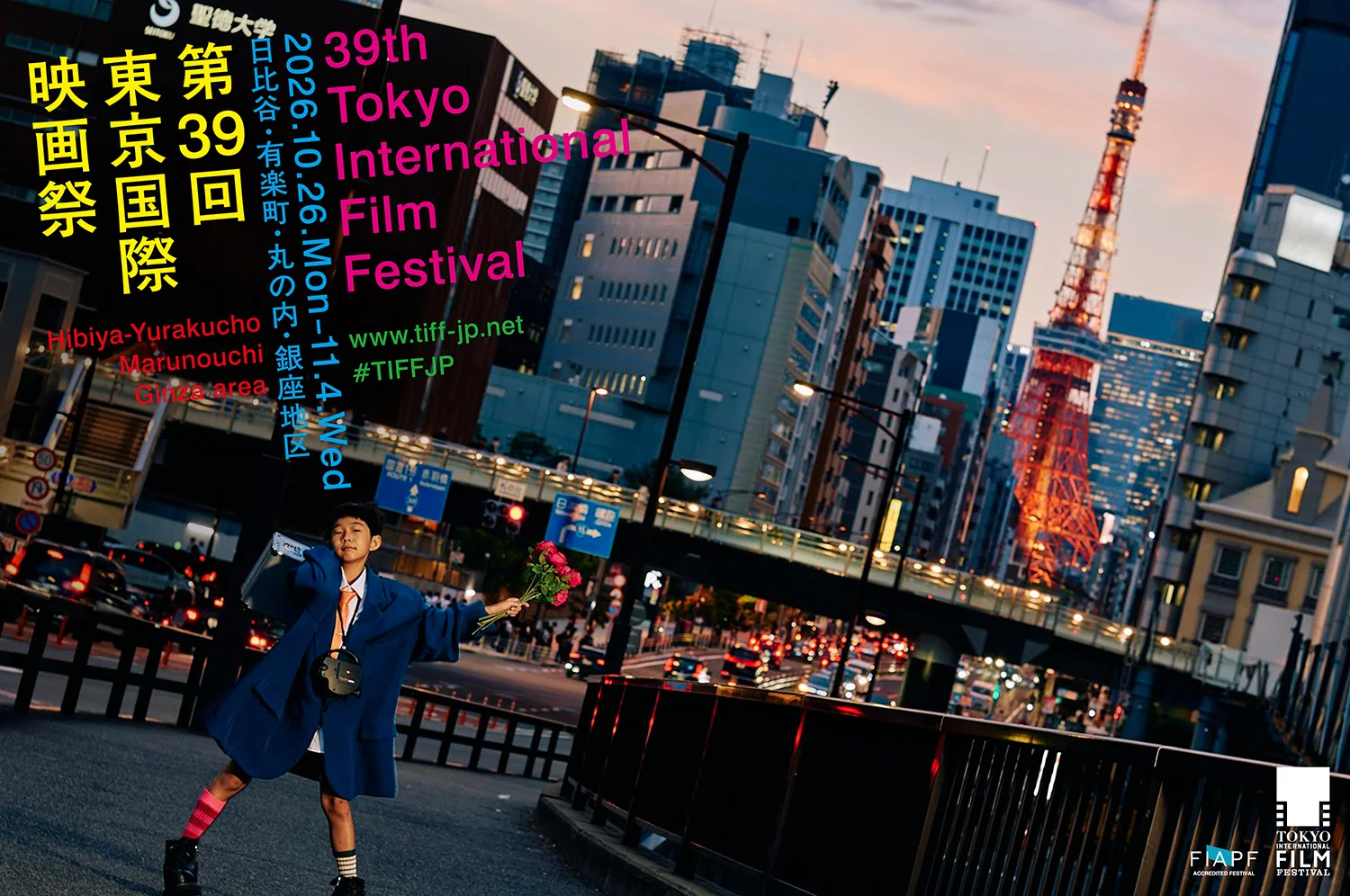
Under the crisp autumn breeze filtering through tree-lined metropolitan avenues, cheers from filmmakers worldwide and the passionate gazes of cinephiles converge upon the heart of Tokyo. As Japan's sole competitive feature film festival accredited by the International Federation of Film Producers Associations (FIAPF), the Tokyo International Film Festival (TIFF) has woven nearly half a century of cinematic history. Celebrating its landmark 39th edition in 2026, the festival unfolds across a vibrant 10-day span from Monday, October 26 to Wednesday, November 4, 2026, throughout Tokyo's cultural and commercial epicenters: the Hibiya, Yurakucho, Marunouchi, and Ginza districts.
From the premier international Competition contending for the pinnacle Tokyo Grand Prix / The Governor of Tokyo Award, to Asian Future spotlighting up-and-coming directors, the red-carpet Gala Selection, Nippon Cinema Now presenting the forefront of domestic filmmaking, and the globally beloved Animation section, over 200 exceptional films grace the screens. From its 1985 inception in Shibuya through its Roppongi chapter to its dramatic renaissance in Hibiya-Ginza, we explore its key organizational reforms, comparative analysis with Asian counterparts and the pinnacle Cannes Film Festival, alongside insider tips to navigate screenings and neighborhood walks for an unforgettable cinematic celebration.
[39th Tokyo International Film Festival (TIFF 2026) Event Overview]
- Festival Name: 39th Tokyo International Film Festival (TIFF)
- Dates: Monday, October 26 – Wednesday, November 4, 2026 (10 Days)
- Venues: Theaters and cultural facilities across Hibiya, Yurakucho, Marunouchi, and Ginza (TOHO Cinemas Hibiya, TOHO Cinemas Chanter, Marunouchi Piccadilly, Kadokawa Cinema Yurakucho, Cine Switch Ginza, Human Trust Cinema Yurakucho, Hulic Hall Tokyo, National Film Archive of Japan, Tokyo Midtown Hibiya Step Square, Tokyo Takarazuka Theater, Imperial Hotel Tokyo, etc.)
- Affiliated Content Market: TIFFCOM 2026 (Tokyo Metropolitan Industrial Trade Center Hamamatsucho-kan, etc.)
- Organizer: UNIJAPAN (39th TIFF Executive Committee)
- Co-organizers: Ministry of Economy, Trade and Industry (TIFFCOM), Tokyo Metropolitan Government (Tokyo Grand Prix, etc.)
- Supporters: Agency for Cultural Affairs, Japan National Tourism Organization (JNTO), Chiyoda City, Chuo City, etc.
- Key Sections: Competition, Asian Future, Gala Selection, Nippon Cinema Now, World Focus, Animation, Japanese Classics, TIFF Youth
- Top Honor: Tokyo Grand Prix / The Governor of Tokyo Award (Cash prize and official statuette)
10 Days of Cinematic Wonder in Ginza & Hibiya! The 39th TIFF Unveiled#
The Tokyo International Film Festival stands as one of Asia's preeminent international film platforms, where diverse global cultures and groundbreaking visual expressions intersect. Marking its 39th edition in 2026, the festival transforms the historical yet ultra-modern districts of Hibiya, Yurakucho, Marunouchi, and Ginza into an open-air wonderland where cinema spills from theatrical auditoriums out into sidewalks and public plazas for ten exhilarating days.
A defining hallmark of recent TIFF editions is its prime urban concentration: a dense cluster of premier screening facilities all situated within easy walking distance. State-of-the-art multiplexes like TOHO Cinemas Hibiya and Marunouchi Piccadilly seamlessly collaborate with revered bastions of art-house mini-theater culture such as Cine Switch Ginza and Kadokawa Cinema Yurakucho, as well as the National Film Archive of Japan—the ultimate sanctuary of cinematic heritage and celluloid projection. Attendees can leisurely stroll between screenings under pleasant autumn skies, indulging in rich multi-film marathons across varied theater environments throughout a single day.
Moreover, at Tokyo Midtown Hibiya's open-air Hibiya Step Square, massive high-definition LED screens host daily outdoor screenings free of charge. Relaxing on the spacious tiered grand staircase to watch beloved vintage classics and family favorites under evening skies has become an iconic, accessible autumn tradition welcoming everyday city strollers into the magic of the seventh art.
As dusk falls, vibrant red-carpet arrivals, filmmaker presentations, and post-screening Q&A sessions illuminate the district. Engaging directly in intimate dialogues with pioneering directors and actors from around the world offers audiences rare glimpses into the creative soul of filmmaking—the purest joy found only within a festival environment.
From Shibuya and Roppongi to Hibiya: Four Decades of Urban Transformation#
Inaugurated in 1985, the Tokyo International Film Festival has continually evolved in tandem with the capital's urban renewal and cultural shifting centers.
The inaugural 1985 edition launched in May across Shibuya's burgeoning youth quarter, utilizing Tokyu railway venues, Shibuya Public Hall, and the newly opened cultural complex Bunkamura. Premiering Akira Kurosawa's epic masterpiece Ran as its opening film, it garnered worldwide headlines as Japan's first full-scale international competitive film event. Initially held biennially, it shifted to an annual cadence from its 4th edition in 1991, cementing its global standing.
In 2004 (the 17th edition), the festival orchestrated a landmark relocation to the newly unveiled Roppongi Hills complex (TOHO Cinemas Roppongi Hills). Blending Roppongi's sleek architectural skyline, Keyakizaka's glittering red carpets, and cosmopolitan nightlife, TIFF entered a gilded era as an entertainment spectacle that attracted mass domestic audiences and Hollywood luminaries.
However, by the late 2010s, concerns arose regarding commercial dilution and waning cinephile engagement amidst fierce competition from burgeoning Asian festivals. In response, TIFF embarked on the boldest structural transformation in its history: relocating to the Hibiya, Yurakucho, and Ginza district in 2021 for its 34th edition.
Hibiya and Yurakucho possess deep historic significance as the birthplace of modern Japanese cinema, where major studios like Toho and Shochiku headquartered theater rows once known as "Japan's Broadway." This homecoming represented more than a geographic relocation; it signaled a decisive artistic pivot away from promotional entertainment toward uncompromising cinephilia, artistic rigor, and global resonance. This bold renewal earned resounding acclaim from domestic and overseas film communities, powerfully revitalizing the TIFF brand.
Rivalry in Asian Cinema: Tokyo (TIFF) vs Busan (BIFF) vs Shanghai (SIFF)#
As Asian cinema commands ever-greater prominence on the world stage, the Tokyo International Film Festival (TIFF) stands alongside South Korea's Busan International Film Festival (BIFF) and China's Shanghai International Film Festival (SIFF) as pillars shaping the region's film culture and markets. Each festival radiates distinctive character shaped by its unique origin, local setting, and programming philosophy.
| Comparison | Tokyo (TIFF) | Busan (BIFF) | Shanghai (SIFF) |
|---|---|---|---|
| Founded & Location | Est. 1985 Tokyo, Japan (Hibiya, Ginza) |
Est. 1996 Busan, South Korea (Haeundae) |
Est. 1993 Shanghai, China (Grand Theatre) |
| Core Philosophy | FIAPF-accredited competitive festival. Curatorial rigor emphasizing cinematic intellect. |
Asia's most vibrant celebratory gathering. Championing emerging indie auteurs. |
Commercial titan backed by huge domestic market. A-class status with mass audience scale. |
| Primary Strength | Immersive urban experience in central Tokyo. Sharp aesthetic selection & co-production support. |
Fervent civic engagement & festival energy. Dedicated Busan Cinema Center & active market. |
Unmatched market power of China's box office. Star-studded Asian and European premieres. |
| Industry Market | TIFFCOM (Multi-content market) | ACFM (Asian Contents & Film Market) | SIFFORUM / Shanghai Film Market |
| Recent Focus | Hibiya renaissance with cinephile focus, aligned closely with Cannes and Berlin trends. |
Renewed institutional stability, reinforcing its role as Asia's primary hub. |
Promoting domestic cinematic expansion, balanced with global auteur retrospectives. |
If Busan represents an explosive citywide celebration of Asian grassroots energy and Shanghai embodies the muscular scale of a massive domestic box office, Tokyo's distinct genius lies in its intellectual and artistic depth—a refined celebration of the medium's historical essence conducted within world-class metropolitan infrastructure.
Distinct Differences from the Pinnacle Cannes Film Festival: Exclusive Prestige vs Open Urban Festival#
When film lovers consider international cinema gatherings, the world's most prestigious summit—the Cannes Film Festival (Festival de Cannes) along the French Riviera—inevitably comes to mind. Holding supreme status among the "Big Three" alongside Berlin and Venice, how does Cannes compare with Tokyo, and what symbiotic relationship connects them?
| Comparison | Cannes Film Festival (France) | Tokyo International Film Festival (Japan) |
|---|---|---|
| Founded & Heritage | Est. 1946 (Approx. 80 years of history) | Est. 1985 (39th edition in 2026) |
| Global Prestige | Apex of the Big Three. The absolute summit of cinema art and commerce. |
Premier FIAPF-accredited Asian festival. East Asia's benchmark of curatorial excellence. |
| Public Access | Strictly Closed (Industry & Press Only). Exclusive badge system barred to general public. |
Fully Open (General Public Welcomed). Accessible to all filmgoers via public ticketing. |
| Premiere Requirement | Strict World Premieres Only. Reserved solely for unseen masterworks worldwide. |
Competition seeks premieres; other sections offer "Fastest Japan Premieres" of global festival gems. |
| Setting & Layout | Cote d'Azur Coastal Resort. Concentrated campus around Palais des Festivals. |
Ultra-Modern Megacity Center. Walkable urban festival spanning Ginza and Hibiya. |
| Industry Market | Marché du Film (World's largest global film rights market) |
TIFFCOM (Multi-content market for film, anime, and TV) |
| Highest Award | Palme d'Or (Golden Palm) | Tokyo Grand Prix / The Governor of Tokyo Award |
1. "Exclusive Professional Sanctum" vs "Democratic Celebration Open to All"#
The paramount divergence lies in whether everyday moviegoers can walk into the theater. Cannes is an uncompromising trade sanctum built strictly for distributors, buyers, producers, directors, and accredited journalists. Members of the general public cannot purchase tickets at the box office; admission is reserved for tuxedo- and evening-gown-clad badge holders.
In vivid contrast, TIFF is a democratic celebration open to every cinema enthusiast. By purchasing public tickets, any film lover can experience groundbreaking competition entries and participate directly in lively Q&A sessions with visiting directors and cast members. Furthermore, free open-air screenings at Hibiya Step Square invite local residents and casual visitors directly into the festival's radiant warmth.
2. Programming Philosophy: World Debuts vs Japan's Fastest Curatorial Showcase#
Because visionary directors worldwide aspire to debut their latest creations at Cannes, its Competition strictly mandates absolute World Premieres.
While Tokyo's Competition similarly seeks ambitious world and international premieres, TIFF's broader superpower lies in acting as Japan's fastest window to the masterpieces that shook Cannes, Berlin, and Venice earlier that year. Through its Gala Selection and World Focus sections, TIFF provides exquisite curatorial bridges bringing international cinematic triumphs directly to discerning Tokyo audiences.
3. Symbiotic Complementarity: A Gateway Connecting Asia and the World#
Far from adversarial rivals, Cannes and Tokyo enjoy a harmonious symbiosis within global film ecology. Acclaimed Cannes winners travel to Tokyo to establish vital footholds across Asian markets. Concurrently, groundbreaking Asian auteurs discovered in TIFF's Asian Future and Competition sections regularly ascend to Cannes' Un Certain Regard or main Competition with their subsequent features. If Cannes serves as the summit of professional contention, Tokyo provides the welcoming gateway celebrating world-class cinema for artists and audiences alike.
Key Visionaries Driving TIFF's Transformation: Hiroyasu Ando & Shozo Ichiyama#
TIFF's remarkable artistic revival is owed significantly to the strategic stewardship of two pivotal leaders.
The first is Hiroyasu Ando, who served as Festival Chairman beginning in 2019. A former diplomat and former President of the Japan Foundation, Ando leveraged profound international diplomacy and governmental networks to reform internal structures. He spearheaded the relocation to Hibiya-Ginza, committed TIFF to global gender equality compacts, and established the permanent "Kurosawa Akira Lounge / International Exchange Lounge," drastically elevating the festival's global transparency and international trust.
The second key figure is Programming Director Shozo Ichiyama, appointed in 2021. A venerated producer of early masterpieces by Takeshi Kitano, Hou Hsiao-hsien, and Jia Zhangke, and founder of Tokyo Filmex, Ichiyama brought uncompromising aesthetic vision to TIFF's lineup. He eliminated superficial star-centric programming in favor of pure artistic innovation and cinematic brilliance, winning widespread international acclaim for Tokyo's newfound programming integrity.
Additionally, the revival of the prestigious Kurosawa Akira Award marked another milestone, honoring luminaries such as Alejandro González Iñárritu, Koji Fukada, and Gu Xiaogang, burnishing TIFF's global prestige.
Essential Section Guide: The Tokyo Grand Prix and Notable Programs#
The 39th edition presents an extraordinary spectrum of programming catering to casual viewers and ardent cinephiles alike.
1. Competition Section#
The festival's crown jewel selects approximately 15 standout features from thousands of global submissions. Evaluated by an international jury of renowned filmmakers and actors, awards culminate on closing day with the Tokyo Grand Prix / The Governor of Tokyo Award, Special Jury Prize, Best Director, Best Actress, Best Actor, and Best Artistic Contribution. In 2024, Daihachi Yoshida's Teki achieved the Grand Prix, marking the first Japanese victory in 19 years.
2. Asian Future Section#
A competitive showcase dedicated to emerging Asian and Middle Eastern directors with up to three feature credits. Serving as a crucible of innovative voices, many honorees advance to future triumphs at Cannes and Venice.
3. Gala Selection Section#
A high-wattage program gathering celebrated international festival favorites, eagerly anticipated major entertainment premieres, and latest works by world masters, complete with star-studded red carpets and stage appearances.
4. Nippon Cinema Now Section#
Curating exceptional contemporary Japanese cinema reflecting bold auteurist visions and unique aesthetics, actively promoting domestic talent to visiting international programmers and critics.
5. Animation & Japanese Classics Sections#
Showcasing the pinnacle of Japanese anime artistry alongside stunning 4K digital restorations of historic masterpieces, breathing vibrant life into century-old celluloid treasures.
Navigating the Festival: Step Square and Practical Ticketing Tips#
Maximizing your festival experience across Tokyo's vibrant central districts requires thoughtful preparation:
[Pro Tips for Navigating the Tokyo International Film Festival]
- Monitor Ticket Release Dates: High-profile gala screenings, opening/closing films, and sessions featuring guest appearances sell out within minutes of general release. Register accounts and newsletters on the official website beforehand.
- Budget Sufficient Transit Intervals: While theaters in Hibiya, Yurakucho, and Ginza sit within a 5-to-15-minute walk, post-screening Q&A sessions often run over. Maintain at least 40 to 60 minutes between scheduled screenings.
- Take Advantage of Outdoor Screenings: The open-air screenings at Tokyo Midtown Hibiya's Step Square require no tickets or reservations. Bring a warm jacket or wrap to enjoy free evening cinema in crisp autumn air.
- Actively Engage in Q&A Sessions: Post-screening discussions allow direct interactions with visionary directors and actors, deepening your understanding of narrative themes and behind-the-scenes artistry.
Between screenings, take time to visit vintage kissaten in Ginza, discuss cinematic discoveries over coffee, and savor autumn delicacies beneath Yurakucho's historic railway arches—an elevated urban lifestyle unique to TIFF.
Connecting Cinema and the Future: TIFF's Enduring Cultural Role#
In an era dominated by on-demand streaming algorithms, gathering together in darkened theaters to breathe, laugh, and shed tears in unison remains an irreplaceable communal sacrament. Cinema connects souls across cultural borders, allowing us to inhabit lives unfamiliar to our own.
The Tokyo International Film Festival endures not merely as an exhibition showcase, but as a vital cultural bridge fostering cross-border dialogue and mutual empathy in an increasingly divided world. In autumn 2026, the screens illuminated across Hibiya, Yurakucho, and Ginza will once again cast their radiant light upon the rich diversity of human storytelling.
[Sources]
- Tokyo International Film Festival (TIFF) Official Website
- Festival de Cannes Official Website
- The Japan Foundation "Arts and Cultural Exchange"
- Agency for Cultural Affairs "Film and Visual Arts Promotion"