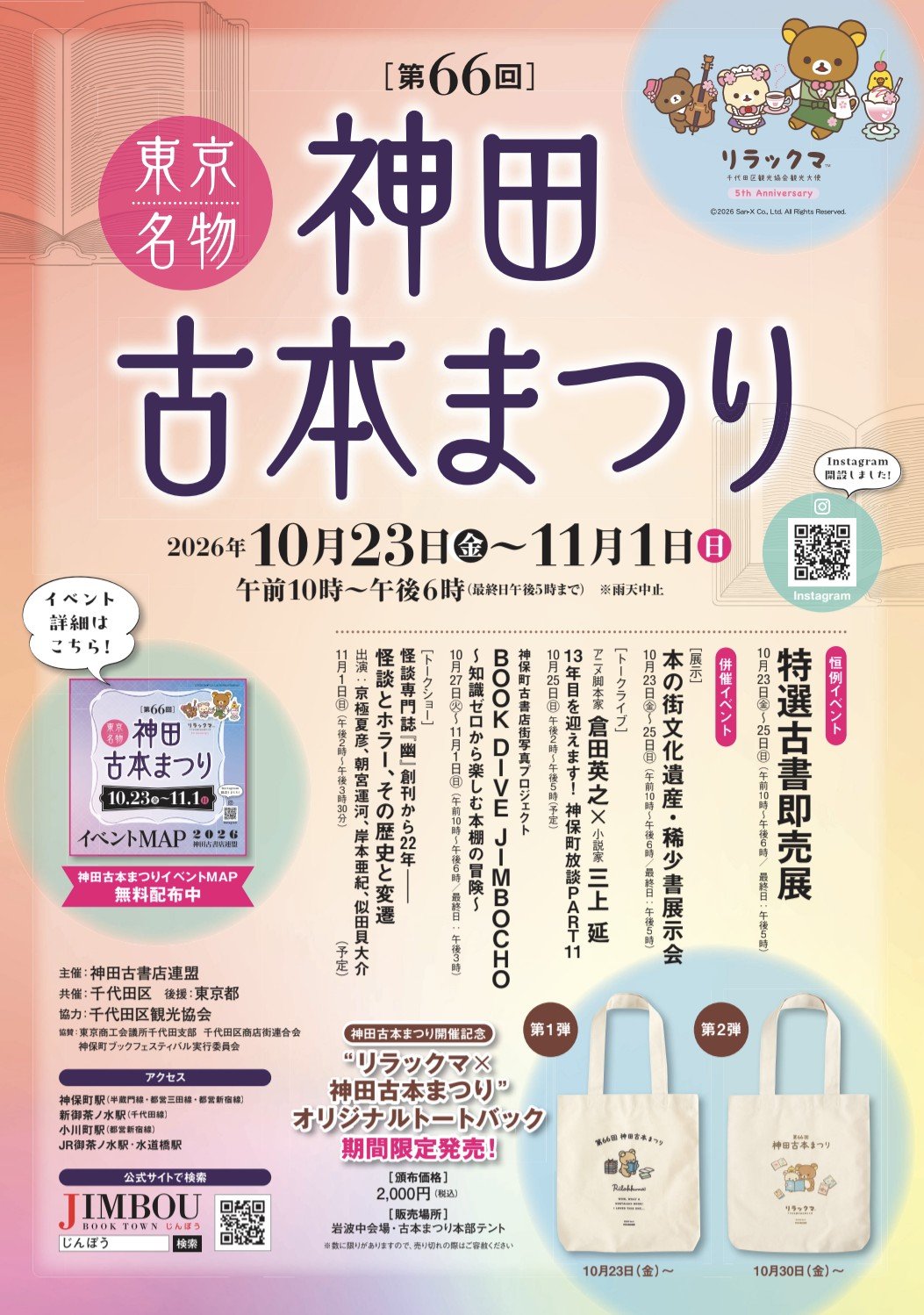
Under crystal-clear autumn skies, the season has arrived when the nostalgic scent of vintage movable type and the tactile warmth of aged paper permeate every corner of the street. Kanda Jinbocho in Chiyoda Ward, Tokyo, is universally revered across the globe as the world's premier used book district, densely packing approximately 130 bookstores and antiquarian dealers into a vibrant cultural enclave. (Later sections explore comparisons with renowned book towns worldwide.) The crowning event that stirs this neighborhood to its highest fever pitch all year is the "Tokyo Specialty: Kanda Used Book Festival," held in harmony with Japan's annual autumn Reading Week (October 27 to November 9).
Celebrating its milestone 66th edition in 2026, the Kanda Used Book Festival runs for 10 glorious days from Friday, October 23 to Sunday, November 1. Along the sidewalks of the main artery, Yasukuni-dori, more than 100 outdoor book wagons line up end-to-end, forming a breathtaking 500-meter "Corridor of Books (Open-Air Bargain Fair)." Hundreds of thousands of bibliophiles, scholars, collectors, and international travelers descend upon this dizzying ocean of over 1 million volumes, all searching for that singular, miraculous find. From its Meiji-era origins as a student district and insider treasure-hunting tips to comparisons with the concurrent Jinbocho Book Festival, historic kissaten cafes, and fragrant curry houses favored by literary giants, here is your definitive guide to experiencing the ultimate autumn celebration of print culture.
[66th Tokyo Specialty Kanda Used Book Festival Event Overview]
- Event Name: The 66th Tokyo Specialty Kanda Used Book Festival
- Dates: Friday, October 23 – Sunday, November 1, 2026 (10 Days) *Open-Air Bargain Fair canceled in rain
- Hours: 10:00 AM – 6:00 PM (Closes at 5:00 PM on final day, Nov 1)
- Venues: Kanda Jinbocho Antiquarian Book Quarter (Yasukuni-dori sidewalks, Iwanami Courtyard Venue, Tokyo Kosho Kaikan Hall, etc.)
- Main Events: Open-Air Bargain Fair (Corridor of Books), Special Antiquarian Book Sale (Oct 23–25), Rare Book Exhibitions, Official Collaborations (Limited-edition tote bags featuring Chiyoda Tourism Ambassador Rilakkuma, etc.)
- Scale: Approx. 120 participating bookshops, over 1 million total volumes on display
- Admission: Free admission (Individual book purchases paid separately)
- Nearest Transit: Direct access from Jinbocho Station (Toei Shinjuku & Mita Lines, Tokyo Metro Hanzomon Line); 8–10 min walk from JR Ochanomizu and Suidobashi Stations
- Organizer: Kanda Antiquarian Booksellers Federation (Co-organized by Chiyoda Ward, Chiyoda City Tourism Association, Tokyo Antiquarian Booksellers Cooperative, etc.)
- Venue Notice: Due to ongoing reconstruction of the Iwanami Jinbocho Building, some event layouts have shifted. Please consult on-site signage.
A 500m "Corridor of Books" Appears! 1 Million Volumes Swarm the Pavements#
The crown jewel of the Kanda Used Book Festival is undoubtedly the legendary "Open-Air Bargain Fair" sprawling along the sidewalks of Yasukuni-dori. Centered primarily on the southern pavement stretching from Surugadaishita intersection through Jinbocho intersection toward Senshu University, around 120 antiquarian bookstores roll out their display carts simultaneously, creating an uninterrupted 500-meter "Corridor of Books."
More than 1 million volumes grace the wagons throughout the festival's duration. The offerings are wonderfully eclectic, ranging from 100-yen bargain bins piled high with paperbacks and pocketbooks to lavish art monographs, architecture folios, vintage cinema pamphlets, retro manga, out-of-print literature, and specialized academic treatises. Each shop releases prized inventory at deep gratitude discounts (frequently half-price or uniform low fees). The fair’s greatest delight lies in making high-end specialty dealers—whose quiet storefronts might seem intimidating to casual passersby—accessible to everyone under open skies.
At 10:00 AM on opening day, seasoned connoisseurs and passionate collectors swarm the wagons the moment bells ring, igniting an electrifying surge of excitement along the pavement. Unearthing a long-sought first edition hidden in the back row or rediscovering a nostalgic periodical you thought lost forever is a true serendipitous encounter. That focused, hungry sparkle in visitors' eyes has become an iconic autumn portrait of Jinbocho.
Because the Open-Air Bargain Fair takes place outdoors, it is suspended during rainy weather, with blue waterproof tarps thrown over the wagons. On overcast days, checking the official portal "BOOKTOWN Jinbocho" or weather forecasts before venturing out is strongly advised.
Communing with Living History: Tokyo Kosho Kaikan's Special Antiquarian Sale#
If the open-air stalls along Yasukuni-dori offer the thrill of popular treasure hunting, the "Special Antiquarian Book Sale" held at Tokyo Kosho Kaikan in Kanda-Ogawamachi is a sanctuary for connoisseurs seeking museum- and cultural-property-grade masterpieces. Spanning the first three days of the festival from Friday, October 23 to Sunday, October 25, this prestigious exhibition takes place in the building's basement hall.
Here, the elite members of the Kanda Antiquarian Booksellers Federation display their finest, hand-selected treasures. Visitors will find traditional Japanese woodblock-printed wahon from the Edo period, handwritten manuscripts and signed first editions by Meiji and Taisho literary giants, historical calligraphy, and rare Western incunabula—primary cultural artifacts seldom witnessed outside glass vitrines in national libraries or fine art museums.
Prices range from accessible historical ephemera costing a few thousand yen to museum-tier rarities valued in the millions. The hall buzzes with quiet, reverent intensity. Concurrently, the 2nd-floor information gallery hosts the "Book Town Cultural Heritage & Rare Book Exhibition," showcasing irreplaceable archival artifacts free of charge. Even without purchasing, browsing this space offers an awe-inspiring masterclass in the depths of global print civilization.
Why Did Jinbocho Become the World's Premier Book Quarter? Student Roots & Fires#
Jinbocho's emergence as an unparalleled antiquarian hub was no mere accident; it was a historical inevitability closely intertwined with Japan's modernization following the Meiji Restoration.
In early Meiji, prestigious institutions of higher learning gathered in rapid succession around Kanda, Surugadai, and Ochanomizu, including the University of Tokyo, Tokyo Law School (now Hosei University), Meiji Law School (now Meiji University), Senshu School (now Senshu University), English Law School (now Chuo University), and Nihon Law School (now Nihon University). As this district blossomed into Japan's largest student metropolis, bookstores catering to students and professors needing costly legal tomes, scientific papers, and imported Western texts naturally multiplied.
A pivotal turning point arrived with the Great Kanda Fire of 1913 (Meiji 46). Amid the ashes of Jinbocho, Shigeo Iwanami founded a modest second-hand bookstore named "Iwanami Shoten." The following year, he funded the self-publishing of Natsume Soseki's masterpiece novel Kokoro, scoring an immense triumph that cemented Jinbocho's prestige as the national crucible of academic thought and literary publishing.
There is also an ingenious geographical secret etched into Jinbocho's streetscape. Strolling Yasukuni-dori, one notices that almost all antiquarian shops stand along the southern curb, facing strictly north. This deliberate orientation shields fragile paper, ink, and binding glue from the sun's damaging ultraviolet rays. Preserved through the devastating 1923 Great Kanto Earthquake and the air raids of World War II by devoted bookmen, this architectural resilience gave Jinbocho its enduring character. Established in 1960 (Showa 35) to commemorate national Reading Week, the Kanda Used Book Festival has carried this civic pride and love of letters forward for more than half a century.
Kanda Used Book Festival vs Jinbocho Book Festival: Two Great Literary Feasts#
Visitors to Jinbocho in autumn often confuse the "Kanda Used Book Festival" with the concurrent "Jinbocho Book Festival." While both ignite the passions of bookworms, they differ fundamentally in character, organizers, and merchandise, as illustrated below.
| Comparison | Kanda Used Book Festival (Antiquarian Federation) |
Jinbocho Book Festival (Executive Committee / Publishers) |
Shimogamo Antique Book Fair (Kyoto Antiquarian Research) |
|---|---|---|---|
| Main Participants | Antiquarian Bookstores (~120 shops) Independent Jinbocho dealers |
Publishers (100+ publishers) Major and indie publishing houses |
Kansai Dealers (~40 shops) Dealers from Kyoto, Osaka, Hyogo |
| Book Selection | Used, Antiquarian, Rare Books Out-of-print paperbacks, academia, art |
New Books at Bargain Prices Overstock, discounted new titles, children's |
Kansai Heritage & Classic Literature Local history, Japanese bindings, vintage |
| Primary Venue | Yasukuni-dori Sidewalks (500-meter "Corridor of Books") |
Kanda Suzuran & Sakura Streets (Pedestrian shopping alleyways) |
Tadasu no Mori, Shimogamo Shrine (Sacred primeval forest path) |
| Festival Timing | Late Oct to Early Nov (10 days) (Aligned with Reading Week) |
Autumn weekend (2–3 days) (Held concurrently alongside Used Book Fair) |
Mid-August (Obon Season) (Kyoto's summer cooling tradition) |
| Character | Unearthed scholarship and rare treasures World's largest antiquarian open market |
Direct publisher sales, author signings Family-friendly celebration of new print |
Serene reading amidst ancient shrine woods Kyoto's quintessential literary tradition |
| Shopping Appeal | Serendipitous one-of-a-kind vintage gems Unrivaled academic specialization |
Fixed-price new releases at 30–50% off Bulk savings on illustrated books |
Rich repository of Kyoto temple records Luxurious outdoor reading under shade |
In essence, while Yasukuni-dori celebrates second-hand dealers preserving out-of-print heritage, Suzuran-dori showcases publishing houses selling brand-new overstock and discount releases directly to readers. Strolling back and forth between both boulevards is the definitive autumn pilgrimage for any literary explorer.
Global Perspective: Jinbocho vs Iconic Book Towns of the World#
Across the globe, designated "Book Towns" foster dedicated cultures of literacy and print heritage. Yet examining their foundations, geography, and book offerings reveals just how remarkably singular Kanda Jinbocho is on the world stage. Here, we examine three famous international book havens to illuminate their parallels and contrasts with Jinbocho.
1. Wales, UK: Hay-on-Wye
The cradle that birthed and popularized the very concept of the "Book Town." A rural hamlet of merely 1,000 residents on the Welsh border, Hay was transformed in the 1970s by Richard Booth, who opened second-hand bookshops in disused venues, ultimately founding the International Organisation of Book Towns (IOBT). Renowned for open-air honesty bookcases along Norman castle walls and thematic boutiques focusing on poetry, cinema, and botany, Hay also hosts the annual Hay Festival—acclaimed by Bill Clinton as "the Woodstock of the mind." Globally, bibliophiles recognize Hay-on-Wye and Jinbocho as the twin western and eastern titans of the book world.
2. Kolkata, India: College Street
Matching and arguably exceeding Jinbocho in sheer book volume and physical density, College Street is one of the planet's largest second-hand book bazars. Affectionately called "Boi Para" (Book Town) in Bengali, its academic setting surrounding Calcutta University and Presidency University mirrors Jinbocho's student heritage. Spanning roughly 1.5 kilometers, countless small timber and bamboo stalls line the sidewalks shoulder-to-shoulder, conducting commerce in academic texts, Bengali classics, and rare international editions amidst a dizzying vortex of intellectual passion.
3. Wallonia, Belgium: Redu
Continental Europe's pioneering book town, established in 1984 following the blueprint of Hay-on-Wye (and profiled by global media like National Geographic). Nestled amid the verdant Ardennes forests and affectionately hailed as "the village that smells of old paper," this tranquil village houses dozens of antiquarian shops, bookbinders, and paper artisanal studios, hosting an acclaimed Easter book fair each spring.
| Comparison | Kanda Jinbocho (Tokyo, Japan) |
Hay-on-Wye (Wales, UK) |
College Street (Kolkata, India) |
Redu (Wallonia, Belgium) |
|---|---|---|---|---|
| Setting & Character | Hyper-dense urban metropolis (World's largest antiquarian district) |
Quiet historic castle hamlet (Original rural book town pioneer) |
Sprawling university avenue (World's largest street-stall market) |
Pastoral woodland village (Continental Europe's first book village) |
| Store Count & Format | ~130 multi-story specialized shops (High-rise commercial density) |
~30 quaint shops in stone cottages (Famous honesty wall-shelves) |
Thousands of makeshift roadside stalls (Bustling open-air street bazar) |
~20 shops in converted barns (Artisanal bookbinding studios) |
| Curatorial Focus | Hyper-specialized (wahon, art, philosophy, science, manga, subcultures) | Eclectic European literature, poetry, botany, rare illustrated classics | University textbooks, academic monographs, Bengali & English print | French/Dutch literature, bande dessinée, cartography, fine bindings |
| Key Events | Kanda Used Book Festival (Autumn) Jinbocho Book Festival |
Hay Festival (Global literary symposium) |
Kolkata International Book Fair (World's largest non-trade fair) |
Easter Book Fair Nuit du Livre (Summer nocturnal fair) |
| Contrast with Jinbocho | Urban intellectual infrastructure | Rural tourism and heritage revival | Chaotic, vibrant student bazaar | Idyllic countryside literary retreat |
While Hay-on-Wye and Redu revitalized depopulated villages into bucolic literary retreats, Jinbocho stands apart as the world's only hyper-specialized megacity book quarter, evolving over a century in organic synergy with national universities and publishing conglomerates. The Kanda Used Book Festival remains an irreplaceable living museum honoring the human story of ink and paper.
Essential Tactics for Visitors: Treasure Hunting & Comfort Guide#
Navigating 1 million volumes without regret requires practical forethought. Here are battle-tested strategies from veteran book collectors.
[Key Rules for Comfort and Success at Kanda Used Book Festival]
- Backpacks and Sturdy Totes: Books are dense and heavy; carrying paper gift bags by hand quickly leads to strained fingers and exhaustion. Bring a comfortable backpack to keep both hands free for browsing wagons, along with durable shoulder bags.
- Cash and Coins Prepared: Outdoor wagons overwhelmingly favor cash, especially at 100-yen bargain racks. Having ample 100-yen coins and 1,000-yen notes ensures swift, hassle-free transactions.
- Gloves and Wet Wipes: Sifting through thousands of aged volumes exposes fingertips to ink residue and dust. Lightweight driving gloves and pocket wet wipes keep your hands clean throughout the day.
- Prime Hunting Windows: Collectors snatch up top rarities on Friday morning of opening day. For leisurely browsing without crushing crowds, weekday mid-afternoons are ideal. Books are replenished continuously by merchants.
- Rain Protection: Sudden autumn showers are fatal to paper. Pack ziplock bags or waterproof tote liners alongside a compact umbrella.
Direct subway access via Jinbocho Station (Exits A5 and A7) places you immediately in front of the open-air stalls. Alternatively, a pleasant 10-minute stroll downhill from JR Ochanomizu Station allows you to wander past famous musical instrument shops and Kanda Shrine.
Literary Cafes and Curries: Savoring Jinbocho's Iconic Gourmet Culture#
Beyond the printed page, Jinbocho entices with its legendary kissaten (vintage coffee shops) and fragrant curry sanctuaries.
Jinbocho is acclaimed as Tokyo's premier curry battleground. Legend has it that scholars and university students favored curry because it could be eaten briskly with one hand while holding open a book with the other. Landmarks include "Bondy," the pioneer of European-style curry founded in 1973, "Kyoeido" (established in 1924, serving dark, bittersweet Sumatran curry), and spice temple "Ethiopia."
When ready to open your newly acquired books, step into an atmospheric Showa-era coffee house. The brick-clad mountain cabin "Sabouru" is celebrated for towering Neapolitan pasta and rainbow cream sodas; hidden alley gem "Ladrio" claims to be Japan's birthplace of Vienna coffee; while "Milonga Nueva" envelops patrons in vintage tango vinyl and rich dark roasts. Sipping warm coffee while turning crisp antique pages is Jinbocho's most sublime autumn pleasure.
Finally, Books in the Age of AI#
Recent news reported that AI company Anthropic purchased massive quantities of used books from publishers and wholesalers to scan, digitize, and feed into AI training models, sparking concerns that physical book culture might someday wither away. Outside certain regions like Africa, population decline has become an overarching global reality. Even in our own neighborhoods, beloved shops vanish simply because there are no successors to inherit them, making it impossible to ever return—we have truly entered an era where every encounter is a once-in-a-lifetime "ichigo ichie."
This silent erosion is unfolding across food, crafts, and culture alike, which was one of the personal motivations for launching this blog. Being able to experience things firsthand with our own senses is an exquisite blessing. All too often, by the time we learn of a remarkable place or event, it has already slipped into history, leaving us unable to participate. In the physical realm, time is never on our side. Particularly for those of us around sixty, our remaining days are finite. Let us cherish every precious encounter while we can.
[Sources]#
- BOOKTOWN Jinbocho Official Portal: Kanda Antiquarian Booksellers Federation
- Chiyoda City Tourism Association Official Portal
- Tokyo Antiquarian Booksellers Cooperative: "Japanese Antique Books"