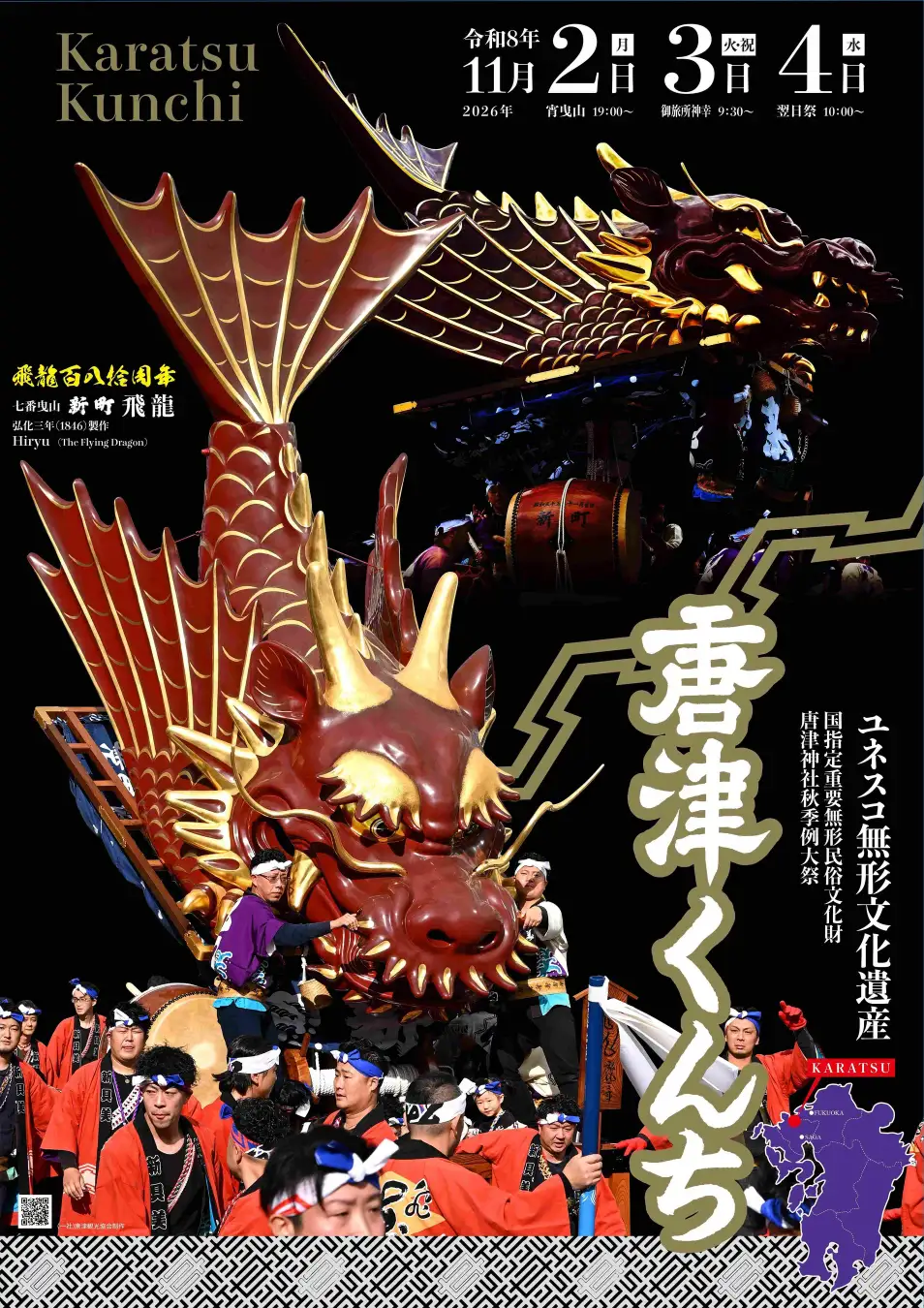
Karatsu Kunchi 2026: Splendor of 14 Giant Lacquer Floats
Following Nagasaki, welcome to Saga! The annual Karatsu Kunchi festival at Karatsu Shrine runs Nov 2–4, 2026. Featuring 14 massive lacquer floats dating back to 1819, enjoy this UNESCO heritage.
As autumn deepens and crisp sea breezes sweep through the historic castle town from the Genkai Sea, Karatsu City in Saga Prefecture enters its most passionate and exhilarating season of the year. Karatsu Kunchi, the autumn grand festival of Karatsu Shrine with over 200 years of history, is a nationally designated Important Intangible Folk Cultural Property. In 2016, it was inscribed on UNESCO's Representative List of the Intangible Cultural Heritage of Humanity as part of the Yama, Hoko, Yatai float festivals in Japan.
Karatsu Kunchi 2026 will be held across three dynamic days from Monday, November 2 to Wednesday, November 4, 2026. The true stars of this festival are 14 magnificent Hikiyama floats, led by the oldest float Akajishi (Red Lion), dedicated in 1819 during the late Edo period. Created through the ancient dry lacquer technique (Ikkanbari) using hundreds of layers of washi paper coated in fine urushi lacquer and lavish gold leaf, these colossal masterpieces race through castle streets to the lively rhythm of flutes, drums, and bells, accompanied by roaring shouts of 'Enya, Enya!' and 'Yoisa, Yoisa!'
From the enchanting Yoiyama night procession lit by thousands of glowing lanterns, to the climactic Hikikomi at the Otabisho where multi-ton floats plunge into sandy coastal banks, and the bittersweet Machimawari finale—this article offers a comprehensive guide to Karatsu Kunchi 2026, exploring its history, the complete 14-float lineup, comparisons with the Three Great Kunchi of Japan, and essential visitor guidelines.
【Karatsu Kunchi 2026: Event Overview & Schedule】
- Festival Name: Karatsu Kunchi (Karatsu Shrine Autumn Grand Festival)
- Dates: Monday, November 2 – Wednesday, November 4, 2026 (3 Days)
Daily Schedule:
- Nov 2 (Mon) Yoiyama (Eve Procession): 19:00 – 21:30 approx. (Departs near Oteguchi. Note: Departure advanced to 19:00)
- Nov 3 (Tue, Holiday) Otabisho Shinko (Main Procession): 09:30 – 16:30 approx. (Nishi-no-hama Hikikomi at approx. 12:00 / Hikidashi at 15:00)
- Nov 4 (Wed) Machimawari / After-Festival: 10:00 – 16:40 approx. (Final float storage at Hikiyama Exhibition Hall approx. 16:30)
- Location: Karatsu City, Saga Prefecture (Karatsu Shrine grounds, historic castle town streets, Nishi-no-hama Otabisho)
- Organizers: Karatsu Shrine, Karatsu Hikiyama Torishimarikai (Float Steering Board)
- Cultural Designations: National Important Intangible Folk Cultural Property (1980) / UNESCO Intangible Cultural Heritage (2016)
- Number of Floats: 14 existing floats (Ikkanbari urushi lacquer crafts / Saga Prefectural Important Tangible Folk Cultural Property)
- Attendance: Approx. 500,000 visitors over 3 days
- Access: Approx. 10-minute walk from JR Karatsu Station (Karatsu Line & Chikuhi Line) to Karatsu Shrine
Historical Background: From Ancient Myth to the Red Lion of 1819#
The roots of Karatsu Kunchi are deeply intertwined with the ancient founding of Karatsu Shrine. According to legend, Empress Jingu enshrined the Sumiyoshi Sanjin deities here to pray for safe navigation across the seas, and shrine pavilions were officially erected during the Tengyo era (938–947).
The word 'Kunchi' originates from 'Kunichi' (the 9th day), referring to the Chrysanthemum Festival (Choyo no Sekku) held on the ninth day of the ninth lunar month. It has long been celebrated as an autumn harvest thanksgiving festival. Originally observed on the 29th day of the ninth lunar month, the date shifted after the Meiji calendar reform and settled into its current November 2–4 dates in 1968.
The introduction of the spectacular floats occurred in 1819 (Bunsei 2) during the late Edo period. Kahei Ishizaki, a master swordsmith leading the Katana-machi merchants, was inspired by the sacred floats of Kyoto's Gion Festival and pilgrimages to Ise Grand Shrine. He crafted and dedicated the 'Akajishi' (Red Lion) to Karatsu Shrine as a divine escort for the sacred palanquins.
Electrified by this magnificent creation, neighboring merchant districts competed fiercely to build their own floats. Nakama's Blue Lion, Zaimokucho's Turtle and Urashima Taro, Gofukumachi's Helmet of Minamoto no Yoshitsune, and Uoyamachi's Sea Bream followed in rapid succession. Over a span of just 50 years between the late Edo and early Meiji periods, 15 floats were born. The patronage of the Karatsu Domain combined with flourishing merchant wealth gave rise to an extraordinary cultural legacy found nowhere else on earth.
Pinnacle of Craftsmanship: World's Largest Dry Lacquer (Ikkanbari) Art#
The global acclaim surrounding Karatsu Kunchi's Hikiyama stems from their breathtaking artistic beauty and unprecedented craftsmanship. Weighing between 2 to 4 metric tons and standing 5 to 7 meters tall, these monumental sculptures are not carved from wood; they are fashioned using an ancient dry lacquer technique known as Ikkanbari.
Craftsmen first construct a temporary mold from clay and wooden framing. Hundreds of layers of fine Mino washi paper are painstakingly pasted over the mold using persimmon tannin and paste. Once thoroughly dried, the interior mold is removed, reinforced with wooden trusses, lined with hemp cloth, and coated with dozens of layers of raw, black, and colored urushi lacquer. Polished repeatedly to a mirror finish, they are embellished with gold and silver leaf.
This unique method produces structures far lighter and more resilient than solid timber, allowing for fluid three-dimensional curves and sculpted contours. Resilient against changing temperatures and sea humidity, they have withstood over two centuries of vigorous festival maneuvering.
Building a single Hikiyama today is estimated to cost hundreds of millions of yen. All 14 floats are designated Tangible Folk Cultural Properties of Saga Prefecture. Periodic comprehensive restorations cost tens of millions of yen and require years of dedicated artisan labor. The deep pride and devotion of each neighborhood association have preserved these priceless treasures across generations.
Magnificent Spectacle: Complete Guide to the 14 Hikiyama Floats#
The 14 Hikiyama floats parade in strict chronological order according to the year they were built. Each district's motif reflects myths, folklore, heroic warlords, and auspicious creatures, representing the pinnacle of merchant aesthetics.
| No. | District | Float Name | Year Built | Motif & Key Characteristics |
|---|---|---|---|---|
| 1 | Katana-machi (刀町) | Akajishi (赤獅子) | 1819 | The oldest float. A majestic lion's head finished in radiant vermilion lacquer, honored to lead the entire procession. |
| 2 | Naka-machi (中町) | Aojishi (青獅子) | 1824 | Built to rival the Red Lion. Deep navy lacquer bordering on midnight black conveys regal solemnity. |
| 3 | Zaimoku-cho (材木町) | Kame to Urashima Taro (亀と浦島太郎) | 1841 | Folkloric masterpiece depicting Urashima Taro riding a giant sea turtle whose neck animates up and down. |
| 4 | Gofuku-machi (呉服町) | Minamoto no Yoshitsune no Kabuto (源義経の兜) | 1844 | Elegant helmet symbolizing the legendary warrior Yoshitsune, adorned with exquisite lacquer filigree. |
| 5 | Uoya-machi (魚屋町) | Tai (鯛) | 1845 | Vivid scarlet fish with charming wide eyes. Its pectoral and tail fins sway rhythmically during transit, delighting spectators. |
| 6 | Oishi-machi (大石町) | Ho-o-maru (鳳凰丸) | 1846 | Magnificent royal barge topped with a mythological phoenix, richly detailed in gold leaf and fine pigment. |
| 7 | Shin-machi (新町) | Hiryu (飛龍) | 1846 | Dynamic winged dragon clutching a sacred jewel with sharp talons, embodying raw elemental power. |
| 8 | Hon-machi (本町) | Kinjishi (金獅子) | 1847 | Gilded lion completely coated in pure gold leaf, completing the trio of legendary lion floats. |
| 9 | Kiwata-machi (木綿町) | Takeda Shingen no Kabuto (武田信玄の兜) | 1864 | Fierce helmet of the 'Tiger of Kai,' adorned with flowing white manes and a fearsome demon crest. |
| 10 | Hirano-machi (平野町) | Uesugi Kenshin no Kabuto (上杉謙信の兜) | 1869 | Dignified helmet of the 'Dragon of Echigo,' featuring a sunburst crest and celestial lion-mask ornament. |
| 11 | Komeya-machi (米屋町) | Shuten-doji to Minamoto no Yorimitsu no Kabuto (酒呑童子と源頼光の兜) | 1869 | Dramatic theatrical scene depicting the severed head of demon Shuten-doji biting into Raiko's battle helmet. |
| 12 | Kyo-machi (京町) | Tamatori Jishi (珠取獅子) | 1875 | Two dynamic lions grappling over a precious jewel, showcasing the peak of late-Edo dry lacquer virtuosity. |
| 13 | Kako-machi (水主町) | Shachi (鯱) | 1876 | Mythical tiger-headed carp guarding castle keeps, featuring a dramatic upturned tail and bold scales. |
| 14 | Egawa-machi (江川町) | Shichihomaru (七宝丸) | 1876 | Grand treasure ship forming the rearguard, carrying a dragon prow and the auspicious treasures of the Seven Lucky Gods. |
Number One 'Akajishi' carries the solemn honor of leading the festival. Number Two 'Aojishi' was crafted in direct response to Katana-machi, with its midnight lacquer radiating quiet majesty. Number Five 'Tai' (Sea Bream) is beloved nationwide for its playful swaying fins and lively crimson curves.
The warlord helmet floats—Takeda Shingen, Uesugi Kenshin, and Minamoto no Yorimitsu—bring dynamic samurai epics to life in towering three dimensions. Note that a 15th float, the 'Kurojishi' (Black Lion) of Konyamachi built in 1847, was tragically destroyed by fire in 1889, leaving the 14 enduring masterpieces celebrated today.
Three Days of Passion: Yoiyama, Otabisho Shinko, and Machimawari#
Each of Karatsu Kunchi's three days offers distinct emotional atmosphere and theatrical climaxes.
Day 1 – Nov 2: Yoiyama (Eve Procession)
At 19:00, evening darkness settles over the castle town as thousands of lanterns illuminating the Hikiyama are lit at once. Gliding through cobblestone streets, the lacquered surfaces gleam warmly beneath paper lanterns. Flutes and drums echo through the crisp autumn night as all 14 floats gather outside Karatsu Shrine. (Note: Departure time advanced to 19:00).
Day 2 – Nov 3: Otabisho Shinko (Main Procession)
The festival reaches its fever pitch on the national holiday of Culture Day. At 09:30, two sacred palanquins depart Karatsu Shrine, escorted by the 14 towering floats through town toward the sandy grounds of Nishi-no-hama.
Around noon, the festival's most famous spectacle—Hikikomi—unfolds. The heavy floats encounter deep, shifting coastal sand, their massive wooden wheels sinking swiftly. Hundreds of pullers (Hikiko) dig their feet into the earth, roaring 'Enya, Enya!' in thunderous unison. Muscular pulling crews strain every fiber to haul the 4-ton behemoths into formation, erupting in euphoric applause. At 15:00, the equally dramatic Hikidashi (pulling out) begins.
Day 3 – Nov 4: Machimawari / After-Festival
The final day adopts a warmer, intimate community feel. Floats navigate narrow neighborhood alleyways, sharing laughter with residents and visiting families. By evening, the floats assemble before the Hikiyama Exhibition Hall for their final storage (Hikiname). The fading notes of the festival flutes leave an enduring sense of bittersweet reverence.
Comparison: The Three Great Kunchi of Japan#
Representing Kyushu's proud autumn festival heritage, Karatsu Kunchi, Nagasaki Kunchi, and Hakata Okunchi all share roots in the Chrysanthemum Festival, yet each evolved with distinctive regional personalities.
| Festival Name | Shrine & Location | Distinctive Form & Style | Main Highlight | Iconic Chant |
|---|---|---|---|---|
| Karatsu Kunchi | Karatsu Shrine (Karatsu, Saga) | 14 monumental dry lacquer floats paraded through town | Thrilling Hikikomi into the sandy beach at Nishi-no-hama | 'Enya, Enya!' / 'Yoisa, Yoisa!' |
| Nagasaki Kunchi | Suwa Shrine (Nagasaki City) | Exotic theatrical performances & dances (Odori-cho system) | Dragon Dance, Dutch Ships, and dynamic dance spectacles | 'Motte-kooi!' / 'Shomo-yare!' |
| Hakata Okunchi | Kushida Shrine (Fukuoka City) | Stately ox-drawn divine palanquin parade & Sen-tomyu | Sacred harvest procession and thousands of candle lanterns | Solemn Shinto gagaku melodies |
While Nagasaki features cosmopolitan dances influenced by trade with the Dutch and Chinese, and Hakata preserves classical merchant grace, Karatsu Kunchi stands supreme in raw kinetic power, showcasing gigantic lacquered art propelled by communal grit and samurai spirit.
The People & Hospitality: Steering Board, Hikiko, and Ara Feasts#
Behind the splendor lies an unbreakable web of community bonds passed down through centuries.
The Karatsu Hikiyama Torishimarikai (Float Steering Board) oversees safety and protocol, coordinating routes and timing for half a million attendees with military discipline. For the Hikiko (pullers), pulling their neighborhood float is the ultimate lifelong honor. Donning traditional happi coats, embroidered nikujuban undershirts, and matching headbands, young people raised on festival rhythms return from across Japan every November to grip the sacred tow ropes.
Karatsu's famed hospitality culture is equally legendary. During the festival, households throw open their entrance doors to welcome relatives, friends, and travelers with lavish feasts. At the center of every table sits 'Ara Ryori'—savory hot pots and stews featuring wild kelp bass (longtooth grouper) caught in the Genkai Sea. Rich in natural collagen and flavor, this banquet renews bonds of friendship across the city.
Visitor Guide & Important Safety Rules#
To ensure a safe and enjoyable visit to Karatsu Kunchi 2026, please observe the following essential guidelines:
【Crucial Safety Rules & Prohibited Behaviors】
- Drone Flight & Selfie Sticks Strictly Prohibited: Flying drones over crowds or procession routes is strictly illegal. Selfie sticks are banned in crowded areas to prevent serious accidents.
- Never Enter Procession Paths or Sit on Roadways: Giant floats cannot stop or turn quickly. Standing between pullers, on tow ropes, or sitting along curbs is strictly forbidden. Maintain generous distance at street corners (Kado-mawashi).
- No Shuttle Bus from Kahan Park: Shuttle buses formerly running from Matsuura Riverside Park have been discontinued. Use public transit due to extensive citywide road closures.
- Verify Transit IC Card Acceptance: While JR Karatsu Station accepts IC cards (Suica, SUGOCA, etc.), non-electrified segments toward Saga and Imari may not. Purchase round-trip paper tickets in advance.
- Autumn Temperature Variations & Sturdy Footwear: Maritime winds from Nishi-no-hama turn chilly by dusk. Layer warm clothing and wear sturdy walking sneakers for sandy terrain.
- Hikiyama Exhibition Hall Redevelopment: The permanent exhibition hall is undergoing redevelopment and relocation. Check Karatsu Tourism Association announcements for current facility hours.
Karatsu is remarkably accessible from Fukuoka. Direct subway-to-JR Chikuhi Line trains connect Fukuoka Airport and JR Hakata Station to Karatsu Station in roughly 75 to 90 minutes without hassle.
Conclusion: A 200-Year Heritage Carried into the Future#
Over 200 years have passed since the Red Lion of Katana-machi was first unveiled in 1819. Through natural disasters, wars, and shifting eras, the citizens of Karatsu have vigilantly protected these sacred floats with unwavering love and reverence.
When vermilion and obsidian lacquer gleam beneath lanterns and gold leaf sparkles in the autumn night, the castle town transcends ordinary time. The determined eyes of the Hikiko, proud cheers of families, and centuries of artisan genius make Karatsu Kunchi an unforgettable testament to the human spirit.
This November 2026, come to Karatsu and feel the ground tremble beneath 200 years of living tradition.
【Sources】#
- Karatsu Tourism Association 'Karatsu Kunchi Special Feature Guide'
- Karatsu City Official Website 'Karatsu Kunchi Overview & Float Introductions'
- Agency for Cultural Affairs 'National Cultural Heritage Database: Karatsu Kunchi Hikiyama Festivities'