400 Years of Bravery Collide: Sendai Otsunahiki Festival in Kagoshima
Held on September 22, 2026, in Satsumasendai, Kagoshima, Sendai Otsunahiki is a legendary festival where 3,000 men clash over a 365m, 7-ton rope. Discover its 400-year history and vibrant battles.
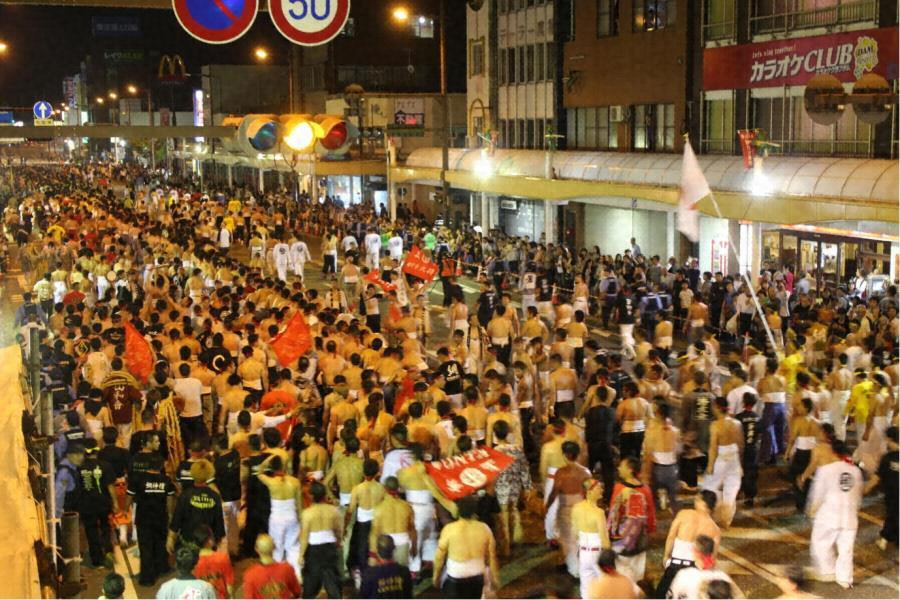
Every year on September 22 (the eve of the Autumnal Equinox), as autumn breezes sweep across southern Satsuma, the main thoroughfare of Satsumasendai City—National Route 3—casts aside its daily quiet and erupts into earth-shaking roars and fiery energy. Over 3,000 men clad only in white sarashi loincloths, proudly known as Satsuma Hayato, face off across one of Japan's most colossal ropes, measuring 365 meters in length and weighing 7 tons. This is the 400-year-old epic spectacle: the Sendai Otsunahiki.
Tug-of-war may evoke images of friendly schoolyard contests, but Sendai Otsunahiki is an entirely different caliber of combat. Rather than simple pulling, it is a highly coordinated collective battle directed by commanders known as the Sanyaku. Let us explore the rich history and captivating highlights of this extraordinary festival.
Raising Morale on the Eve of Sekigahara: 400 Years Born from Yoshihiro Shimazu's Strategy#
Sendai Otsunahiki is said to have begun during the Keicho era (1596–1614). According to tradition, before the fateful Battle of Sekigahara, the 17th feudal lord Shimazu Yoshihiro divided his army into two factions to pull a giant rope to ignite troop morale and forge unbreakable solidarity before marching off to war.
Another theory holds that the roots of the tug-of-war lie in neighboring Korea, and the tradition was integrated into Satsuma's traditional youth education system (the Goju education and mentorship system). Since then, the Great Tug-of-War has rooted itself deeply in the hearts of Sendai residents, cherished across generations as an iconic mid-autumn celebration.
To preserve and pass down this 400-year legacy to future generations, the Sendai Otsunahiki Preservation Society was established in July 1985, actively promoting regional culture, commerce, and tourism.
"Sendai Otsunahiki is far more than a contest of victory and defeat. We put our lives and pride on the line to clash with everything we have, and when it ends, we celebrate each other's valor. The samurai spirit of Satsuma and the boundless energy of the townspeople are crystallized in this single giant rope."
— Sendai Otsunahiki Preservation Society Member
365m Long, 7 Tons! The Mastercraft of Morning 'Tsunaneri' Rope Weaving#
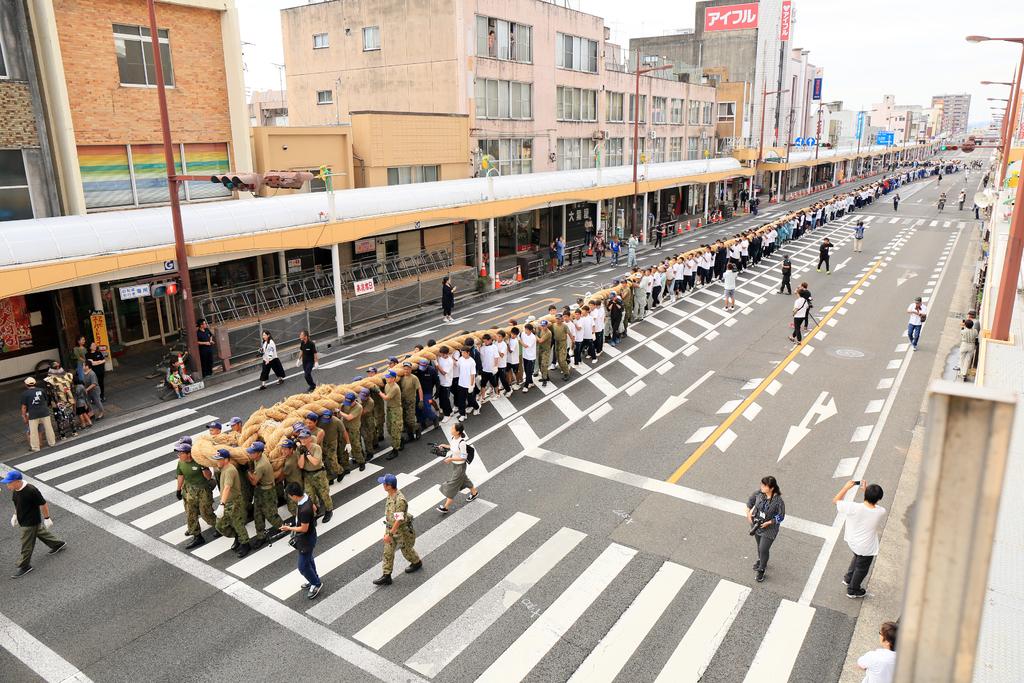
The giant rope used in Sendai Otsunahiki is neither factory-made nor preserved from previous years. Starting early on the morning of the festival, it is woven entirely from scratch by approximately 1,500 local citizens as a majestic, single-day monument.
Measuring 365 meters (symbolizing the 365 days of the year), 35 to 40 cm in diameter, and weighing roughly 7 tons. Using 365 base ropes crafted from thousands of bundles of carefully selected rice straw, approximately 1,500 citizens and executive committee members spend half a day from early morning twisting and braiding them into one unified giant rope.
At both ends of the rope, two large specialized apparatuses known as 'Tateyama' (Fixed Mount) and 'Yoseyama' (Moving Mount) are installed to apply continuous twist. Tateyama is anchored securely inside a pit dug into the ground, applying rotational counter-force as the ropes twisted from Yoseyama are braided together.
The other end is the Yoseyama, which imparts twist into three separate bundles arranged into 122, 122, and 121 ropes respectively (totalling 365). As the twist tightens and the ropes contract in length, the apparatus naturally draws closer to Tateyama—hence the name Yoseyama ('Approaching Mount'). Once the three bundles are sufficiently twisted into three sturdy ropes, a specialized spacer tool called 'Shinko' is inserted to braid the three ropes together into the final single giant rope.
Once completed, the colossal rope resting across the wide boulevard resembles a slumbering dragon. The weaving process itself is a sacred ritual that embodies community unity and craftsmanship.
More Than Tug-of-War: Tactical Full-Body Combat Between 'Pushers' and 'Pullers'
What elevates Sendai Otsunahiki into a truly peerless spectacle is its integrated offense-and-defense tactics. The combatants divide into the Kamigata (Red Headbands) and Shimogata (White Headbands), organizing specialized units with distinct roles.

The Four Specialized Squads of Sendai Otsunahiki
- Hiki-tai (Pulling Squad): The primary backbone that lowers their stance and pulls relentlessly on the main rope and countless branch ropes (eda-zuna). Visitors and local youth join this unit.
- Oshi-tai (Pushing Squad): Burly men in sarashi who charge aggressively into the opponent's vanguard to disrupt their balance and break their pulling power through sheer physical scrums.
- Taiko-tai (Drum Squad): The spotlight heroes who stand directly atop the violently thrashing giant rope, beating massive taiko drums to dictate rhythm and ignite team morale.
- Wasa-gakari (Loop Squad): A specialized team managing the large loop (wasa) at the very end of the rope, executing crucial maneuvers to reset combat positions. (Note: this area is exceptionally dangerous).
At the signal, the Pushing Squads collide at the center with tremendous force. Forming scrums to push back the enemy front line and suffocate the opponent's pullers, the Pulling Squad in the rear leans their entire body weight backward in unison. Atop the bucking rope, drummers swing their bachi drumsticks without pause, vividly re-enacting the intensity of a Sengoku battlefield upon modern asphalt.
What is the 'Sanyaku'?
The Sanyaku refers to the commanding leadership trio responsible for directing the Kamigata and Shimogata factions. It is regarded as the highest, once-in-a-lifetime honorable position in Sendai Otsunahiki.
Historical rosters from the 1960s and 70s show that originally only the Ichiban-daiko (Lead Drummer) or the Ichiban-daiko and General (Taisho) were listed. From the late 1970s onward, the Oshi-taisho (Pushing General) was also formally added. When the tug takes place on the Mukaida side, the Ichiban-daiko is the star role; when held on the Oshooji side, the General takes center stage.
September 22, 2026: Sendai Otsunahiki Visitor Guide & Schedule#
Here is the primary timetable and safety guidelines for attending the Sendai Otsunahiki on Tuesday, September 22, 2026.
| Time | Program Event | Highlights & Viewing Advice |
|---|---|---|
| Around 7:00 AM | Preparation | Executive committee members gather to prepare for the rope weaving. |
| From 7:30 AM | Traffic Restrictions Begin | National Route 3 is fully closed to traffic between Sendai Station Junction and Mukaida Junction. |
| From 8:30 AM | Tsunadashi (Rope Layout) | The preparatory ropes that form the foundation of the giant rope are laid out across the boulevard. |
| Around 10:00 AM | Tsunaneri (Rope Weaving) | Twisting and braiding the laid-out ropes into the great giant rope begins in earnest. |
| After 11:00 AM | Shinko (Braid Spreader) Insertion | The specialized 'Shinko' tool is inserted to merge three ropes into one massive unified rope. |
| 2:00 PM – 3:30 PM | Rope Completion & Repositioning | The completed giant rope is shifted into position, aligning its center precisely with the Dan-boku pivot log. |
| From 7:00 PM | Dan-boku Sacred Shinto Ritual | The sacred ritual before the pull commences. Once the 12 leaders (the Sanyaku trio and Drum Squad from both sides) gather at the center, solemn prayers are offered. |
| Around 8:15 PM | Tsunawari (Battle Commences) | Pushing through the dense scrum of fighters at the center, the Lead Drummers from both sides enter, mount the Dan-boku, and thunderously strike the taiko drums. This serves as the official signal for the great tug to begin, traditionally called 'Tsunawari' (Splitting the Rope). |
| From 9:45 PM | Saw Cut (Noko-ire) & Judgment | The Generals and Chief Directors are summoned to the center by the referee. After confirming the final saw cut, a saw is drawn across the strained rope. With immense tension pulling from both ends, the rope snaps cleanly in two at the cut. The side that holds the center mark within their territory at the exact moment of severance is declared the victor. |
| Spectator Guidelines | Specific Recommended Actions |
|---|---|
| General Participation (Pulling Squad) | Tourists, women, and children can freely pull the branch ropes. Anyone wearing the traditional attire—shirtless with a sarashi sash, jikitabi footwear, and karate/work pants—is welcome to join the pull. |
| Restricted Center Zone (Pushing Squad Area) | The central zone of the main rope involves extreme physical scrums and is highly dangerous. Please remain strictly within designated spectator areas. |
| Access & Traffic Closures | Extensive road closures will be enforced along Route 3 throughout the day. Direct walking access from Kyushu Shinkansen / JR Sendai Station is highly recommended. |
Conclusion: A Passionate Autumn Festival Burning with the Soul of Satsuma#
While the festival was historically referred to by the moniker 'Kenka-tsuna' (Brawling Tug) due to its fiery intensity, this nickname has since been retired to prevent misunderstandings.
Heralding the arrival of autumn in southern Kyushu, Sendai Otsunahiki stands as one of Japan's purest, most fervent folk cultural treasures—unfolding in modern times relying solely on human muscle, unbreakable spirit, and tight community bonds.
As a 365-meter giant rope groans and 3,000 men clash amidst clouds of dust and sweat, the spectacle is breathtaking. On the night of September 22, 2026, come witness the beating heart of history in Satsumasendai, Kagoshima.