
December is Shiwasu: Origins of Japanese Traditional Month Names & Yin-Yang Five Elements
Explore Wafu-getsumei, traditional Japanese lunisolar month names from Mutsuki to Shiwasu. Complete guide to etymologies, agricultural ties, Five Elements philosophy, and seasonal festivals.
When I, Kurousagi, was a child, I was told that December is called 'Shiwasu' because even Buddhist monks are so busy they have to run around. However, it turns out that this name carries far richer and multifaceted meanings. In this article, we explore 'Wafu-getsumei' (traditional Japanese month names)—beautiful poetic terms we often see on calendars yet rarely know the true depth of.
On modern Japanese calendars, beside numerical notations like 'January,' 'February,' and 'December,' one often sees elegant classical Japanese month names: Mutsuki (January), Kisaragi (February), Minazuki (June), Kannazuki (October), and Shiwasu (December). Known collectively as 'Wafu-getsumei' (和風月名), these poetic designations have been passed down from ancient times, deeply intertwined with the daily lives of Japanese ancestors, the rhythms of the four seasons, agrarian rituals, and spiritual prayers.
The numbers on a calendar can never capture the stirring breath of budding flora, heartfelt gratitude for autumn harvests, or the quiet resilience demanded by winter's chill. Wafu-getsumei encapsulates the exquisite aesthetic sensibility of our forebears, who cherished the spirit of language (kotodama) reflected in seasonal transitions. Yet beneath these names lie profound linguistic and historical depths: Why does Minazuki ('Waterless Month') fall right during the rainy summer season? What is the true origin behind the legend of all deities gathering in Izumo during Kannazuki ('Month of No Gods')? Surface-level Chinese characters alone cannot fully unlock these mysteries.
Furthermore, Japan's traditional lunisolar calendar developed in inseparable harmony with Yin-Yang and Five Elements philosophy (陰陽五行思想 / Inyo Gogyo Shiso) and the astrological framework of the Ten Heavenly Stems and Twelve Earthly Branches. Wood in spring, Fire in summer, Metal in autumn, Water in winter, and Earth governing the 'Doyo' seasonal transitions. In this guide, alongside a comprehensive comparative table of all 12 month names and etymologies, we delve deeply into both folkloric and calendrical perspectives to illuminate how these cosmic cycles breathe life into Japanese seasonal customs.
【Fundamental Knowledge】Definition of Wafu-getsumei & the Lunisolar Calendar System
- Official Definition: Traditional Japanese month names originally assigned to each month of the lunisolar calendar (kyureki). Today, they are conventionally printed alongside Gregorian calendar months on modern diaries and calendars.
- Seasonal Shift: Because the lunisolar calendar is based on lunar phases, it lags behind the modern solar (Gregorian) calendar by approximately one to one-and-a-half months. For instance, lunisolar Month 1 (Mutsuki) corresponds to late January through late February in the Gregorian calendar, coinciding perfectly with the dawn of spring (Risshun).
- Earliest Records & Historical Evolution: In ancient Nara-period records such as the Nihon Shoki (720 CE) and the poetic anthology Manyoshu, several individual month names such as Kisaragi, Yayoi, Kannazuki, and Shiwasu (written phonetically in Man'yogana as Shihasu) were already employed in kanji and native script, representing immense historical significance as living seasonal terms for over 1,300 years. However, they were not yet formalized into a unified 12-month system. The oldest extant official document that records all 12 Wafu-getsumei together with their native readings is the mid-Heian encyclopedia Wamyō Ruijushō (compiled by Minamoto no Shitagō in the Jōhei era, c. 930s), Book 3 ('Seishi-bu: Months').
- Cultural Significance: Rather than mere units of numerical calculation, these names served as agricultural guidelines, sacred markers for shrine festivals, and collective wisdom for living in harmony with the spirits of the natural world.
【Overview Table】Months 1 to 12: Complete Readings, Meanings & Etymologies#
Below is an overview of the 12 traditional Japanese month names from Month 1 to Month 12, detailing their readings, kanji interpretations, and foremost etymological origins. Viewing them through the seasonal lens of the lunisolar calendar vividly illuminates the keen observation and poetic heart of ancient Japan.
【Overview Table】Lunisolar 12 Months: Wafu-getsumei Readings, Meanings & Leading Etymologies
| Month | Wafu-getsumei (Reading) | Seasonal Backdrop & Lunisolar Timing | Leading Etymological Theories & Explanations |
|---|---|---|---|
| Month 1 | Mutsuki (むつき / 睦月) | Early Spring (Late Jan – Late Feb) | Derived most plausibly from Mutsubitsuki (睦び月), celebrating family harmony and joyful feasts at the New Year. Another agricultural theory links it to Mutsuki (生月), praying for the birth and sprouting of crops. |
| Month 2 | Kisaragi (きさらぎ / 如月) | Mid-Spring (Late Feb – Late Mar) | Commonly attributed to Kisaragi (衣更着, 'wearing extra layers of clothes') due to lingering winter chill (recorded in the Heian-period poetic treatise Okugishō). The kanji '如月' stems from China's oldest dictionary Erya ('Second month is Ru'), symbolizing nature awakening in its own course. Another theory suggests Kisaragi (生更木, trees sprouting anew). |
| Month 3 | Yayoi (やよい / 弥生) | Late Spring (Late Mar – Late Apr) | Derived from Iyaoi (弥生ひ, 'plants growing ever more vigorously'), contracted into Yayoi. Evokes the boundless surge of spring life across the warming earth. |
| Month 4 | Uzuki (うづき / 卯月) | Early Summer (Late Apr – Late May) | Short for Unohanazuki (卯の花月), the month when delicate white deutzia blossoms (u-no-hana) bloom in abundance (recorded in Okugishō). *Note: In the Twelve Earthly Branches of the lunisolar calendar, Month 4 corresponds to the Snake (巳), not the Rabbit (卯); the name derives from the botanical flower. Another agricultural theory suggests Uzuki (植月, rice-planting month). |
| Month 5 | Satsuki (さつき / 皐月) | Mid-Summer (Late May – Late Jun) | Short for Sanaezuki (早苗月), the month of transplanting young rice seedlings (sanae). The prefix 'sa' is an archaic root denoting the sacred rice and paddy deity (Sa-no-Kami). The kanji '皐月' originates from Erya, where the fifth month is called 'Gao' (皐), signifying waterside vitality and life. |
| Month 6 | Minazuki (みなづき / 水無月) | Late Summer (Late Jun – Late Jul) | The character '無' (na) does not indicate absence, but is an archaic grammatical genitive particle meaning 'of' (no), signifying 'Month of Water' (when paddies are flooded after planting). |
| Month 7 | Fumizuki / Fuzuki (ふみづき / 文月) | Early Autumn (Late Jul – Late Aug) | Originates from Fumihirakizuki (文披月), when people unfurled scrolls and composed poetry during Tanabata to pray for literary and calligraphic mastery. Another prominent theory is Hofumizuki (穂含月, the month when rice ears swell with grain). |
| Month 8 | Hazuki (はづき / 葉月) | Mid-Autumn (Late Aug – Late Sep) | In the deepening autumn of the lunisolar calendar, deciduous foliage turns color and falls, giving rise to Haochizuki (葉落ち月, 'month of falling leaves'). Another theory is Hatsukarizuki (初雁月, the arrival of the first migratory wild geese). |
| Month 9 | Nagatsuki (ながつき / 長月) | Late Autumn (Late Sep – Late Oct) | Short for Yonagatsuki (夜長月, 'month of long nights'), as the autumn equinox passes and nights lengthen significantly. Another agricultural theory points to Nagamezuki (長雨月, prolonged autumn rains). |
| Month 10 | Kannazuki / Kaminazuki (かんなづき / 神無月) | Early Winter (Late Oct – Late Nov) | The grammatical root 'na' means 'of,' originally signifying 'Month of the Gods' (sacred rites celebrating the autumn harvest). From the medieval era onward, folklore spread that myriad Shinto deities depart their home provinces to convene at Izumo Grand Shrine, leaving their lands 'without gods' (Kannazuki), while Izumo celebrates 'Kamiarizuki' (Month of Gods Present). |
| Month 11 | Shimotsuki (しもつき / 霜月) | Mid-Winter (Late Nov – Late Dec) | Short for Shimofurizuki (霜降り月, 'month when frost falls'), as cold air intensifies and morning frost carpets the ground. Also associated with Oshimonozuki (食物月), offering newly harvested grain to the gods during the Niinamesai feast. |
| Month 12 | Shiwasu (しわす / 師走) | Late Winter (Late Dec – Late Jan) | Popularly imagined as 'monks running' (Shi-hasu) due to year-end Buddhist memorials and prayers, though linguists consider this a later folk etymology. In classical Yamato speech, it is an ancient word (recorded in Nihon Shoki as Shihasu) likely derived from Shiitsu (四時果つ, ending of the four seasons), Toshihatsu (歳果つ, ending of the year), or Shihatsu (為果つ, completing all year's labors). |
Deeper Layers of Wafu-getsumei: Dual Structure of Kanji & Native Yamato Speech#
The most vital linguistic key to understanding Wafu-getsumei lies in its dual structure: written Chinese characters (kanji) versus native Japanese spoken heritage (Yamato-kotoba).
A prime example is the character '無' (na) in Month 6 Minazuki (水無月) and Month 10 Kannazuki (神無月). On the surface, kanji characters seem to mean 'month without water' or 'month without gods.' However, in classical Japanese grammar, this 'na' functions as an ancient genitive particle meaning 'of' (equivalent to modern 'no'). Thus, Minazuki originally meant 'Month of Water' (the crucial season when paddy fields are flooded), while Kannazuki signified 'Month of the Gods' (when communities dedicated the bountiful autumn harvest to local deities).
As Chinese kanji culture deepened from the Heian through medieval periods, imaginative folklore blossomed directly from visual kanji interpretations. The famed legend—that all eight million Shinto kami leave their home shrines to convene at Izumo Grand Shrine for matchmaking and agricultural council, leaving the rest of Japan 'godless'—is a quintessential example of how phonetic wordplay and kanji evolved into a rich, uniquely Japanese cultural narrative.
Ancient Philosophy of 'Yin-Yang & Five Elements' and Japan's Calendrical Rhythms#
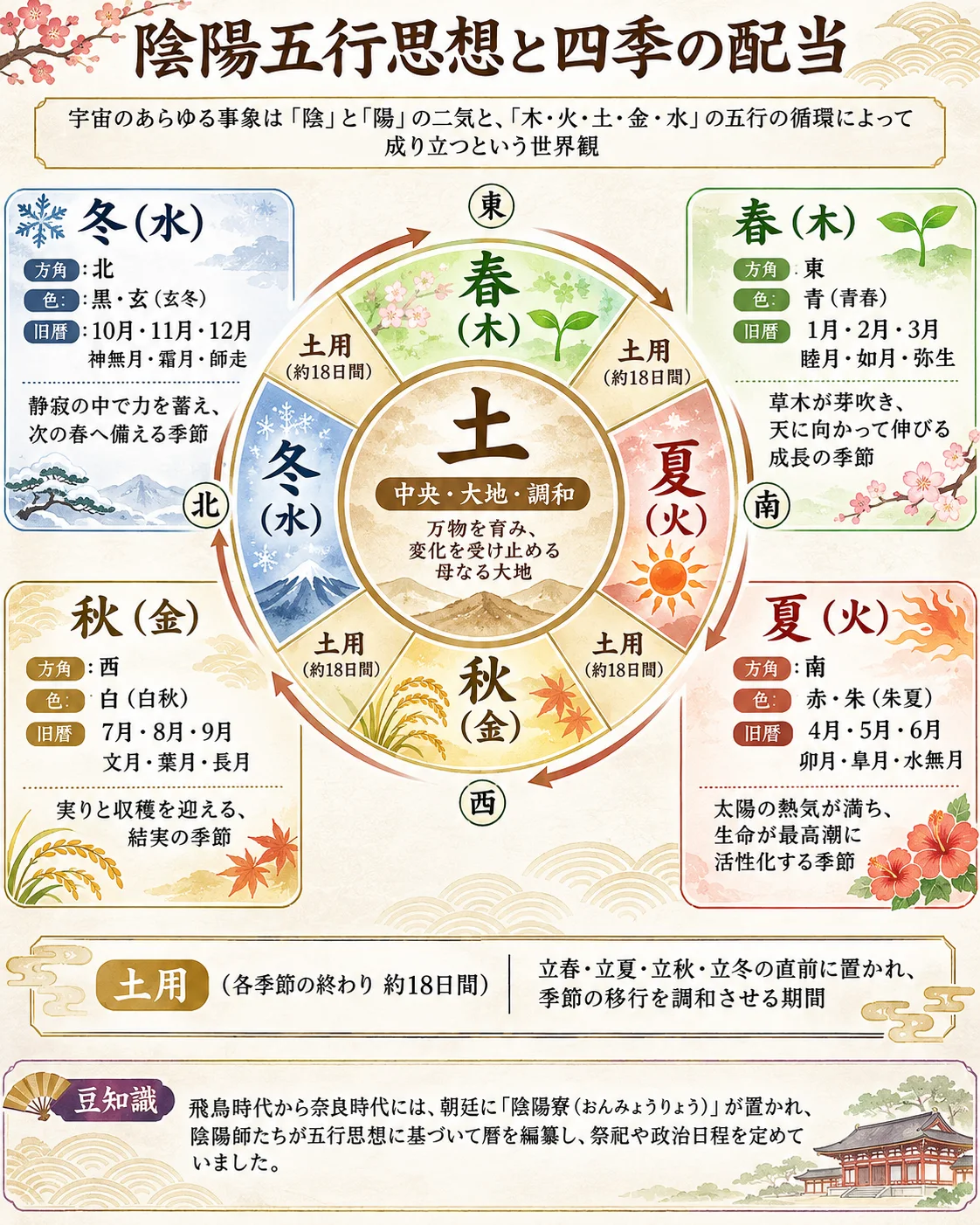
Japan's seasonal transitions and lunisolar calendar were systematically shaped by the profound integration of Yin-Yang and Five Elements philosophy (Inyo Gogyo Shiso) imported from ancient East Asia.
The Five Elements doctrine holds that the universe is governed by the ebb and flow of Yin and Yang, with all natural phenomena arising through the cyclical interactions of five elemental energies: Wood (木), Fire (火), Earth (土), Metal (金), and Water (水). From the Asuka to Nara periods, the imperial court established the specialized state ministry Onmyō-ryō (Bureau of Yin and Yang), where imperial astrologers and masters compiled official calendars and guided state ceremonies according to Five Elements principles.
Under Five Elements doctrine, the four seasons are mapped to the following elemental forces:
- Spring (Lunisolar Months 1, 2, 3 / Mutsuki, Kisaragi, Yayoi): 【Wood (木)】
Direction: East; Color: Blue/Green (Youth / 青春 'Seishun'). Symbolizes burgeoning vitality, sprouting seeds, and dynamic growth reaching toward the sky. - Summer (Lunisolar Months 4, 5, 6 / Uzuki, Satsuki, Minazuki): 【Fire (火)】
Direction: South; Color: Red/Vermilion (Crimson Summer / 朱夏 'Shuka'). Governs radiant heat, maximum solar energy, and exuberant biological flourishing. - Autumn (Lunisolar Months 7, 8, 9 / Fumizuki, Hazuki, Nagatsuki): 【Metal (金 / Kin/Kon)】
Direction: West; Color: White (White Autumn / 白秋 'Hakushu'). Represents crisp autumn breezes, condensation, crystallization, and the golden fruition of harvested crops. - Winter (Lunisolar Months 10, 11, 12 / Kannazuki, Shimotsuki, Shiwasu): 【Water (水)】
Direction: North; Color: Black/Darkness (Dark Winter / 玄冬 'Gento'). Characterizes freezing silence, resting vitality, and the underground storage of life energy preparing for the next spring. - Doyo (Seasonal Transition / ~18 Days before each Solstice & Equinox): 【Earth (土)】
Position: Center; Color: Yellow. Earth represents the nurturing ground that balances and harmonizes shifts between the four seasons. Although modern Japan is familiar with the 'Midsummer Doyo Ox Day,' an 18-day Doyo period originally preceded spring, summer, autumn, and winter alike.
【Correlation Matrix】Four Seasons, Five Elements, Earthly Branches & Wafu-getsumei
| Season | Five Elements (Qi) | Symbolic Color & Direction | Lunisolar Month & Branch | Corresponding Wafu-getsumei | Natural Cycles & State of Vitality |
|---|---|---|---|---|---|
| Spring | Wood (木 / Moku) | Blue/Green (East) | Month 1 (Tiger) / Month 2 (Rabbit) / Month 3 (Dragon) | Mutsuki, Kisaragi, Yayoi | Genesis & expansion: dormant seeds sprout, life bursts into upward growth. |
| Summer | Fire (火 / Ka) | Red/Vermilion (South) | Month 4 (Snake) / Month 5 (Horse) / Month 6 (Goat) | Uzuki, Satsuki, Minazuki | Luxuriance & vigor: solar heat peaks, rice paddies flourish under summer sun. |
| Seasonal Shift | Earth (土 / Do) | Yellow (Center) | 18-day 'Doyo' period before each seasonal change | Season-end transitions (End of M3, M6, M9, M12) | Transformation & harmony: the nurturing earth buffers transitions between climates. |
| Autumn | Metal (金 / Kin, Kon) | White (West) | Month 7 (Monkey) / Month 8 (Rooster) / Month 9 (Dog) | Fumizuki, Hazuki, Nagatsuki | Fruition & ripening: golden grain matures, crisp autumn air consolidates the harvest. |
| Winter | Water (水 / Sui) | Black/Dark (North) | Month 10 (Boar) / Month 11 (Rat) / Month 12 (Ox) | Kannazuki, Shimotsuki, Shiwasu | Dormancy & conservation: life retreats underground, storing vital energy for spring. |
Japanese Seasonal Festivals Resonating with 24 Solar Terms & Five Sekku#
The Five Elements and Wafu-getsumei are not merely abstract concepts; they served as the foundational bedrock for Japan's celebrated Five Sacred Festivals (Go-sekku / 五節句) and the 24 Solar Terms.
In ancient philosophy, odd numbers were revered as powerful 'Yang' figures. When double odd numbers aligned on the calendar, Yang energy was thought to reach extreme intensity, prompting rituals to ward off malevolent spirits and pray for well-being. This gave birth to the Five Sekku:
- January 7: Jinjitsu no Sekku (Festival of Seven Herbs / Nanakusa-gayu) (Originating from ancient Chinese seasonal records where each day after New Year represented an animal, with the 7th day designated as 'Human Day' [Jinjitsu]. Avoiding New Year's Day as a unique ancestral holiday, people honored human life on the 7th by eating a warm herb broth—the root of seven-herb rice porridge—to ensure annual health.)
- March 3: Joshi no Sekku (Peach Festival / Hinamatsuri / Yayoi) (During spring's Wood phase, peach blossoms dispelled misfortune, celebrating the health and prosperity of young girls.)
- May 5: Tango no Sekku (Iris Festival / Children's Day / Satsuki) (Before summer's Fire heat, aromatic iris and mugwort were hung to banish pestilence and protect youth.)
- July 7: Tanabata no Sekku (Star & Bamboo Festival / Fumizuki) (At autumn's onset, people gazed upon the celestial Milky Way to pray for excellence in handicrafts, poetry, and calligraphy.)
- September 9: Choyo no Sekku (Chrysanthemum Festival / Nagatsuki) (Celebrating the alignment of the supreme Yang number '9.' Originating from ancient traditions, people drank sake infused with autumn chrysanthemums to pray for longevity and vitality.)
Furthermore, poetic expressions describing human life stages—'Seishun' (Green Spring / Youth: teens to 20s), 'Shuka' (Vermilion Summer / Prime of Life: 30s to 40s), 'Hakushu' (White Autumn / Mature Years: 50s to 60s), and 'Gento' (Dark Winter / Elder Wisdom: 70s and beyond)—stem directly from this seasonal and Five Elements color mapping. Wafu-getsumei reflects a magnificent philosophical system that unifies celestial mechanics, earthly weather, and the human lifespan into a harmonious whole.
Savoring Wafu-getsumei in Contemporary Life: Wealth of Language and Seasonality#
With the calendar reform of Meiji 5 (1872), Japan transitioned from the lunisolar calendar to the solar (Gregorian) calendar. This shift created a one-month seasonal gap, leading to familiar modern anomalies such as 'Mutsuki' (January) arriving in bitter midwinter or 'Minazuki' (June) coinciding with the peak of the rainy season.
Yet in modern times, surrounded by digital screens and climate-controlled rooms where seasons blur, pausing to appreciate classical words like 'Kisaragi,' 'Kannazuki,' and 'Shiwasu' on a calendar provides profound grounding. Incorporating traditional month names into seasonal letters or savoring seasonal confections (such as 'Minazuki' rice cakes eaten on June 30) directly connects us to the poetic sensibilities of ancestors who lived over a thousand years ago.
Conclusion: Ancient Wisdom of Living in Rhythm with Nature#
The 12 Wafu-getsumei, from Mutsuki to Shiwasu, are far more than markers of passing time. They are the crystalline essence of the Japanese spirit—a profound reverence for nature that cherished the budding of shoots, gave thanks for the water sustaining paddy fields, and noted the shifting winds and lengthening nights.
The wisdom of the Five Elements reminds us of the universal rhythm of life: sprouting in spring, flourishing in summer, fruiting in autumn, and resting in winter. Whenever we reflect upon the spirit of Wafu-getsumei as the months turn, we find a tranquil pause in our bustling lives, reconnecting with the eternal harmony of the natural world.
【Sources & References】#
- National Diet Library 'The Japanese Calendar: Month Aliases (Wafu-getsumei)'
- National Astronomical Observatory of Japan, Ephemeris Computation Office 'Koyomi Wiki: Lunisolar Calendar & History'
- Minamoto no Shitagō, Wamyō Ruijushō (Jōhei era, c. 930s, Book 3 'Seishi-bu: Months')
- Fujiwara no Kiyosuke, Okugishō (Kyūan era, mid-12th century, Book 1 'Month Names')
- Classical Treatises: Liji ('Yueling'), Huainanzi ('Tianwenxun'), Erya ('Shi Tian')
- Zong Lin, Jingchu Suishiji & Dongfang Shuo, Zhanshu
- Agency for Cultural Affairs 'Database of Nationally Designated Cultural Properties (Seasonal Customs & Rites)'