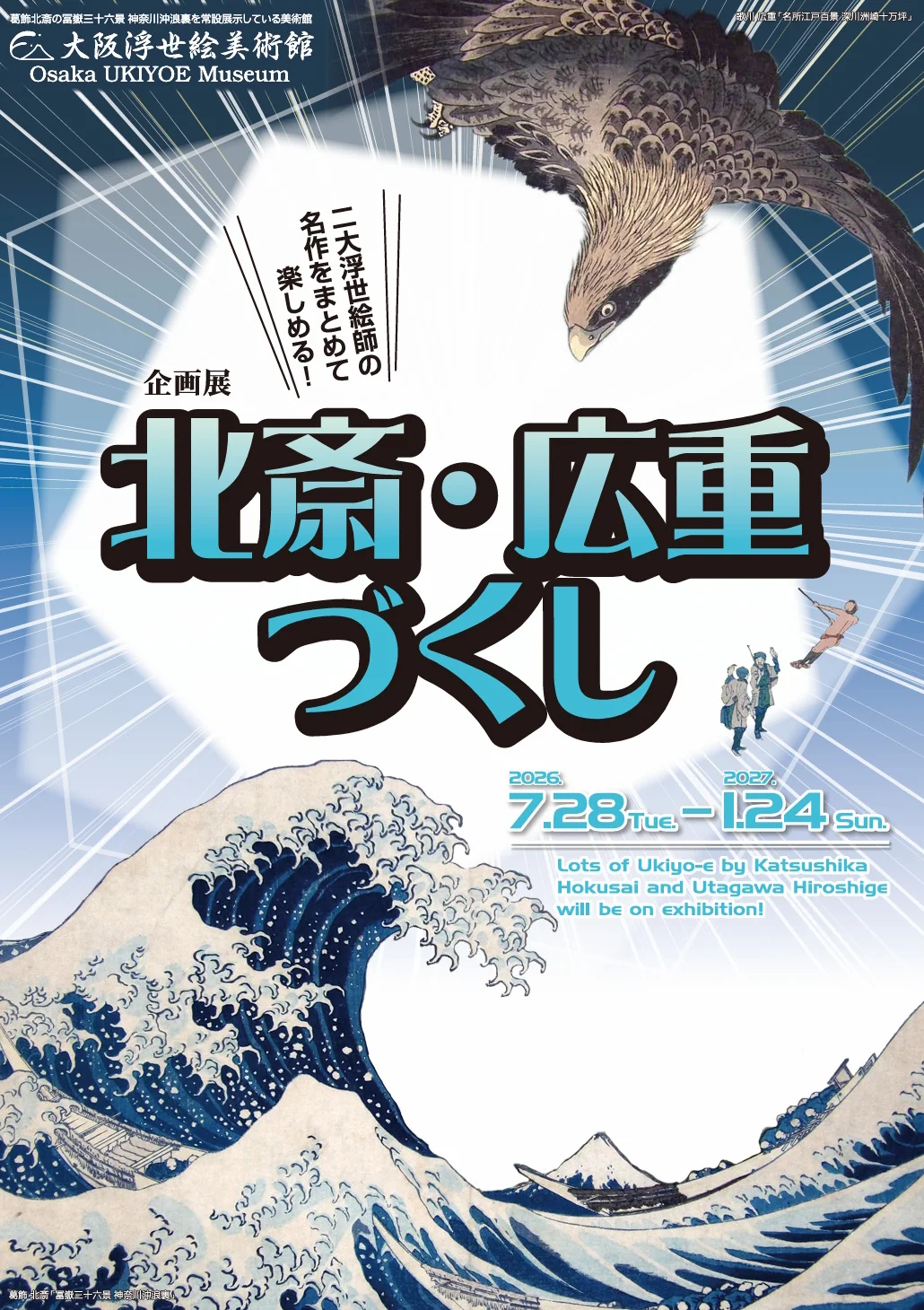
Hokusai and Hiroshige Extravaganza 2026! Ukiyo-e Masters in Osaka
Held July 28, 2026 – Jan 24, 2027, at Osaka Ukiyoe Museum, this exhibition displays 59 original Edo-period prints, including Hokusai's Three Great Fujis and Hiroshige's Masterpieces of Edo.
Ukiyo-e woodblock printing stands as one of Japan's most celebrated treasures, having fundamentally altered the course of global art history. Its two towering giants, Katsushika Hokusai (1760–1849) and Utagawa Hiroshige (1797–1858), brought the genre to its absolute zenith. The Osaka Ukiyoe Museum in Shinsaibashi hosts a breathtaking special exhibition, 'Hokusai and Hiroshige Extravaganza,' running from Tuesday, July 28, 2026, through Sunday, January 24, 2027.
The exhibition's crowning distinction is that all 59 works on display are genuine original woodblock prints pulled during the Edo and Meiji eras. Free from the detachment of modern digital reproductions, visitors can experience the organic fibers of handmade washi paper, the crisp incisions of master carvers, the subtle swirl of the baren press, and the vivid luminescence of natural mineral pigments and authentic Prussian blue preserved across more than 150 years.
In addition to the museum's permanent treasure, Hokusai's iconic 'Under the Wave off Kanagawa' (The Great Wave), this showcase unites the revered 'Three Great Fujis' alongside 'Fine Wind, Clear Morning' (Red Fuji) and 'Rainstorm Beneath the Summit' (Black Fuji). Complementing these are premier masterpieces from Hiroshige's crowning late series 'One Hundred Famous Views of Edo' and evocative views of the Kamigata (Kansai) region. Here is a complete guide to the exhibition's highlights, aesthetic contrasts, and visitor recommendations.
【Highlights】 Exhibition Overview & Visitor Essentials
- Exhibition Title: Special Exhibition 'Hokusai and Hiroshige Extravaganza'
- Dates: July 28, 2026 (Tue) – January 24, 2027 (Sun)
- Hours: 10:00–17:00 (Last entry at 16:30)
- Closed: Year-end & New Year (Dec 31, 2026 – Jan 2, 2027), Exhibition Turnover (Jan 25, 2027)
- Venue: Osaka Ukiyoe Museum (Fujiya Shinsaibashi Bldg. 3F, 2-2-23 Shinsaibashisuji, Chuo-ku, Osaka)
- Admission: Adults 1,000 JPY / Students (High School & College) 600 JPY / Elementary 300 JPY (Preschool free)
- Exhibition Scale: 59 works (All original Edo- and Meiji-period woodblock prints)
Overview & Intimate Appeal of 'Hokusai and Hiroshige Extravaganza'#
Located along the bustling Shinsaibashisuji shopping arcade in the heart of Minami, Osaka, the Osaka Ukiyoe Museum offers an intimate viewing experience rarely found in massive public institutions. Without obstructive security barricades, guests can observe the delicate details of historical prints up close through protective glass display cases.
A particularly beloved service is the complimentary loan of handheld magnifying loupes (limited quantities). Traditional ukiyo-e was produced through a rigorous collaborative tripartite system involving painter, carver, and printer. By examining prints through a loupe, visitors can discern individual hair strands, micro-fine water droplets, and the subtle raised embossing of 'karazuri' (blind printing) that remains invisible to the naked eye.
| Exhibition Section | Key Featured Works & Artistic Highlights |
|---|---|
| The Realm of Katsushika Hokusai | The 'Three Great Fujis' from Thirty-Six Views of Mount Fuji: The Great Wave, Red Fuji, and Black Fuji. Early pillar print 'Seven Lucky Gods' under the Katsukawa Shunro art name. |
| The Pinnacle of Utagawa Hiroshige | Five monumental masterpieces from One Hundred Famous Views of Edo: Sudden Shower over Shin-Ohashi bridge and Atake, Plum Park in Kameido, 100,000 Tsubo Plain at Fukagawa Susaki, Kinryusan Temple in Asakusa, and Surugadai in Suidobashi. |
| Kamigata & Highway Series | Landscapes of western Japan including Hiroshige's Famous Places of Kyoto, Naniwa Famous Views, and celebrated vistas from The Fifty-Three Stations of the Tokaido. |
| Historical Editions | All 59 exhibited works are authentic original woodblock prints pulled during the 19th-century Edo and Meiji periods. |
The Three Great Fujis United! Hokusai's Masterly Structural Vision#
Published when Katsushika Hokusai was in his seventies, 'Thirty-Six Views of Mount Fuji' (c. 1831–1833) revolutionized Japanese landscape prints. Among the 46 plates in the expanded series, three stand undisputed at the pinnacle of international renown: 'Under the Wave off Kanagawa', 'Fine Wind, Clear Morning', and 'Rainstorm Beneath the Summit'—collectively celebrated by connoisseurs as the 'Three Great Fujis.'
'Under the Wave off Kanagawa' freezes a dramatic split second as towering waves threaten to engulf fragile cargo barges. The claw-like crests contrast with the serene permanence of Mount Fuji in the deep background. Integrating Western linear perspective with circular and triangular geometry, Hokusai deployed newly imported Prussian blue ('bero-ai') to achieve unprecedented nautical depth.
In contrast, 'Fine Wind, Clear Morning' (Red Fuji) portrays the sacred peak illuminated by early autumn dawn light against cirrocumulus clouds and forested slopes. 'Rainstorm Beneath the Summit' (Black Fuji) captures a duality where clear skies crown the summit while lightning bolts tear across thunderclouds at the mountain's base.
【Featured Highlight】 Rare Early Work: Pillar Print 'Seven Lucky Gods' by Katsukawa Shunro
The exhibition also showcases an extraordinary early pillar print (hashira-e) of the 'Seven Lucky Gods' created during Hokusai's twenties under the moniker Katsukawa Shunro. Its vertical arrangement demonstrates Hokusai's innate compositional genius long before his late landscape triumphs.
Poet of Lyricism: Hiroshige's 'One Hundred Famous Views of Edo' & Kansai#
While Hokusai favored dynamic tension, Utagawa Hiroshige was the poetic master of climate, seasonal atmosphere, and human sentiment. Following the devastating 1855 Ansei earthquake, Hiroshige poured his remaining life energy into his magnum opus, 'One Hundred Famous Views of Edo' (1856–1858).
The exhibition features five of the series' most celebrated plates. Foremost is 'Sudden Shower over Shin-Ohashi bridge and Atake,' depicting townsfolk scurrying across the bridge beneath a sudden summer squall. The sharp slanting black rain lines and misty riverbanks so captivated Vincent van Gogh that he created an oil study, 'Bridge in the Rain.'
Equally striking are 'Plum Park in Kameido'—with its extreme foreground crop of a gnarled flowering plum branch (also copied in oils by Van Gogh)—and '100,000 Tsubo Plain at Fukagawa Susaki,' where an eagle's bird's-eye perspective sweeps across snowy marshlands with cinematic flair.
Furthermore, Hiroshige's affectionate depictions of western Japan in 'Famous Places of Kyoto' and 'Naniwa (Osaka) Famous Views' highlight the lively waterborne bustle and cultural warmth distinctive to the Kamigata region.
【In-Depth Contrast】 Hokusai vs. Hiroshige — Motion & Stillness, Geometry & Poetry#
Though contemporaries who elevated ukiyo-e landscapes to global acclaim, Hokusai and Hiroshige embraced fundamentally divergent creative philosophies. The rivalry—sparked when the 37-year-younger Hiroshige published 'The Fifty-Three Stations of the Tokaido' in response to Hokusai's 'Thirty-Six Views'—forms a fascinating backdrop for this exhibition.
| Comparison Metric | Katsushika Hokusai (1760–1849) | Utagawa Hiroshige (1797–1858) |
|---|---|---|
| Artistic Essence | Dynamic energy and architectural drama. Deconstructs nature through rigorous geometry. | Serene poetry and lyricism. Captures seasonal air, rain, snow, and travel nostalgia. |
| Compositional Style | Calculated precision combining circles and triangles from unexpected, daring perspectives. | Dramatic foreground zooming (framing effect) paired with vast panoramic background vistas. |
| Chromatic Mastery | Vibrant, high-contrast gradations of newly imported synthetic Prussian blue (aizuri-e). | Soft, atmospheric indigo washes known globally as 'Hiroshige Blue' with subtle bokashi shading. |
| Western Influence | Directly inspired Claude Monet, Edgar Degas, and Claude Debussy (La Mer score cover). | Profoundly influenced Vincent van Gogh (oil studies) and James McNeill Whistler (Nocturnes). |
Where Hokusai constructed nature through overwhelming structural power, Hiroshige empathized with human vulnerability within the natural world. Comparing both masters side-by-side in one gallery reveals the profound diversity of Edo visual culture.
Japonisme Revolution! How Ukiyo-e Transformed Western Master Painters#
During the second half of the 19th century, ukiyo-e prints arrived in Europe, triggering the sweeping artistic movement known as Japonisme. For Western painters trapped within strict linear perspective, chiaroscuro modeling, and anatomical academicism, Japanese woodblock prints offered an exhilarating visual liberation.
Crisp calligraphic contours, flat color planes without shadows, radical high-angle cropping, and an affectionate gaze directed toward everyday street life rather than classical mythology dismantled academic dogma, directly inspiring Impressionist and Post-Impressionist pioneers.
| Artist (Country & Movement) | Influential Masters & Works | Representative Masterpieces (Museum) | Specific Influence & Art Historical Verification |
|---|---|---|---|
| Vincent van Gogh (Netherlands / Post-Impressionism) | Utagawa Hiroshige (Plum Park in Kameido, Sudden Shower), Keisai Eisen (The Courtesan) | Flowering Plum Tree & Bridge in the Rain (Van Gogh Museum) Portrait of Père Tanguy (Musée Rodin) | Applied a grid across Hiroshige prints to replicate compositions in oil with decorative kanji borders. Collected hundreds of prints and wrote that studying ukiyo-e was akin to a new religion, establishing his vivid color-contrast style. |
| Claude Monet (France / Impressionism) | Katsushika Hokusai (Thirty-Six Views), Utagawa Hiroshige (One Hundred Famous Views) | Water Lilies and Japanese Bridge (Musée d'Orsay) La Japonaise (MFA Boston) Haystacks Series | Displayed over 230 ukiyo-e prints in his Giverny home and built a Japanese arched bridge in his garden. His serial paintings capturing light across hours and seasons directly evolved from Hokusai and Hiroshige. |
| Edgar Degas (France / Impressionism) | Katsushika Hokusai (Hokusai Manga), Torii Kiyonaga | The Tub (Musée d'Orsay) The Star / Dancer on Stage (Musée d'Orsay) | Studied kinetic twists of artisans and sumo wrestlers in Hokusai Manga. Discarded classical symmetry to depict ballerinas and bathing women from bird's-eye viewpoints and asymmetrical crops. |
| Édouard Manet (France / Pre-Impressionism) | Utagawa Kuniaki II (Sumo Wrestler Onaruto Nadaemon), Hokusai, Utamaro | Portrait of Émile Zola (Musée d'Orsay) The Fifer (Musée d'Orsay) | Depicted a sumo woodblock print by Utagawa Kuniaki II on the wall in his Zola portrait. In The Fifer, he abolished chiaroscuro shadows in favor of flat color fields and dark contours, stunning the Salon. |
| Henri de Toulouse-Lautrec (France / Post-Impressionism) | Toshusai Sharaku, Kitagawa Utamaro, Katsushika Hokusai | Divan Japonais poster Moulin Rouge: La Goulue | Adopted Sharaku's close-up cropping and flat color blocks for color lithography posters. Created a personal Japanese-style seal monogram (HTL), elevating commercial graphic design into fine art. |
| Paul Gauguin (France / Post-Impressionism) | Katsushika Hokusai (Hokusai Manga), Utagawa Hiroshige (Plum Park) | Vision of the Sermon / Jacob Wrestling with the Angel (National Galleries of Scotland) | The wrestling pose of Jacob and the angel is verified as a direct borrowing from sumo wrestlers in Hokusai Manga, while the diagonal apple tree trunk reflects Hiroshige's compositional division. |
| James McNeill Whistler (USA & UK / Aestheticism) | Utagawa Hiroshige (Kyobashi Bamboo Bank, Sudden Shower) | Nocturne: Blue and Gold – Old Battersea Bridge (Tate Gallery) | Composed London's Thames bridges using the soaring vertical framing and elevated viewpoints seen in Hiroshige's night views, championing pure harmonic tonal arrangements over literary narrative. |
| Gustav Klimt (Austria / Vienna Secession) | Katsushika Hokusai, Ogata Korin, Pillar Prints (Hashira-e) | The Kiss (Belvedere Palace, Vienna) Portrait of Adele Bloch-Bauer I | Inspired by the planar decorative patterns of kimonos and the vertical format of pillar prints, fusing eastern flatness with gold leaf and intricate geometric ornament during his Golden Phase. |
【Analysis】 Three Visual Revolutions Gifted by Ukiyo-e to Western Masters
- 1. Elimination of Chiaroscuro & Revival of Flat Planes: By replacing heavy modeling with vibrant flat colors and definitive contours, artists escaped oppressive academic conventions.
- 2. Daring Cropping & Asymmetrical Balance: Placing bold foreground elements before distant horizons and off-centering focal points provided visual freedom unmatched by early photography.
- 3. Empathic Observation of Everyday Life: Shifting focus from heroic myths to sudden summer rainstorms and seasonal shifts directly nurtured the Impressionist pursuit of fleeting moments.
Masterpieces such as 'The Great Wave' and 'Sudden Shower over Shin-Ohashi bridge' on display in this exhibition are the very prints that Monet and Van Gogh held in their hands with boundless passion. Standing before authentic 19th-century originals in Osaka allows modern viewers to rekindle that profound historic thrill.
Visitor Tips & Recommended Cultural Itinerary in Shinsaibashi#
To make the most of your visit to the Osaka Ukiyoe Museum, here are practical appreciation guidelines and an enticing cultural day-trip itinerary.
【Practical Guide】 3 Key Points for Examining Original Prints
- 1. Observe Bokashi Gradations: Examine how printers delicately applied wet pigment with brushes to create seamless atmospheric fadeouts across horizons and skies.
- 2. Discover Karazuri with Loupes: Look for uninked embossed textures on fabric folds, wave patterns, and sparkling mica flakes using museum-provided magnifying glasses.
- 3. Explore Authentic Prints at the Museum Shop: Beyond souvenir postcards, the museum shop offers authentic Edo-period woodblock prints for purchase by collectors.
Access is exceptionally convenient: approximately 5 minutes on foot from Exit 6 of Shinsaibashi Station (Osaka Metro Midosuji & Nagahori Tsurumi-ryokuchi Lines) or 7 minutes from Namba Station, located on the 3rd floor along the covered Shinsaibashisuji arcade.
Recommended 1-Day Itinerary: Ukiyo-e & Classic Osaka Culture#
- 10:30–12:30 【Osaka Ukiyoe Museum】: Arrive during quiet morning hours with a magnifying loupe to absorb every detail of the Hokusai and Hiroshige special exhibition.
- 12:45–14:00 【Kamigata Lunch at Hozenji Yokocho】: Stroll south toward Dotonbori, pay respects at Mizukake Fudo, and savor traditional Kansai dashi rolled omelet or udon noodles.
- 14:15–15:30 【Kamigata Ukiyoe Museum】: Visit this nearby boutique museum specializing in kabuki actor prints from Dotonbori theaters to compare Osaka and Edo styles.
- 16:00–17:30 【Shinsaibashi & Amerikamura Exploration】: Admire the historic Vories architecture of Daimaru Shinsaibashi, browse local boutiques, and enjoy an evening cafe.
Original Edo Prints Transcending Time: Intimacy with Living History#
For ordinary citizens of Edo, prints by Hokusai and Hiroshige were accessible popular media enjoyed in daily life. Yet the uncompromising artistry of the painters and craftsmen crossed oceans to shake Monet and Van Gogh, enduring today as universal cultural treasures.
'Hokusai and Hiroshige Extravaganza' offers an invaluable opportunity to experience the tactile energy carved into handmade washi paper 150 years ago. Immerse yourself in this peerless artistic dialogue in the heart of Osaka.
【Sources & References】