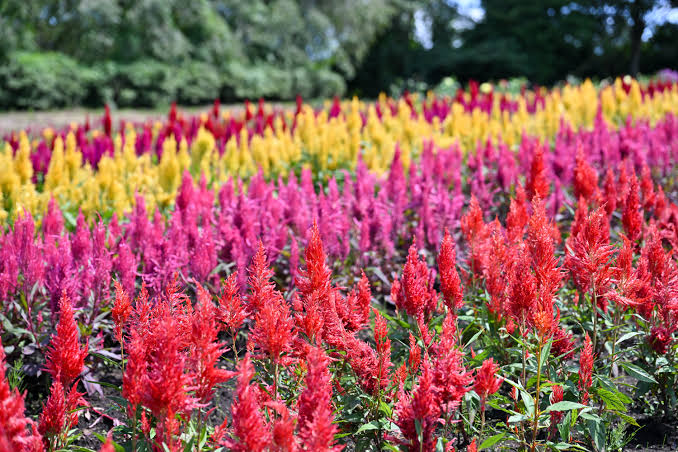
Better Late Than Never: Peak Autumn Blooms of Celosia & Salvia at 5 Top Spots Across Japan
A complete guide to autumn Celosia and Salvia blooms in Japan. With Kanto spots in peak bloom now, explore 5 famous flower parks nationwide—from Hokkaido to Kyushu—plus viewing and photo tips.
When people think of autumn flower fields in Japan, cosmos and crimson kochia often come to mind first. Yet beneath the crisp autumn sky, two other stars blaze with extraordinary intensity, dyeing the earth in passionate reds, golden yellows, and refreshing purples: Celosia (cockscomb / plumed celosia) and Salvia (scarlet and blue sage). With celosia's velvety texture and flame-like plumes alongside salvia's sweeping carpets across entire hillsides, these blooms create breathtaking panoramas at flower parks nationwide from late summer through late autumn.
In particular, the period from mid-September to early November—when both flowers reach peak bloom together—coincides with the season of sharp day-to-night temperature swings that make floral pigments develop far deeper and more vividly. From dynamic single-color slopes of blazing scarlet to rainbow patchwork beds woven from bands of red, yellow, orange, pink, and purple, each destination offers a uniquely artistic landscape.
In this guide, we explore the botanical history, signature varieties, and regional blooming seasons of celosia and salvia, highlight five of Japan's most celebrated viewing spots (in Hokkaido, Saitama, Chiba, Hyogo, and Oita), and share practical photography tips to help you capture their full beauty.
[Autumn Flower Guide] Celosia & Salvia Peak Season & Top 5 Spots Summary
• Overall Peak Season: Early September to early November (*Mid-August to mid-October in Hokkaido; through mid-November in Kyushu and warmer regions)
• Celosia Highlights: Multi-colored gradations and fluffy, flame-like plumes of Plumed Celosia (Umou-geitou)
• Salvia Highlights: Blazing slopes of Scarlet Sage (deep red) and elegant waves of Blue Salvia and Amethyst Sage
• Top 5 Spots Nationwide: (1) Shikisai-no-Oka (Hokkaido), (2) Musashi Kyuryo National Government Park (Saitama), (3) Mother Farm (Chiba), (4) Awaji Island National Government Akashi Kaikyo Park (Hyogo), (5) Kuju Flower Park (Oita)
• Recommended Viewing Hours: 9:00–10:30 AM or late afternoon golden hour, when side-lighting illuminates the three-dimensional plumes
Botanical History and Varieties of Beloved Autumn "Celosia" and Healing "Salvia"#
The celosia and salvia we admire in autumn parks each carry fascinating histories across continents, along with diverse cultivars developed through modern horticultural breeding.
1. Celosia: The Ancient Autumn Flower That Traveled the Silk Road
An annual plant in the Amaranthaceae family, Celosia (scientific name: Celosia argentea) is native to tropical Asia, India, and Africa. Its genus name Celosia derives from the Greek word keleos, meaning "burning." Introduced to Japan via China between the Nara and Heian periods, it was celebrated in the ancient poetry anthology Man'yoshu under the name Kara-ai, resonating with Japanese autumn sensibilities for over a millennium. Alongside traditional cockscomb varieties (Tosaka-geitou) resembling a rooster's red crest, modern large-scale flower beds primarily feature Plumed Celosia (Umou-geitou), which bears soft, fluffy, cone-shaped plumes like bird feathers, and Wheat Celosia (No-geitou / Yari-geitou), which rises sharply like candle flames. Boasting extraordinarily rich shades of red, yellow, orange, rose pink, and lime green that resist fading, celosia carries the floral meanings of "unfading love" and "elegance."
2. Salvia: Expanding from Blazing Crimson to Mystical Purple
Belonging to the mint family (Lamiaceae), Salvia takes its name from the Latin word salvare ("to save" or "to heal") and has long been cherished as part of the medicinal sage family. Three main types grace Japan's autumn flower fields. First is the classic Scarlet Sage (Salvia splendens), native to Brazil and famous for its fiery crimson blooms. Second is Blue Salvia (Salvia farinacea), whose cool violet-blue flower spikes sway in the breeze much like lavender. Third is Mexican Bush Sage / Amethyst Sage (Salvia leucantha), which unfurls velvety purple calyxes as autumn deepens.
3. Why Is Autumn (September to November) Their Most Spectacular Season?
Although both celosia and salvia begin flowering in early summer, they reach their most breathtaking peak from mid-September to early November. At many botanical gardens and parks, horticulturists perform careful summer pruning ("cutback") during the intense heat of July and August so that dense, uniform flower spikes burst into bloom simultaneously once cool autumn breezes arrive in September. Combined with crisp autumn sunlight and chilly nights, the flowers develop far richer, glossier tones than in summer.
[Variety Guide] Main Types and Characteristics of Autumn Celosia & Salvia
| Variety / Type | Flower Color & Form | Peak Season & Viewing Highlights |
|---|---|---|
| Plumed Celosia (Umou-geitou) | Red, yellow, orange, pink, etc. Fluffy, feather-like conical flower plumes. | Mid-Sep to early Nov. Ideal for colorful striped flower beds and vibrant patchwork designs. |
| Wheat Celosia (Celosia spicata, etc.) | Magenta, pink, silvery white. Slender, candle-like flower spikes growing in clusters. | Early Sep to mid-Nov. Natural, breeze-swaying silhouette that glows magically in autumn sunset light. |
| Scarlet Sage (Salvia splendens) | Vivid scarlet (deep crimson). Upright flower spikes blooming in dense profusion. | Early Sep to early Nov. Famous for dyeing entire hillsides and vast flower beds like a crimson carpet. |
| Blue Salvia (Salvia farinacea) | Refreshing violet-blue to white. Powdery, refined calyxes and flower spikes. | Aug to late Oct. Planted alongside red salvia or yellow celosia to accentuate complementary color contrasts. |
| Amethyst Sage (Salvia leucantha) | Large variety with velvety deep-purple calyxes and small white or purple flowers. | Late Sep to mid-Nov. Grows to waist or chest height, creating an elegant, serene autumn landscape. |
5 Must-Visit Celosia & Salvia Flower Spots Across Japan#
Here are five of the most popular flower parks and national government parks across Japan, carefully selected for the scale of their celosia and salvia displays, artistic landscape design, and spectacular surrounding scenery.
1. Panoramic Flower Gardens Shikisai-no-Oka (Biei, Hokkaido) | A Rainbow Carpet Against the Daisetsuzan Mountains#
Located in Biei Town—famous for its rolling patchwork hills near the center of Hokkaido—Panoramic Flower Gardens Shikisai-no-Oka spans roughly 15 hectares (about three Tokyo Domes), where dozens of flower species are planted in sweeping ribbons. While lavender and sunflowers are famous in summer, the crisp autumn season from late August to mid-October is beloved by photographers as the time when color contrasts shine most vividly.
[Highlights, Features & Peak Season]
The defining feature of Shikisai-no-Oka is its "rainbow flower bands" contoured along the undulating hills. Deep crimson, orange, and yellow celosia, vibrant red salvia, and violet-blue salvia run across the slopes in long, multi-layered stripes. From late September into October, the first snows crown the peaks of the Tokachidake mountain range (part of the Daisetsuzan volcanic group) in the background—offering a magnificent three-tiered Hokkaido panorama of snow-capped peaks, golden birch forests, and primary-colored celosia and salvia. Visitors can tour the grounds comfortably aboard the tractor-pulled "Shikisai Norokko" bus or rental carts, and the on-site alpaca ranch is a hit with families.
- Peak Season: Mid-August to mid-October (until the first frost)
- Main Varieties: Multi-colored Celosia, Scarlet Sage (Salvia splendens), Blue Salvia, Marigolds, and more
- Location & Access: Shinsei Dai-3, Biei-cho, Kamikawa-gun, Hokkaido / Approx. 25 min walk from JR Furano Line Bibaushi Station, or approx. 30 min by car from Asahikawa Airport
2. Musashi Kyuryo National Government Park (Namegawa, Saitama) | 250,000 Plumed Celosia & Crimson Salvia#
Accessible in about an hour by train or car from central Tokyo yet encompassing roughly 304 hectares (about 65 Tokyo Domes) of rich woodland, Musashi Kyuryo National Government Park in Namegawa Town, Saitama Prefecture, is Japan's first national government park. Dotted with seasonal flower fields, the park captivates autumn visitors with two massive floral attractions: the Plumed Celosia at the West Gate Plaza Flower Field and the Scarlet Sage at the Sports Square Flower Field.
[Highlights, Features & Peak Season]
Just a short walk from the West Gate, the gentle bowl-shaped slope of the West Gate Plaza Flower Field is planted with approximately 250,000 Plumed Celosia plants in six vibrant colors, including red, pink, yellow, and orange. Designed in sweeping curves that follow the natural terrain, the field looks straight out of a storybook. Meanwhile, at the Sports Square Flower Field in the central area, roughly 8,000 Scarlet Sage plants (cultivar: 'Roman Red')—carefully pruned in August—transform into a blazing crimson sea from late September to early November. Enjoying both the pop-art multi-colored celosia gradation and the sophisticated forest-ringed crimson salvia field in a single day is the park's signature appeal.
- Peak Season: Mid-September to late October (into early November) for Plumed Celosia; late September to early November for Salvia
- Scale & Count: Approx. 250,000 Plumed Celosia (West Gate Plaza Flower Field), approx. 8,000 Salvia plants (Sports Square Flower Field)
- Location & Access: 1920 Yamada, Namegawa-machi, Hiki-gun, Saitama / Approx. 7 min by bus from Tobu Tojo Line Shinrin-koen Station, or approx. 10 min by car from Higashi-Matsuyama IC on the Kan-Etsu Expressway
3. Mother Farm (Futtsu, Chiba) | A Grand Slope of 300,000 Scarlet Salvia Dyeing the Mountainside#
Spread across a 300-meter-high plateau near the summit of Mt. Kano on the Boso Peninsula, Mother Farm is one of Kanto's premier tourist ranches, offering not only animal encounters but also mountainside flower fields every season. Following rape blossoms in spring and pink petunias in early summer, a massive display of scarlet salvia takes center stage from September to October.
[Highlights, Features & Peak Season]
Centered on the "Flower Slope West" area (approx. 5,000 sq. meters), around 300,000 vivid red Scarlet Sage plants burst into bloom. The sight of the steep slope completely carpeted in crimson from top to bottom is breathtaking: looking up from the base fills your entire field of vision with deep red salvia and clear blue autumn sky, while looking down from the top reveals the lush green ridges of the Boso hills (Kujukutani) and even the distant silhouette of Mt. Fuji beyond the sea of red. Around 2 million cosmos flowers also bloom during the same period, allowing visitors to enjoy pink cosmos alongside fiery salvia, complemented by signature ranch cuisine like Genghis Khan (grilled lamb) and rich soft-serve ice cream.
- Peak Season: Early September to mid-October
- Scale & Count: Approx. 300,000 Salvia plants (Flower Slope West and surrounding beds)
- Location & Access: 940-3 Tagura, Futtsu-shi, Chiba / Approx. 30–40 min by direct bus from JR Uchibo Line Kimitsu Station, or approx. 10 min by car from Kimitsu PA Smart IC on the Tateyama Expressway
4. Awaji Island National Government Akashi Kaikyo Park (Awaji, Hyogo) | 3D Flower Beds & Autumn Carnival by the Sea#
For artistic garden design featuring celosia and salvia in the Kansai region, Awaji Island National Government Akashi Kaikyo Park in Awaji City, Hyogo Prefecture, leads the list. Developed on the former site of the "Japan Flora 2000" international garden exposition, this seaside national park overlooks Osaka Bay and is renowned for its monumental three-dimensional topiary flower beds.
[Highlights, Features & Peak Season]
During the annual "Autumn Carnival" held from mid-September to early November, over 9,000 vibrant red, yellow, and orange Celosia plants, along with refreshing Blue Salvia and velvety purple Amethyst Sage (Salvia leucantha), bloom across the park's iconic "Poplar Hill" and "Rainbow of the Earth" zones. The park's greatest highlight is the fusion of flat flower beds with some of Japan's largest 3D mosaiculture sculptures—shaped like a giant "Firebird," an octopus, and sailing ships. Framed by palm trees, poplar avenues, and the azure sea, the celosia and salvia evoke the bright, festive atmosphere of a Mediterranean resort.
- Peak Season: Late September to early November
- Scale & Main Varieties: Over 9,000 Celosia plants, Blue Salvia, Amethyst Sage, Cosmos, and more
- Location & Access: 8-10 Yumebutai, Awaji-shi, Hyogo / Approx. 15 min by highway bus from JR Maiko Station or Sanyo Electric Railway Maiko-koen Station (get off at Seirei Awaji Hospital or Awaji Yumebutai), or approx. 5 min by car from Awaji IC
5. Kuju Flower Park (Taketa, Oita / Kuju Plateau) | 850m Highland Splendor Beneath the Kuju Mountain Range#
Situated on the Kuju Plateau at an elevation of 850 meters within Aso-Kuju National Park in Taketa City, Oita Prefecture, Kuju Flower Park is one of western Japan's largest flower parks, boasting 5 million blooms across 500 species each year on its 22-hectare grounds. Thanks to the cool highland climate, intense sunlight, and sharp day-to-night temperature swings, it stands as a premier sanctuary for viewing some of the most vividly pigmented celosia and salvia in Japan.
[Highlights, Features & Peak Season]
In autumn, over 30,000 vibrant Plumed Celosia plants (cultivars such as 'Bright Sparks' and 'Smart Look') and tens of thousands of Tricolor Salvia (in red, white, and purple) and Blue Salvia carpet the park's "Miharashi-no-Oka" and "Shikisai-no-Oka" hills. With the majestic Kuju Mountain Range directly ahead and the distant ridgeline of the Five Peaks of Aso as a borrowed landscape, the densely planted patchwork of fiery celosia truly feels like a flower field in the sky. Through cold-hardy cultivar selection and meticulous maintenance, the blooms stay vibrant from mid-September through mid-November, overlapping beautifully with the autumn foliage of the Kuju mountains.
- Peak Season: Early September to late October for Salvia; mid-September to mid-November for Celosia
- Scale & Main Varieties: Over 30,000 Celosia plants, diverse Salvia species (splendens, farinacea, leucantha, etc.), Marigolds, and more
- Location & Access: 4050 Oaza Kuju, Kuju-machi, Taketa-shi, Oita / Approx. 50 min by car from Kokonoe IC on the Oita Expressway, or approx. 30 min by taxi from JR Hohi Main Line Bungo-Taketa Station
[Complete Comparison Table] Top 5 Celosia & Salvia Spots Across Japan
| Spot Name (Prefecture) | Featured Flowers & Scale | Typical Peak Season | Key Appeal & Landscape Features |
|---|---|---|---|
| Shikisai-no-Oka (Biei, Hokkaido) | Celosia, Red & Blue Salvia (Approx. 15 ha total flower fields) | Mid-Aug to Mid-Oct | Rainbow stripes across rolling hills paired with the snow-capped Daisetsuzan range. |
| Musashi Kyuryo National Park (Namegawa, Saitama) | Approx. 250,000 Plumed Celosia Approx. 8,000 Salvia plants | Mid-Sep to Early Nov | Two major zones: curving 6-color celosia beds and a deep crimson 'Roman Red' salvia sea. |
| Mother Farm (Futtsu, Chiba) | Approx. 300,000 Salvia plants (Plus 2 million Cosmos nearby) | Early Sep to Mid-Oct | A steep mountainside carpeted solid red with sweeping views over the Boso hills. |
| Awaji Akashi Kaikyo Park (Awaji, Hyogo) | Over 9,000 Celosia plants Blue & Amethyst Salvia | Late Sep to Early Nov | Breezy bayside gardens overlooking Osaka Bay combined with giant 3D floral sculptures. |
| Kuju Flower Park (Taketa, Oita) | Over 30,000 Celosia plants Tens of thousands of multi-color Salvia | Early Sep to Mid-Nov | Extraordinarily rich, high-altitude flower colors shining at 850m against the Kuju Mountains. |
Photography Tips & Viewing Advice to Enjoy Celosia and Salvia 10x More#
Because celosia and salvia reflect light differently than thin-petaled flowers like cosmos or cherry blossoms, a small adjustment in camera angle or time of day can dramatically transform your photos.
- Shoot Plumed Celosia and Amethyst Sage in "Semi-Backlight (Side Light)": When photographed with the sun directly behind you (front lighting), the fluffy plumes of celosia and the fine, velvety hairs on amethyst sage calyxes can look flat. Shooting in early morning or late afternoon with diagonal backlighting makes the edges of the flower spikes glow like spun gold, bringing out remarkable three-dimensional depth and softness.
- Use a "Low-Angle Upward Shot" on Large Salvia Slopes: At mass plantings like Mother Farm or Musashi Kyuryo National Government Park, shooting while standing and looking down often exposes gaps of soil and green leaves between plants. Lower your camera or smartphone to flower level and tilt upward along the slope—the flower spikes will overlap tightly, filling the entire frame with a seamless crimson carpet.
- Frame "Complementary Color Contrasts": Pairing red salvia with a clear blue sky or lush green lawns and trees makes the red appear far more vivid through complementary color contrast. In multi-colored celosia beds, framing the red, yellow, and purple bands along a diagonal line creates dynamic depth.
- Check Weekly Bloom Reports Before Visiting: While celosia and salvia bloom until the first frost, late October onwards can bring typhoons or sudden cold snaps. Always check the weekly bloom photos posted on each park's official website or social media before heading out.
Embark on an Autumn Journey to Meet Passionate Colors Under the Sunny Sky#
Swaying in the cool autumn breeze like warm flames rising from the earth, celosia and the passionate crimson and noble purple carpets of salvia stage a vibrant celebration of color from September to early November—just before the forest leaves reach their peak autumn foliage.
This autumn, why not take your camera to one of Japan's flower parks or national government parks and experience the unforgettable panorama woven by crisp blue skies and dazzling seasonal blooms?
[Sources]